
Farmington TMA Fly Anglers Track Wild Browns on the Hendrickson Long Before Weekend Crowds Find the Run. What USGS Flow Data, CT DEEP Catch-and-Release Regulations, and the April-to-October Hatch Calendar Reveal About Connecticut's Most Technical Tailwater Fishery
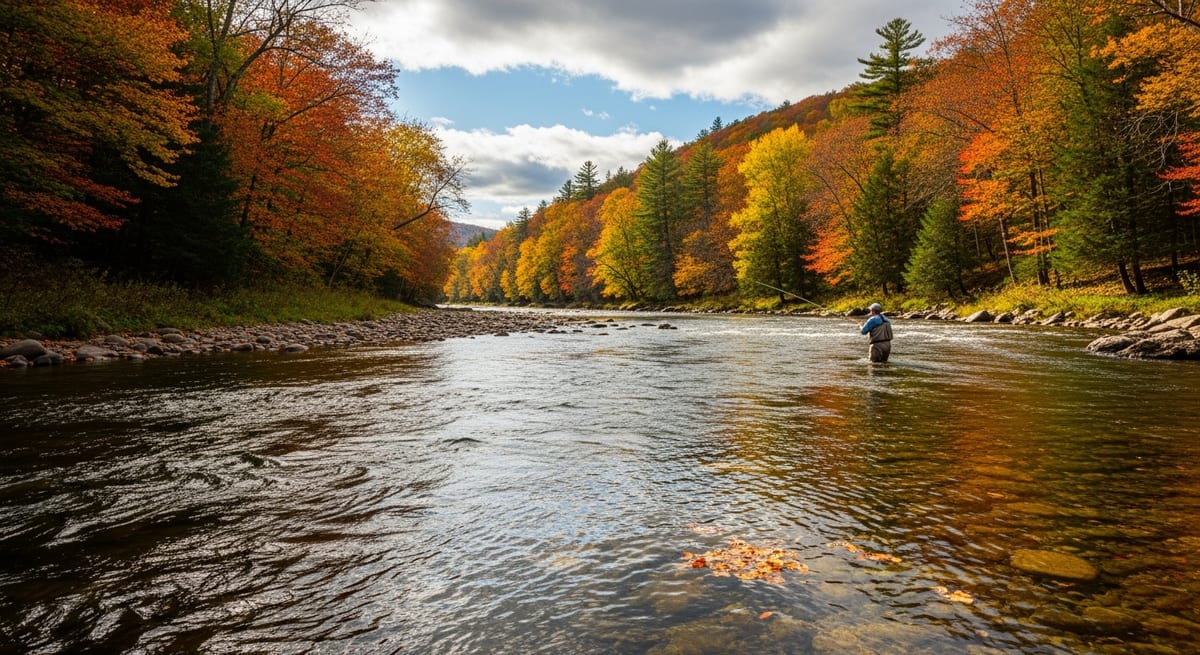
When Farmington TMA flows sit between 150 and 250 CFS in mid-April, anglers who fish the Hendrickson hatch consistently report surface action from noon through 4 PM across the People's State Forest sections, often well before weekend pressure has located the run. CT DEEP manages the Trout Management Area under catch-and-release, artificial-lures-and-flies-only regulations from roughly Riverton to New Hartford, a corridor where CT DEEP wild-trout surveys have confirmed brown trout reproduction, though population estimates vary by year and survey. Below the TMA boundary, the regulations shift to general statewide rules, DEEP stocking cycles in, and the character of the fishery changes entirely. The Farmington's value as a technical fly fishing destination comes from that regulatory contrast and from Barkhamsted Reservoir's cold bottom-release, which keeps upper-river water temperatures below 65°F through summer heat that makes most Connecticut freestone trout streams unfishable.
TMA vs. Below-TMA: The Regulation Boundary That Changes the Fish
The Farmington is effectively three distinct fisheries depending on where you access it, and the regulatory boundary is the defining variable.
Above New Hartford (TMA Section): CT DEEP designates the stretch roughly from Riverton to New Hartford as the Trout Management Area. Current regulations require catch-and-release only with artificial lures and flies only, no bait (verify the latest rules at ct.gov/deep before each season). TMA regulars consistently note that the wild brown trout holding in this section have been caught and released many times over, producing fish that are measurably more drag-sensitive and position-aware than newly stocked trout from the same river.
Barkhamsted Reservoir Tailwater: The upper Farmington below the reservoir receives cold bottom-release discharge that holds water temperatures below the thermal stress threshold through July and August. Anglers who fish this section through summer report trout remaining active when Connecticut's freestone rivers see extended stress periods. This tailwater effect makes year-round TMA fishing viable rather than a spring-only proposition.
Below New Hartford: General Connecticut statewide fishing regulations apply south of the TMA boundary. Bait is permitted, harvest is permitted within current CT DEEP daily creel and size limits, and DEEP conducts regular stocking runs through spring. Anglers fishing Collinsville and Unionville sections in April and early May report strong numbers in the weeks immediately following stocking. Regulars treat this section as a separate destination with its own character.
The Farmington Hatch Calendar: What TMA Regulars Track from April Through October
The Farmington's hatch sequence is among the most-documented in Connecticut fly fishing communities, and the timing windows below reflect the consensus among anglers who fish the TMA across multiple seasons, including the 2024 season.
April, hendrickson Hatch: The first significant dry fly hatch of the Connecticut season typically begins mid-April, contingent on air and water temperatures reaching threshold. Hendricksons (size 12-14) hatch midday through early afternoon, with TMA regulars reporting the most consistent surface activity between 11 AM and 3 PM on days when temperatures climb into the low 50s. Early Black Caddis (size 18-20) also appear in April. The midweek Hendrickson sessions in the first warm spell of the month are the sessions regulars schedule their spring calendar around.
May-June, sulphurs, Green Drakes, and Light Cahill: Evening Sulphur hatches (size 16-18) typically peak from mid-May into June. Farmington fly anglers describe Sulphur evenings as producing the most visually active surface feeding of the season when conditions align. Green Drakes (size 10-12) appear late May into early June and trigger aggressive surface responses when the hatch coincides with low light. Light Cahill and March Brown round out the late spring calendar.
July, trico Spinner Falls and Isonychia: Morning Trico spinner falls typically wrap by 9 AM. Isonychia (Slate Drake, size 10-12) hatch in late afternoon and evening through summer into fall. Anglers who fish the TMA in July consistently report that early starts and precise presentation matter more than any other month, and that summer TMA fishing demands patience the spring hatches do not require.
September-October, blue-Winged Olives: The fall BWO season (size 18-22) is described by TMA regulars as the most reliable dry fly window of the year. Overcast, light-rain days trigger the best hatches. Many Farmington fly anglers treat October as their primary trout month precisely because weekend pressure drops while BWO activity peaks.
People's State Forest Access and the Route 44 Corridor: Where TMA Regulars Actually Park
The Farmington has more publicly accessible wading water than most Connecticut trout rivers, and knowing which access points carry less pressure is part of what separates productive sessions from crowded ones.
Riverton (Route 44 at the village): Entry to the upper TMA. The parking area on Route 44 above the village center gives access to wide, open runs with pocket water upstream. Anglers who wade upstream from the parking area rather than downstream report meaningfully less competition for water on most days.
People's State Forest (Barkhamsted): CT State Parks maintains multiple river-access corridors through People's State Forest along the mid-TMA. The forest road system provides pull-offs giving entry to sections between Riverton and New Hartford that see less pressure than the obvious roadside spots. Anglers who fish the People's Forest sections midweek consistently describe it as the least-pressured publicly accessible TMA water, with runs and pools that see significantly less traffic on weekdays.
New Hartford Route 44 Parallels: Route 44 follows the river through New Hartford with multiple pull-offs. Ledge-water sections near the New Hartford village center hold wild fish. Regulars who know this water note that upstream wading approaches are necessary to avoid spooking fish that hold in pool tailouts facing downstream.
Collinsville and Unionville (Below TMA): Route 179 provides access below the TMA boundary through Collinsville. Easier wading and more accessible parking than the TMA sections, with solid early-season stocked trout numbers through May.
Wading note: The TMA's ledge-rock substrate is notably slippery. Anglers who fish it regularly recommend felt soles or studded rubber boots; smooth rubber-soled footwear draws consistent criticism in Farmington fly fishing community reports. At flows above 300-350 CFS on the USGS gauge at Tariffville, TMA wading becomes difficult enough that most regulars wait for conditions to drop.
What Experienced TMA Anglers Do Differently: Community-Reported Tactics
The consensus among anglers who fish the Farmington TMA across multiple seasons points to consistent differentiators between productive and unproductive sessions.
Gauge-based trip timing: Checking the USGS streamflow gauge at Tariffville before leaving home is treated as non-negotiable by TMA regulars. The most consistently cited target range for comfortable wading is 150-300 CFS. Above 400 CFS, many regulars delay the trip entirely. The USGS Water Resources site updates the Tariffville gauge every 15 minutes.
Midweek scheduling: The TMA sees heavy weekend pressure from April through June. Anglers who fish on Tuesdays, Wednesdays, and Thursdays consistently report more open water and less-pressured fish than weekend sessions. The difference is significant enough that most experienced TMA anglers plan their spring calendar around it.
Reading soft water, not fast water: Wild brown trout in the TMA hold in subtle seam water: the soft edges adjacent to fast runs, the inside corners of bends, and the tailouts of pools, not the obvious white-water pockets. Community reports from TMA anglers emphasize that fish caught multiple times relocate to less-obvious holding lies. The advice that surfaces repeatedly in Farmington fly fishing circles is to read the soft water before wading into the obvious spots.
Presentation before pattern: TMA fly anglers typically report that a clean, drag-free drift on a slightly wrong fly outperforms a precise-match pattern with any drag. The consensus framing: match the hatch silhouette and size first, then color, and fix the drift before switching flies.
Current shop reports: Up Country Sportfishing in New Hartford and TroutFitters in Collinsville maintain current-conditions reports and are the Farmington's primary fly shops. TMA regulars describe pre-trip shop checks as more reliable than historical hatch calendars, since timing shifts year to year.
West Branch and Lower River: When TMA Flows or Crowds Push Anglers Elsewhere
The West Branch Farmington, a tributary entering the main river near Riverton, offers a lower-pressure small-stream alternative with wild brook trout and stocked browns. Anglers who fish the West Branch after high-pressure TMA weekends report that its pool-and-drop structure rewards short-line nymphing and small dry flies in ways the main river's open runs do not.
The lower Farmington below Collinsville and into Farmington town holds some wild fish alongside stocked populations. This section is easier to wade than the TMA, sees less fly fishing pressure, and provides a productive option when TMA flows are too high for safe wading. The lower river's wider, slower character with varied substrate draws a mixed crowd of bait, spinning, and fly anglers through spring.
Anglers who fish the Farmington regularly and also track other CT trout options note that the Housatonic TMA at Falls Village and the Salmon River below Leesville Dam offer comparable catch-and-release wild-trout environments with their own hatch calendars and CT DEEP-maintained public access corridors.
EVERY SATURDAY MORNING
Weekly fishing intelligence
Nationwide conditions, what's biting, and honest gear deals. One email, no noise.
No spam. Unsubscribe anytime.