
Bunker Schools Move Through Long Island Sound Every Spring. The Big Stripers Following Them Are at the Downcurrent Edge, not Where Most CT Anglers Are Anchored.
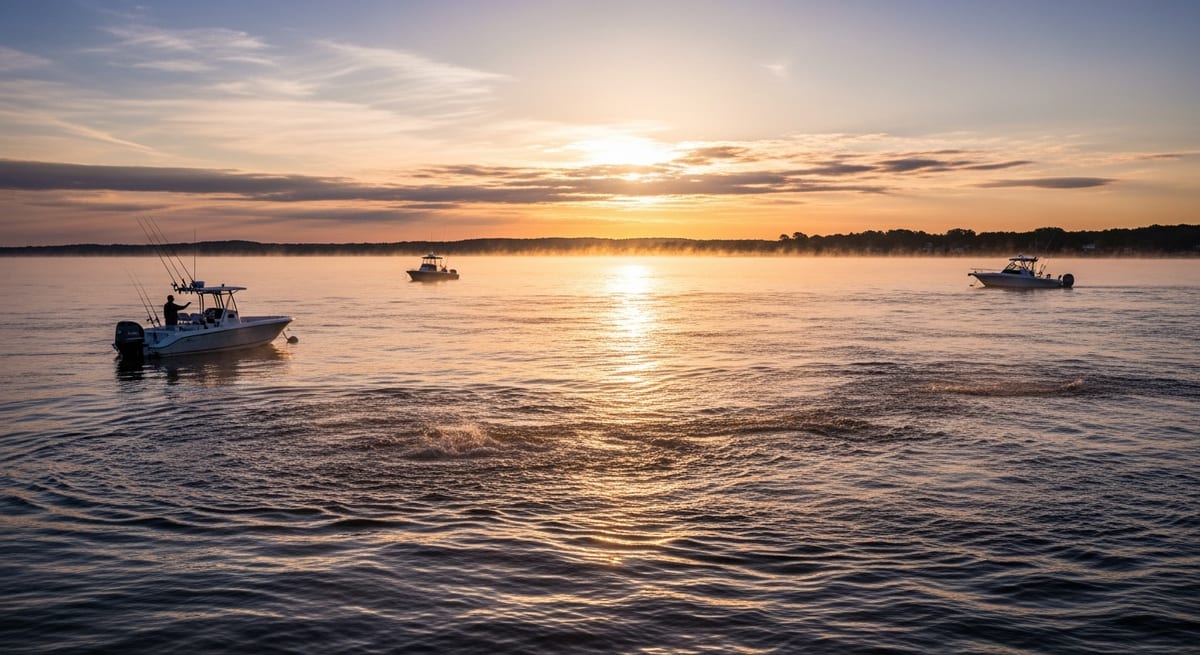
Charter captains fishing Connecticut's western Sound consistently report finding the largest stripers. Fish in the 35-to-50-pound range, not at the center of a bunker school where the blitz action is most visible, but at the downcurrent edge where injured and scattered menhaden drift away from the mass. That's the detail most bunker guides skip over: the fish aren't necessarily where the birds are stacked. Menhaden (bunker, pogies, same fish, regional names) are the primary prey for large striped bass in Long Island Sound, and the anglers who target trophy fish on them consistently are fishing tide stage and current orientation, not just the school itself.
Why Trophy Bass Key on Bunker, and What CT Anglers See When It Happens
Menhaden (Brevoortia tyrannus) are oily, filter-feeding baitfish that gather in large schools in Long Island Sound from spring into fall. Large striped bass key on them heavily, along with bluefish, bluefin tuna, and osprey, but what matters practically is that the biggest stripers don't waste energy chasing small baitfish once bunker schools are present. A single menhaden delivers more caloric value than a dozen sand eels, and a compressed school makes feeding efficient.
Timing: CT angler reports and fishing forums suggest the first bunker push typically appears in the western Sound, greenwich, Stamford, Norwalk, Westport, sometime in late April to early May, depending on water temperature that year. This is consistent with the Atlantic menhaden's northward spring migration from New Jersey and New York coastal waters, though arrival varies season to season. Reports from spring 2024 noted solid concentrations in the western Sound by mid-May. Schools generally remain in CT waters into October. For current-year timing, CT DEEP trawl survey reports and the CT Saltwater Fishing Reports archived at ct.gov/deep are the most reliable sources.
Schools move east as the season progresses: The concentrations that start in Greenwich and Norwalk typically push east toward Bridgeport, New Haven, and into the eastern Sound by midsummer. Fall bunker schools can be dense, large enough that their surface flashing is visible from a significant distance on calm days.
What a feeding situation looks like: When stripers are actively working a bunker school, the menhaden at the surface act erratic, jumping, scattering in multiple directions, moving without clear surface predation above them. A full blitz boil, where stripers crash through the surface directly into the school, is visually unmistakable and often short-lived.
How CT Anglers Snag Bunker and Keep Them Alive
Bunker won't take a baited hook. They're filter feeders. The technique is snagging: a weighted treble hook cast into or past the school, allowed to sink through it or retrieved through it, then swept sharply to foul-hook a fish.
Snagging rigs: Most CT bunker anglers use a weighted treble hook, with treble sizes and lead weight varying by water depth and personal preference, tackle shop rigs typically run in the 4/0 to 6/0 treble range with somewhere around 1 to 3 oz of weight above. Store-bought bunker snag rigs designed specifically for this purpose are widely available at CT tackle shops including Black Hall Outfitters (Old Lyme) and Fisherman's World (Norwalk). The rod is typically a 7-to-9-foot spinning or conventional setup with 25-40 lb braid.
Hook placement after snagging: Anglers who prioritize keeping bunker alive longest use two main approaches: hooking through the back, behind the dorsal fin, forward toward the tail, for open-water free-lining, and nose-hooking through both nostrils for fishing in current, where the fish faces the flow and swims more naturally.
Keeping them alive: Bunker are fragile out of water. The consensus among CT striper guides is that a large aerated livewell, not a bait bucket, is non-negotiable. Without active aeration and water circulation, bunker die within minutes. Many serious bunker anglers run dedicated aeration systems and swap water regularly to keep oxygen levels up.
Legal note: CT regulations on bunker snagging, including any area or seasonal restrictions, should be verified with CT DEEP at ct.gov/deep each season before targeting menhaden, as rules can change.
Why Tide Stage Matters More Than Most Bunker Guides Mention
The most consistent observation from CT charter captains and experienced Sound anglers is that tide stage often determines whether you're on fish, not just location. Stripers relating to bunker schools tend to feed most aggressively during moving water, incoming or outgoing, rather than at slack.
The current-edge dynamic: Moving current causes bunker schools to orient and compress. Injured or struggling menhaden drift downcurrent and away from the school, and stripers holding at the downcurrent edge intercept them with minimal energy expenditure. At slack tide, schools spread out and bass have less opportunity to pin fish against a current direction.
What anglers report at specific locations: Anglers fishing the Norwalk Islands area and the rips near Penfield Reef off Fairfield consistently note that the bite window tightens around the first two hours of the outgoing tide in summer. On the eastern end, anglers working the Groton Long Point and Avery Point areas describe productive incoming-tide windows, particularly when bunker are pushed toward shoreline structure with current behind them.
River mouths and tidal transitions: Locations where tidal flow concentrates naturally. The Housatonic at Stratford, the Connecticut River at Old Saybrook, the Niantic River inlet, stack both bunker and the stripers following them during tide transitions. Anglers who time arrivals to catch the first hour of moving water at these spots report more consistent action compared to slack-water starts.
Practical note: If you're on a visible bunker school at slack tide and not getting hits, many experienced CT bunker anglers move rather than wait, repositioning to nearby structure or checking adjacent moving water (inlets, tidal rips, river mouths) where fish and bait naturally concentrate during the transition.
Live-Lining Setups and Named CT Shore Access Points
Live-lining a bunker is the simplest and most effective presentation: a naturally swimming, distressed baitfish generating its own action and scent plume.
Circle hooks: 8/0-10/0 circle hooks are standard among CT striper anglers fishing live bunker. The circle design reduces gut-hooking and increases hookup rates. When a striper picks up the bunker, experienced anglers let the fish run, reel down to remove slack, and come tight steadily. The circle hook sets at the corner of the mouth without a hard rod-sweep.
Weighted vs. unweighted: An unweighted bunker free-lined in moving current covers water and creates a realistic drifting presentation. A small egg sinker ahead of the hook puts the bunker at a specific depth or holds it near bottom structure, which many CT anglers prefer when fishing over rock and reef.
Leader: 60-80 lb fluorocarbon, 3-6 feet, between braid main line and the hook. Heavy leader handles bluefish, which consistently appear when bunker are present and will find a live menhaden before a striper does, particularly in midsummer, as well as rocky structure abrasion.
From a boat: Anchor or slow-drift near bunker concentrations. Watch the rod tip. A striper on a live bunker rarely telegraphs subtly.
Shore and jetty access, named CT locations:
Penfield Reef (Fairfield): The reef structure and surrounding rips draw bunker schools and the stripers following them close to shore. Shore casters working Penfield Beach and the rocky sections near the reef report productive live-bunker fishing when schools move close to structure, particularly on the outgoing tide.
Groton Long Point (Groton/Noank): Anglers fishing the rocky points and current-facing structure on the eastern Sound shore describe consistent bunker-and-striper action in summer and early fall, with the incoming tide producing the better windows when menhaden push toward shoreline structure.
Avery Point (Groton): The state pier and surrounding rocky shoreline provide public access to moving water where bunker concentrations occur regularly. CT recreational fishing forums note this as a reliable summer bunker-fishing location for shore-based anglers without boat access.
Hammonasset Beach State Park (Madison): The point structure gives shore casters access to open Sound water where bunker schools pass seasonally. Longer casts are typically needed compared to rocky jetty locations, and a heavier egg sinker helps hold position in the current.
From shore: Toss the bunker gently. A hard overhead cast kills the bait quickly. Free-line with minimal weight and watch the line carefully for movement.
When Live Bait Isn't Available: Chunks and Fresh Dead Bunker
Fresh dead bunker is a legitimate alternative when livewells fail or live bait isn't available, particularly for large stripers that rely heavily on scent to locate food at night and around structure.
Chunking: A fresh bunker cut into 3-to-4-inch sections, hooked through the flesh, weighted to sink, and cast into moving current releases a continuous scent trail. Anglers who fish CT jetties and rocky structure at night, including locations around Groton Long Point and the New Haven harbor breakwaters, use chunking as a standard technique on incoming tide. Moving water dispenses the scent effectively; slack water reduces the method's reach.
Whole dead bunker: A whole fresh-dead bunker on a circle hook, soaked near structure for a stretch, is a known big-fish method. The scent dispersion in moving water over an hour or two covers significant ground. Night fishing from rocky points and jetty structure produces consistent results for CT anglers using this approach, based on fishing reports from those locations.
Why freshness matters significantly: Bunker caught that day and kept on ice produce far more scent than frozen-and-thawed fish. Fresh menhaden releases potent oil; degraded bait loses that effectiveness. CT striper anglers who fish dead bunker regularly don't rely on frozen menhaden unless no other option is available, and they keep fresh bait cold until it's in the water.
What Experienced CT Bunker Anglers Actually Run for Gear
Most experienced CT bunker anglers favor conventional (baitcasting) setups over spinning. A 7-to-8-foot conventional rod paired with a 5500-to-6500-class reel loaded with 50-80 lb braid. The preference comes from practical experience: conventional reels handle the drag demands of large stripers more consistently on heavier line, and managing big live bait on a conventional setup is easier for anglers who fish it regularly.
Spinning is workable: A 9-to-10-foot heavy spinning rod with a large-frame reel (5000-6000 class, such as the Shimano Saragosa or Penn Spinfisher series) loaded with 30-50 lb braid handles live-lining well. For shore anglers or those who aren't practiced on conventional gear, spinning is a reasonable choice that many CT anglers use effectively.
Leader: 60-80 lb fluorocarbon, 3-6 feet, is standard. The reasons are consistent throughout the season: bluefish on live bunker, abrasion from rocky structure, and the strain of large bass running against a tight drag.
Drag: Set drag firmly enough to tire the fish but not so locked down that a big striper surging on the first run breaks the line or tears the hook. Most experienced bunker anglers set drag before fishing and test it by hand. The right setting varies by line weight, hook size, and personal preference, and there's no single formula that applies across all setups. The goal is smooth yield under a hard run without giving line freely.
CT Slot Limits, Proper Release, and Where to Verify Before You Go
Connecticut striped bass regulations use a slot limit structure. Anglers may only keep fish within a specified size range. Slot boundaries, bag limits, and season dates change regularly; the binding source is CT DEEP at ct.gov/deep, which posts current-season regulations before each spring opener. The Atlantic States Marine Fisheries Commission (ASMFC) publishes the interstate management framework that Connecticut operates within, and ASMFC addenda are publicly available at asmfc.org.
Why large fish are managed carefully: Large stripers. The fish most often encountered on big bunker, include the oldest, most productive breeding fish in the population. Recent slot-limit structure has reflected management concern about the stock's age and size composition, though specific slot boundaries for any given season must be verified at CT DEEP rather than assumed from the prior year's rules.
Proper release: Keep large stripers in the water during hook removal when possible. Support the fish horizontally. Don't grip large fish vertically by the jaw. This can cause internal injury. Revive in the water until the fish swims away under its own power, particularly in warm midsummer water where stress compounds quickly.
Circle hooks improve survival rates: The circle hook design used for live and dead bunker typically produces corner-of-mouth hookups rather than deep hookups, which significantly improves survival for released fish. This is one reason CT striper anglers fishing bunker have largely moved to circle hooks over J-hooks for large bait presentations. It aligns catch-and-release intent with the actual biology.
EVERY SATURDAY MORNING
Weekly fishing intelligence
Nationwide conditions, what's biting, and honest gear deals. One email, no noise.
No spam. Unsubscribe anytime.