
CT Striper Anglers Who Fish the Niantic Mouth and Housatonic in Fall Report Live Bunker Outproduces Cut Bait When Schools Stack. What Shore and Boat Communities Say About Finding Menhaden, Legal Cast Netting, and the DEEP Slot Limit
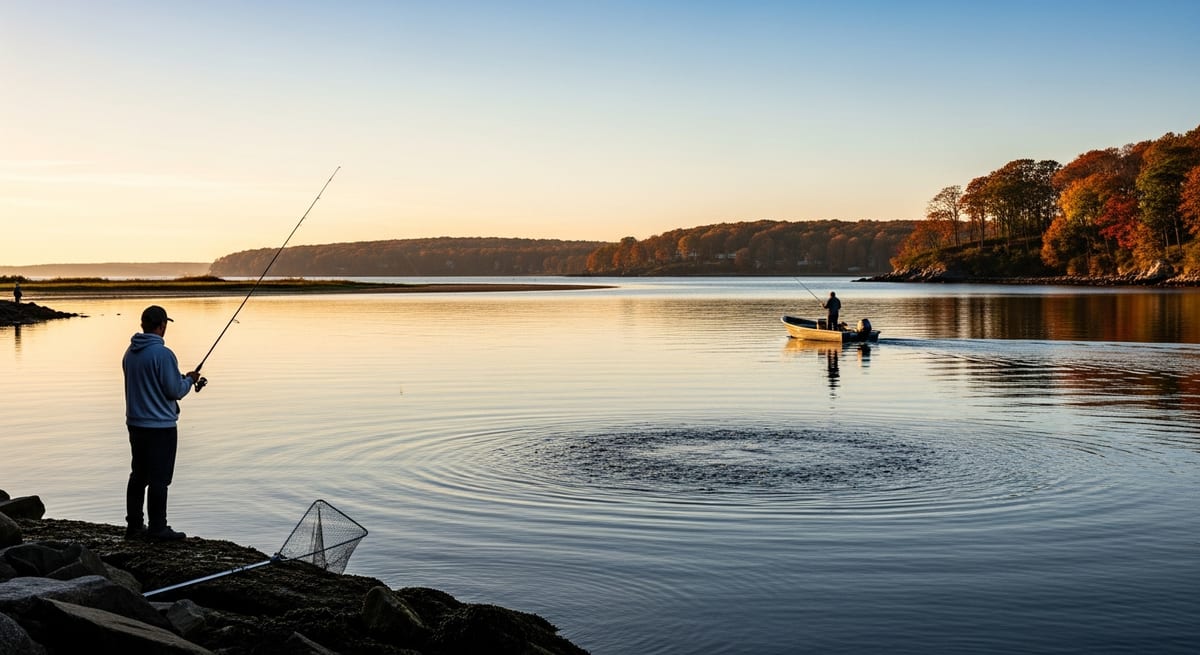
The timing of the fall bunker migration along Long Island Sound varies with water temperature rather than the calendar. CT striper anglers who fish the run annually report that significant menhaden schools typically begin stacking in the Niantic River mouth, the Housatonic mouth, and along the Old Lyme flats anywhere from mid-September into November, depending on how quickly surface temps drop toward the low 60s°F. Where bunker concentrate, stripers follow: ASMFC stock assessments consistently identify Atlantic menhaden as a critical forage species for striped bass populations along the Atlantic coast. Learning to find these schools and present menhaden as bait is something CT Sound regulars who fish the fall run describe as the highest-leverage skill shift for anglers targeting keeper-class fish.
Bunker in the Sound: How the Fall Migration Concentrates Stripers
Atlantic menhaden (Brevoortia tyrannus) are an oily, filter-feeding schooling fish that migrate seasonally along the Atlantic coast. ASMFC stock assessments document their role as a key forage species for striped bass, bluefish, osprey, and marine mammals including humpback whales. In Connecticut waters, bunker typically appear in spring, build through summer, and begin their southward push through Long Island Sound as water cools in fall.
The term 'bunker' is the dominant colloquial name in New York and southern New England, and CT anglers use it almost universally, though the label varies elsewhere along the coast. The fall movement is temperature-driven rather than date-driven: anglers who fish the run annually report the most concentrated schools arrive when surface temps fall from the upper 60s toward the low 60s°F, a window that can span late September through November depending on the season.
When conditions align, the fall bunker run is a visible event. Anglers on the Old Lyme flats and near the Niantic River mouth describe days when menhaden fill inlet mouths with birds stacking above them and stripers working the perimeter below, a pattern that compresses otherwise scattered fish into a predictable, fishable window.
How to Locate Bunker Schools from Shore and Boat
Bunker are visible when near the surface. Schools produce 'nervous water': a subtle disturbance from thousands of fish moving just below the surface, often with scales catching the light. Birds are the most reliable real-time indicator. When osprey, terns, and gannets are circling and diving over a specific area, menhaden are almost certainly below them.
From the beach: Elevated vantage points along the CT shore give good sightlines during the fall run. The causeway approach at Old Lyme, the western shore of the Niantic River mouth, and the outer ledges near Stonington harbor all provide useful angles for spotting diving birds and surface disturbance during the peak fall window.
On the water: Bunker show on sonar as dense clouds in the upper water column. Anglers fishing the Housatonic mouth describe school signals spanning significant width just below the surface. A large, diffuse sonar mass near the top of the water column in September or October often means menhaden.
Smell: Dense bunker schools produce a distinctive oily odor that Sound regulars describe as unmistakable. An oil slick on otherwise calm water near an inlet mouth or tidal rip is worth investigating.
Catching Your Own Menhaden: Cast Nets and What CT Regulations Require
Fresh bunker consistently outperforms frozen bait. Anglers who fish the fall run in CT report that a cast-net-caught menhaden used within hours of capture produces noticeably stronger results than thawed bait, particularly for live presentations. A 10-foot radius cast net in 3/8" or 1/2" mesh handles adult bunker; 1/4" mesh works better for juvenile peanut bunker.
Cast net technique: Position the boat within 20 to 30 feet of the school. A proper cast opens the net into a full circle. Most CT bait anglers report putting in significant practice time on land before achieving consistent throws from a moving boat.
What experienced bait anglers do differently: Regulars on the Housatonic and Niantic report throwing the net well ahead of the school's direction of travel rather than into the center of the pod. Bunker spook quickly and sound fast, and a net dropped directly onto a moving school often comes up empty.
CT DEEP regulations: Cast netting for baitfish in CT tidal waters is subject to restrictions that vary by area, including closures near fish ladders and certain conservation zones. Before using a cast net for menhaden in any tidal water, verify current rules directly with CT DEEP. The CT DEEP Fishing Guide at ct.gov/deep is the authoritative source and is updated each season.
Chunk Bunker Rigs That Produce on the CT Coast
Chunk bunker is the most widely used striper bait along the CT shore. A palm-sized section of fresh menhaden soaked on the bottom or drifted in current produces consistent action from keeper-class fish on the Housatonic mouth, the outer Stonington ledges, and the Race area during the fall run.
Cut: Fillet or slice the bunker into 3 to 4 inch chunks. The belly section, thicker and more oil-rich, is what most CT regulars prefer.
Rig: A fish-finder (sliding sinker) rig with a 4 to 6 oz pyramid sinker above a swivel, then 18 to 24 inches of 30 lb monofilament to a 5/0 to 7/0 circle hook. Circle hooks reduce deep-hooking significantly and make release cleaner, which matters under CT DEEP's current recreational striper slot limit of 28 to 35 inches, one fish per day as of the 2025 season. Confirm the current regulation at ct.gov/deep before fishing, as striper rules have been updated frequently in recent seasons.
Hook set: When you feel weight, reel down and apply steady pressure rather than sweeping the rod. The circle hook sets in the corner of the jaw on its own.
Current positioning: Anglers who fish the Housatonic mouth consistently emphasize casting uptide and letting the bait swing down-current into the feeding zone. Stripers hold facing into the current; bait needs to approach from the uptide direction.
Live Bunker: When to Use It and How to Present It
A live 4 to 6 inch peanut bunker (juvenile menhaden) is considered by many CT striper anglers to be the highest-percentage bait for trophy-class fish during the fall run. The erratic, wounded swimming action of a live bunker near a striper school triggers aggressive strikes that chunk bait sometimes cannot match, particularly when fish have been pressured or are feeding selectively.
Hook placement: A 7/0 to 9/0 single hook through the nose or through the back behind the dorsal fin. Anglers fishing Niantic Bay during the fall run more often favor nose-hooking for its natural swimming action; back-hooked bunker tend to stay alive longer when casting to distance from shore.
Presentation: Free-lining the bunker with no weight, letting it swim naturally near the surface, is the approach CT Sound anglers most often describe for fish feeding actively on schooled bunker. A large float works to hold bait at a controlled depth when stripers are positioned mid-column rather than at the surface.
Reading the bait: A bunker that suddenly changes direction, accelerates, or goes still is often reacting to a following striper. Anglers fishing live bunker near the Old Lyme flats and in Niantic Bay during fall report that watching the bait's behavior closely is as important as watching the rod tip.
EVERY SATURDAY MORNING
Weekly fishing intelligence
Nationwide conditions, what's biting, and honest gear deals. One email, no noise.
No spam. Unsubscribe anytime.