
The CT Freshwater Map Has a Second Layer. Bantam Back Coves, Pachaug's Pine-Shadowed Arms, and the Salmon River Backwaters Produce Bass, Pickerel, and Trout That Powerboat Pressure Doesn't Reach.
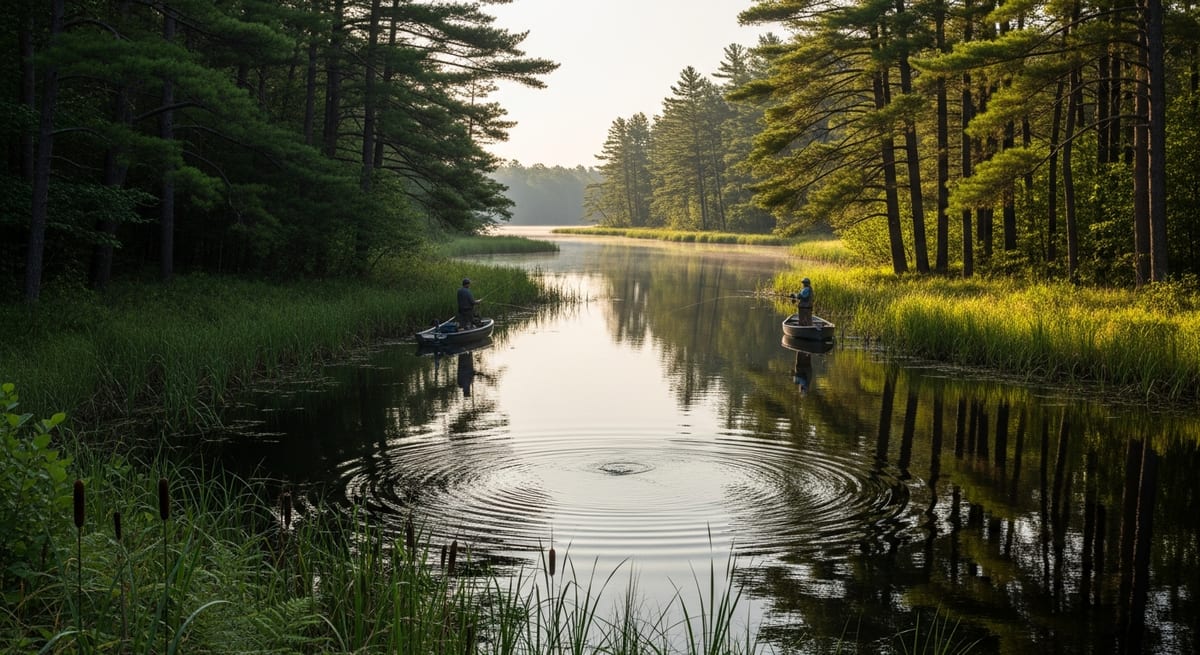
Bantam Lake's northern coves hold largemouth through late June in water under two feet deep that most powerboats have no reason to enter. Canoe anglers who stage out of the DEEP launch in Morris report consistent fish in these shallows when the main basin crowd is working deeper structure. Across CT, that pattern repeats at the pine-shadowed arms of Pachaug Pond, the slow bends of the Salmon River below Salmon River State Forest, and the reed-edged flats of Moodus Reservoir. For anglers running a canoe, these are primary water, not backup spots.
CT Waters That a Canoe Reaches First
Certain CT water types favor a shallow-draft craft over everything else, and they show up consistently in what canoe anglers report as their most productive spots:
Bantam Lake (Morris/Litchfield): The northern and eastern coves hold pre-spawn largemouth in April and May in water so shallow that a flat-bottom johnboat will drag bottom. Canoe anglers report steady fish on soft plastics and topwater from late April through June, before summer boating pressure disperses them toward deeper structure.
Pachaug Pond and Beachdale Pond (Voluntown): Surrounded by Pachaug State Forest, the connected Pachaug and Beachdale system sees minimal motorized traffic. Canoe anglers report pickerel, bass, and panfish through the spring and summer season in the lily pad bays along the western shore. CT DEEP maintains a launch here; check the DEEP Boating Access map for seasonal hours before making the drive.
Lake McDonough (Barkhamsted): Metropolitan District Commission water with no gasoline motors permitted. The no-gas rule keeps the lake quiet in a way most CT impoundments aren't. Trout hold in the colder, deeper sections; bass and pickerel concentrate in the coves where the canoe water is best.
Salmon River (Colchester/East Haddam): Below Salmon River State Forest, the Salmon carries CT DEEP trophy trout designation. Canoe anglers report drifting the slow pools and backwaters produces through the early stocking window (March through May) and again in fall for wild brown trout residents in the deeper bends.
Moodus Reservoir (East Haddam): The shallow reed flats on the western edge produce chain pickerel through summer and into fall. Canoe anglers report largemouth mixed in near submerged wood cover on the northern shoreline.
How CT Paddlers Rig for Shallow-Water Work
The setup canoe anglers on CT waters consistently describe is functional rather than elaborate. A few patterns show up repeatedly across the community:
Seating and trim: For solo fishing, the standard position described by CT paddlers is just forward of center rather than in the stern seat. Sitting in the stern alone makes the bow ride high and the canoe weathervane in crosswind on open ponds like Bantam or Pachaug. Many anglers add a foam kneeling pad between the thwarts for stability during casting.
Rod holders: Two or three rod holders clamped to the gunwales keep rods secured during paddling transitions. Scotty and RAM gunwale-mount holders come up frequently in CT paddling conversations as reliable options for this use.
Anchor system: A folding 3 to 5 lb anchor on a bow cleat is the most commonly described setup for CT pond and river work. On the Salmon River, anglers report using lightweight anchors to hold position in moderate current while working pools. On exposed ponds like Bantam, a heavier anchor or a kayak-style anchor trolley helps hold angle in wind.
Weight placement: Keep gear centered between the seats. A small soft cooler or milk crate behind the bow seat puts tackle within reach without overloading the ends. CT canoe anglers who fish the Pachaug arms note that bow-heavy loads catch wind and make flat-water tracking difficult.
What consistently goes wrong on early trips: Rod tubes across the floor, loose tackle bags underfoot, and oversized boxes jammed into the gunwale space. The accounts from paddlers who fish CT regularly describe a single organized bag, secured rod holders, and a clear floor between the seats.
Spring Through Fall: Species Timing and What the CT Community Reports
Canoe fishing in CT tracks species behavior more closely than most platforms, and community reports reflect consistent seasonal patterns:
Spring (April through mid-June): The most frequently cited window for CT canoe largemouth. Pre-spawn bass stage in water as shallow as 18 inches in the coves of Bantam, Pachaug, and similar ponds. Canoe anglers consistently report that the quiet approach matters most in spring: bass in clear, shallow water often abandon spawning beds when powerboat wakes arrive nearby. The DEEP-stocked trout season opens in April; the Salmon River and Farmington River are the most cited canoe-accessible trout sections among CT fishing communities.
Summer (late June through August): Topwater fishing from first light in shaded coves and along lily pad edges is the dominant pattern CT canoe anglers describe for this window. Bantam's western shore and Pachaug's reed flats produce pickerel and largemouth through roughly 8 a.m. before heat and powerboat traffic increase. Many paddlers report shifting to panfish in shaded mid-lake structure as the day progresses.
Fall (September through October): Chain pickerel reports pick up on CT ponds as water temperatures drop through the 60s. Anglers report that drifting parallel to weed lines with spinners or soft-plastic swimbaits produces more consistently than anchoring for fall pickerel. Largemouth become more aggressive ahead of winter, and the back coves and shallow rock piles on Lillinonah and Bantam see noted action through October.
Regulations to verify before launching: CT requires a freshwater fishing license for all anglers 16 and older. Bass carry a 12-inch minimum length in most CT waters; the DEEP Freshwater Fishing Regulations (available at ct.gov/deep) lists body-specific exceptions. Pachaug Pond and Bantam Lake both appear in the DEEP regulations with current slot and bag limits.
Working CT Current: Drift Patterns on the Salmon River and Farmington Backwaters
On CT rivers, the most common approach canoe anglers describe is a drift-and-stop pattern rather than continuous paddling:
Drifting pools: Drift through faster sections, then drop anchor or back-paddle to hold position at the head of a productive pool. Canoe anglers on the Salmon River report working each pool thoroughly before moving downstream. Trout in these sections typically don't relocate far, and covering a run twice often produces fish that ignored the first pass.
Two-person coordination: The stern angler controls direction; the bow angler casts. On tight river bends like those on the Moodus River and lower Eight Mile River, CT canoe anglers report that the bow angler calling direction adjustments while casting is one of the first skills a two-person crew needs to develop before fishing effectively together.
Solo on CT ponds: Paddling solo from just forward of center is the standard described across CT canoe communities for open-water ponds. An outrigger stabilizer improves stand-up casting stability on calm-water ponds like Moodus or the sheltered coves of Pachaug. Experienced CT paddlers consistently report fishing seated or kneeling in anything above glass-calm conditions, noting that standing in current or crosswind is how capsizes happen on this water.
Paddle management: Keeping the paddle secured in a gunwale clip or bungee rather than balanced across the rails comes up repeatedly in paddler accounts as a small detail that prevents repeated interruptions during long fishing days.
DEEP Launch Sites, Portage, and CT License Requirements
CT DEEP maintains publicly accessible boat launches at dozens of freshwater sites, and most of the productive canoe waters described above are on the DEEP Boating Access list. The directory at ct.gov shows current launch sites, parking capacity, and seasonal restrictions.
Portage reality: Many of the less-pressured CT ponds and river sections involve a carry of 50 to 200 yards from the nearest launch or road pullout. Canoe anglers who regularly portage to the upper Pachaug arms or the Salmon River's mid-section report that the carry is the primary filter: most anglers won't make it, which keeps the water quiet. Canoe weight and portage difficulty vary by hull material and length; most two-person canoes in the 16-foot range are manageable for short carries with two people.
What experienced CT paddlers carry beyond fishing gear: A PFD for each occupant (required by CT law for all canoe occupants on state waters), a dry bag for electronics and licenses, a spare paddle bungeed to a thwart, and a whistle. CT DEEP Boating Regulations apply to canoes; PFD requirements are not discretionary.
DEEP launch timing: CT DEEP ramps are shared with trailered motorboats, and weekend morning launches at busy sites like the Bantam Lake access can involve a wait during peak season. Canoe anglers who fish Bantam regularly report arriving before 7 a.m. on weekends or switching to weekday launches to avoid congestion.
License and registration: CT freshwater license required for all anglers 16 and older, available at ct.gov/deep or at licensed agents statewide. Canoes without motors do not require motorboat registration in CT; verify with CT DMV if an electric motor is added. Current fees and regulations are posted at ct.gov/deep.
EVERY SATURDAY MORNING
Weekly fishing intelligence
Nationwide conditions, what's biting, and honest gear deals. One email, no noise.
No spam. Unsubscribe anytime.