
The Day After a Spring Rain on the Farmington, Salmon River, or Willimantic, Nightcrawlers Outproduce Most Lures in the Box. What CT Trout and Panfish Communities Report About Rigging, Hook Choice, and Reading the Water.
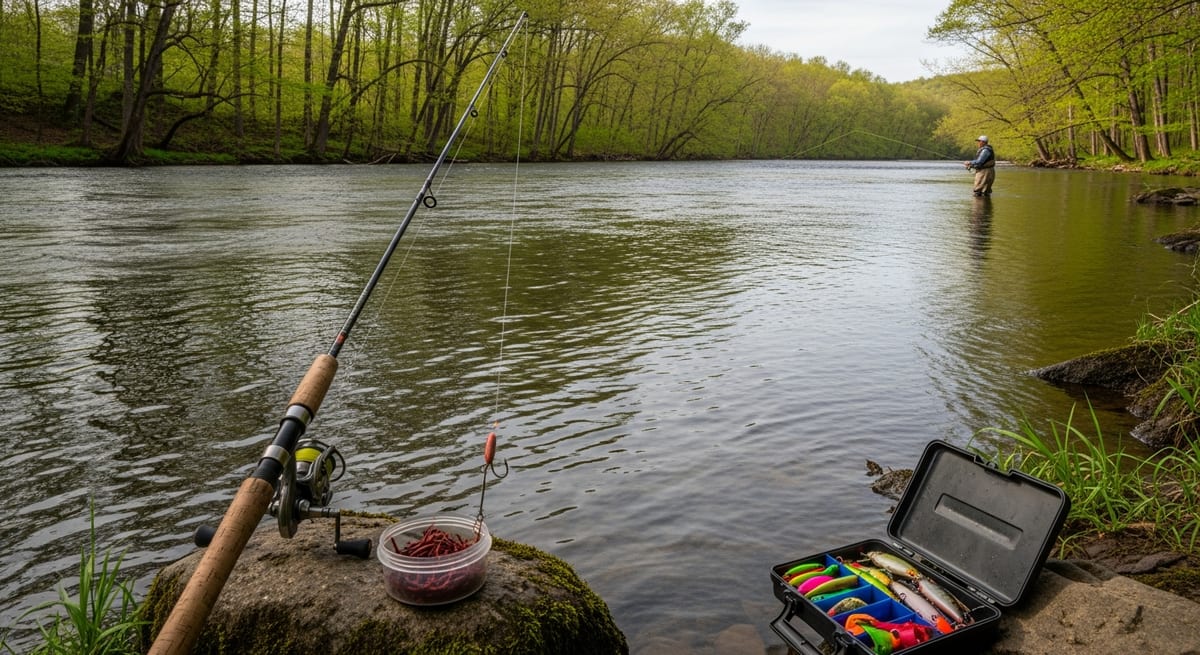
Anglers fishing the Salmon River below Leesville Dam in late April consistently describe the same post-rain pattern: a plain nightcrawler on a size 10 hook outproduces most lures in the box for the first couple of hours after flow picks up. Storm runoff carries earthworms directly into the current, and trout, stocked or wild, locate them by scent before any artificial can compete. Nightcrawlers and earthworms catch bass, trout, perch, bluegill, catfish, and pickerel across CT's public waters. They're available at bait shops near most state launches and at sporting goods retailers along Route 44. And unlike artificials, they produce real scent and movement that fish respond to even when the water is off-color.
Types of Worms, and Which CT Species They Match Best
Nightcrawlers: Large earthworms, typically 4-8 inches. Among the most versatile freshwater baits anglers carry in CT, useful for bass, trout, catfish, walleye, and any species large enough to take them. Fish whole or cut in half, half a nightcrawler on a small hook often outproduces a whole worm on an oversized hook, particularly for the stocked rainbows CT DEEP puts into the Farmington and Willimantic each spring.
Red wigglers and garden worms: Smaller and more active than nightcrawlers. Effective for panfish, bluegill, perch, and crappie, and for trout in smaller, clearer streams where a large crawler looks out of place. CT panfish regulars on Bantam Lake and Moodus Reservoir tend to reach for red wigglers when bluegill are holding tight to structure in less than four feet of water.
Mealworms: Technically beetle larvae, not worms, but sold alongside live bait in most CT shops. Effective for panfish and trout, particularly in late fall and early winter when insect activity drops. Available at bait shops near state boat launches and at most pet supply retailers.
Keeping worms alive on the water: Store in the refrigerator in their container at 35-45°F. Don't freeze. Nightcrawlers typically last 2-3 weeks when refrigerated in good-quality bedding, though condition at purchase affects actual shelf life. On the water in warm weather, keep the container in a small cooler with an ice pack, heat kills worms quickly, and CT's midsummer days can exhaust a supply in under two hours.
Hooking Worms: What CT Anglers Default To by Situation
The right hooking approach depends on water type, current speed, and target species. CT trout communities who drift the Farmington and Willimantic's upper pools tend to converge on a small set of techniques based on conditions rather than rotating through a fixed checklist.
For drifting in current: Thread the hook through the worm once near the middle, leaving both ends free to wave. The movement draws strikes from trout holding in the slower water behind rocks and in pool tailouts. A size 10 or 12 hook works for garden worms; a size 8 for half a nightcrawler.
Weedless setup for bass in cover: Push the hook point into the head of the worm, thread roughly a half-inch onto the shank, then reinsert so the point is buried in the body. CT bass anglers who work the weed mats on Bantam Lake and the coves along Lillinonah pull worms through vegetation with this setup without constant fouling.
Threaded for bottom fishing: Slide the worm onto the hook from end to end, pushing it up the shank and onto the line, leaving 1-2 inches of tail hanging free. Useful for still-water catfish and bottom-feeding bass, and keeps the worm intact through repeated casts when fishing the CT River pools from shore.
Piece on a small hook for panfish: Break off a 1-inch section of nightcrawler and hook it once through the end. Size 10-12 hook, small bait, for small-mouthed species. The consensus among panfish regulars is that less worm on the hook produces more hookups, sunfish and yellow perch bite a smaller piece and get the hook more consistently than when they're nibbling at the end of a full crawler.
Rigs That Fit CT Water Conditions
Bobber rig: A float 18-36 inches above a hook with a split-shot weight between them. The baseline setup for panfish in still water, dock anglers on Bantam Lake and anyone targeting perch in the shallows of Moodus Reservoir default to this rig. Adjust the depth stop until the worm sits just above bottom or in the active strike zone.
Bottom rig (Carolina-style): An egg sinker sliding on the main line, a swivel, a 12-18 inch fluorocarbon leader, and a hook. The weight anchors; the worm drifts freely above it on the leader. Anglers fishing the CT River's slower pools for catfish and walleye use this as the standard setup when water clarity drops after rain events.
Split-shot rig: A hook on the end with one or two small split-shot weights 6-12 inches above it. Minimal hardware, very natural drift. CT trout anglers who fish the Farmington's open-regulation sections and the Salmon River below Leesville Dam rely on this rig for pressured fish. The reduced resistance means fish hold the bait longer before dropping it.
Slip float rig: A float with line running through it, set to depth with a bobber stop. More versatile than a fixed bobber once the target depth exceeds 4-5 feet. Anglers on Candlewood Lake and Shenipsit Lake use this for crappie and perch suspended at 6-12 feet, particularly useful when marking fish at mid-column on a sonar screen and needing to match that exact depth without switching rigs.
CT Windows and Waters Where Nightcrawlers Produce Most Consistently
Spring and post-rain conditions: The day after any significant spring rain, earthworms wash into every CT stream and pond. Trout communities who fish the Willimantic and Natchaug rivers describe post-rain nightcrawler fishing in the pools and tailouts as among the most productive freshwater situations they encounter all year. CT DEEP's spring stocking schedule, typically beginning in late March and running through May for inland trout, means freshly stocked fish enter the water during peak earthworm-runoff season, which accelerates how quickly they respond to the bait.
The Farmington River: Anglers who fish the Farmington's open-regulation sections drift nightcrawlers on a split-shot rig through the pools and tailouts of riffles. The most common approach CT trout communities describe: cast upstream into the head of a pool, maintain light line contact, and watch for the drift to pause or the line to tick as the worm slows in deeper water. Note that several Farmington sections carry special regulations restricting live bait use, including gear-restricted and minimum-size stretches. Check the current CT DEEP Inland Fishing Guide at portal.ct.gov/DEEP before fishing any new section of the river.
Bantam Lake and Lake Lillinonah for panfish: A worm under a bobber next to dock pilings, fallen timber, or submerged structure in 2-4 feet of water catches bluegill, yellow perch, and small bass consistently from May through September. Panfish regulars on Bantam describe tighter fish-to-structure patterns in midsummer heat, moving the bobber closer to shade and dock edges improves hookup rate through July and August compared to open-water presentations.
CT River for catfish: Channel catfish in the Connecticut River feed primarily at night, though anglers fishing the slower pools south of Hartford report they will take bottom-fished bait during overcast afternoons and post-rain periods as well. A large nightcrawler on a circle hook on a weighted bottom rig, set near structure, is the standard approach among river regulars. Catfish locate prey by scent and will produce results in near-zero-visibility water where lures don't register.
Candlewood Lake for depth fishing: CT DEEP has stocked lake trout and brown trout in Candlewood in past seasons. Anglers who fish the deeper coves in spring report that a nightcrawler drifted on a slip-float rig at 8-12 feet reaches holdover depth windows that most lures pass through too quickly to draw a strike. Check the current DEEP stocking report at portal.ct.gov/DEEP before targeting stocked trout water, stocking density and timing vary each season.
EVERY SATURDAY MORNING
Weekly fishing intelligence
Nationwide conditions, what's biting, and honest gear deals. One email, no noise.
No spam. Unsubscribe anytime.