
When Bass Scatter Across Candlewood and Bantam Flats, CT Anglers Default to the Carolina Rig. What the Community Reports About Building It, Reading Bottom Transitions, and Pre-Spawn Staging on CT Impoundments
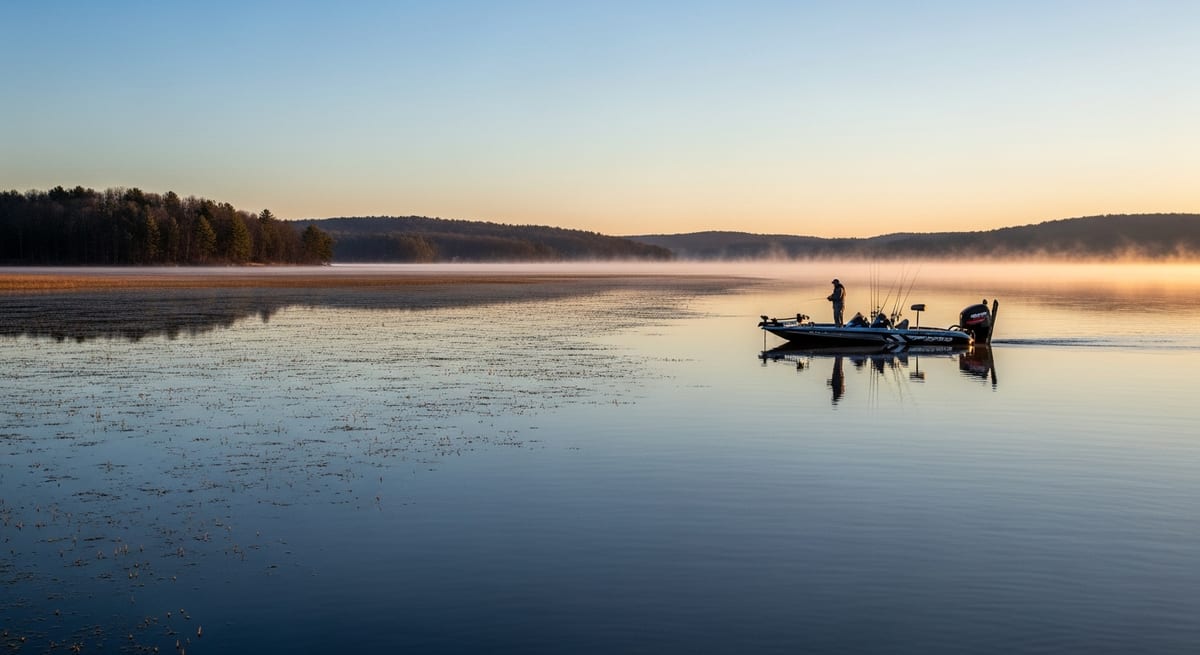
The sandy gravel flats on Candlewood Lake's east arm hold scattered post-spawn largemouth at 8 to 12 feet from late May through June, and CT bass communities report the Carolina rig covers those flats faster and with more consistent bottom contact than any other technique at that depth. Unlike a Texas rig, which fishes a tight zone with precision, or a drop shot, which stays in one spot, the C-rig drags across large flat areas and telegraphs what's below through the rod the entire way. The tournament bass community used it to produce some of the most dominant Classic-era performances of the early 1990s, and CT impoundment regulars have carried that same reasoning onto Bantam, Lillinonah, and the Housatonic impoundments in the decades since.
What the Leader Separation Actually Does
The defining feature of the Carolina rig is the gap between the weight and the bait. CT bass anglers who fish it regularly describe that gap as the whole point of the setup.
Components:
- Egg sinker or bullet weight (1/2 to 1 oz): Heavy enough to maintain bottom contact across Candlewood's gravel flats or the deeper ledges off Lillinonah. Slides freely on the main line.
- Glass or plastic bead: Sits between the weight and swivel. Protects the knot and produces a subtle clicking sound when the weight strikes it: a small attractor on hard bottom.
- Barrel swivel: Tied to the main line above the bead. The leader attaches below it; the weight slides freely above it.
- Fluorocarbon leader (12 to 36 inches): Connects swivel to hook. Longer leaders allow more bait freedom and work well across open flats.
- Wide-gap hook (3/0 to 5/0): Standard offset wide-gap for most soft plastics.
- Soft plastic: Lizards and finesse worms are the traditional choices on CT impoundments; craw imitations, creatures, and Senko-style baits all produce depending on season and water clarity.
Why the gap matters: In a Texas rig, the weight sits at the nose of the bait. In the Carolina rig, the weight drags along the bottom while the bait floats naturally above it on the leader, moving freely in the current the dragging weight creates. Anglers on Bantam and Candlewood describe this as the closest thing to a live-bait presentation achievable at depth across hard substrate: the bait drifts and undulates while the weight handles bottom contact.
The Situations CT Anglers Reach for It
Post-spawn scatter on CT impoundments: After the spawn wraps up on Candlewood and Bantam, largemouth spread across wide flat areas at 8 to 15 feet. CT bass communities report the C-rig as the fastest locating tool for this window. Once a bite comes, the standard approach among Candlewood regulars is to slow down and fish that area thoroughly with a Texas rig or drop shot before moving on.
Pre-spawn staging on points and ledges: Bass using underwater points and ledges before moving to spawn respond consistently to a Carolina rig dragged slowly through their zone. Anglers fishing Lillinonah's steeper drop-offs and the secondary points off Bantam in mid-April report reliable pre-spawn contact using this setup.
Connecticut's current DEEP Angler's Guide confirms the bass season is open year-round on the major impoundments, with a 12-inch minimum size limit for largemouth and smallmouth. Many CT anglers fish the pre-spawn window catch-and-release regardless of regulatory requirements.
Deep summer ledges on Candlewood: The heavy weight handles depth and current. Anglers fishing the 15 to 20-foot ledges along Candlewood's main basin in July and August drag C-rigs to locate fish that have pushed down away from summer surface heat.
Hard and sandy bottom areas: The dragging weight on hard bottom creates sound and vibration. Gravel flats, rock transitions, and sand points across the CT impoundment system are widely considered ideal C-rig water by the communities that fish them.
When CT anglers set it down: Heavy wood and brush cause the trailing leader to tangle constantly. Thick vegetation creates the same problem. Water under 6 feet makes the setup awkward. In those conditions, communities on Bantam, the Housatonic backwaters, and the shallower coves on Lillinonah consistently favor a Texas rig, swim jig, or weightless Senko.
Reading Bottom Transitions Through the Rod
The retrieve: Cast beyond the target area. Let the rig settle completely to the bottom. Then drag it forward using slow, sweeping rod movements of 6 to 18 inches, reeling down to take up slack between each sweep. The bait floats behind and above the weight throughout the drag.
What the rod transmits: CT bass anglers who fish the C-rig describe the bottom-reading quality as one of its most underrated advantages. Soft mud feels like dragging through thick resistance. Sand feels smooth and consistent. Gravel produces constant small ticks through the rod. Rock delivers distinct hard clicks. The transitions between bottom types, where gravel meets sand or rock meets soft substrate, are where CT communities report the most consistent bass contact on large flat areas like Candlewood's east arm and the hard-bottom points off Bantam.
The strike: C-rig bites on CT impoundments are often subtle: a slight heaviness, line moving sideways, or the rod tip loading during a sweep. Anglers familiar with the setup recommend a firm sideways sweep rather than a straight-up lift to set the hook. The long line and heavy weight require more force than lighter finesse rigs to drive the hook cleanly.
Leader length by conditions: CT anglers use shorter leaders (12 to 18 inches) near submerged brush or vegetation where a longer leader would tangle. Longer leaders (24 to 36 inches) suit open gravel and rock flats, where maximum bait movement is the goal.
What CT Bass Communities Have Settled On for the Leader
Lizard (6 to 7 inch): The traditional C-rig bait on CT impoundments, particularly during the pre-spawn window on Bantam and Candlewood. The tournament bass community has long attributed the lizard's effectiveness in pre-spawn and spawn-adjacent situations to its aggressive, intrusive profile. Among CT impoundment anglers, watermelon and green pumpkin are the dominant color choices in clear-water conditions.
Finesse worm (6 to 7 inch): A long, slender worm on a 24 to 30-inch leader creates the most subtle presentation. CT anglers fishing the clear-water sections of Candlewood and Bantam in summer report this as their go-to when bass have seen heavy pressure and avoid flashier profiles.
Craw imitation: In rocky and gravelly areas, including the northwest shore of Candlewood and the harder-bottom points on Lillinonah, a craw on a 24-inch leader floats naturally above the substrate where bass expect to find crawfish. The slow drift of the leader keeps the imitation at the right height above the bottom.
Scented soft plastics: The slow retrieve gives fish extended time to locate the bait. CT bass anglers who regularly fish scented or salt-impregnated baits on the C-rig report that follows more often convert to bites on this setup than on faster presentations, particularly in lower-visibility water after rain events stir up Candlewood and Bantam.
EVERY SATURDAY MORNING
Weekly fishing intelligence
Nationwide conditions, what's biting, and honest gear deals. One email, no noise.
No spam. Unsubscribe anytime.