
A Connecticut Shore Bluefish Blitz Lasts About Eight Minutes. The Anglers Who Catch Them Consistently Were Already Positioned at Structure Before It Started.
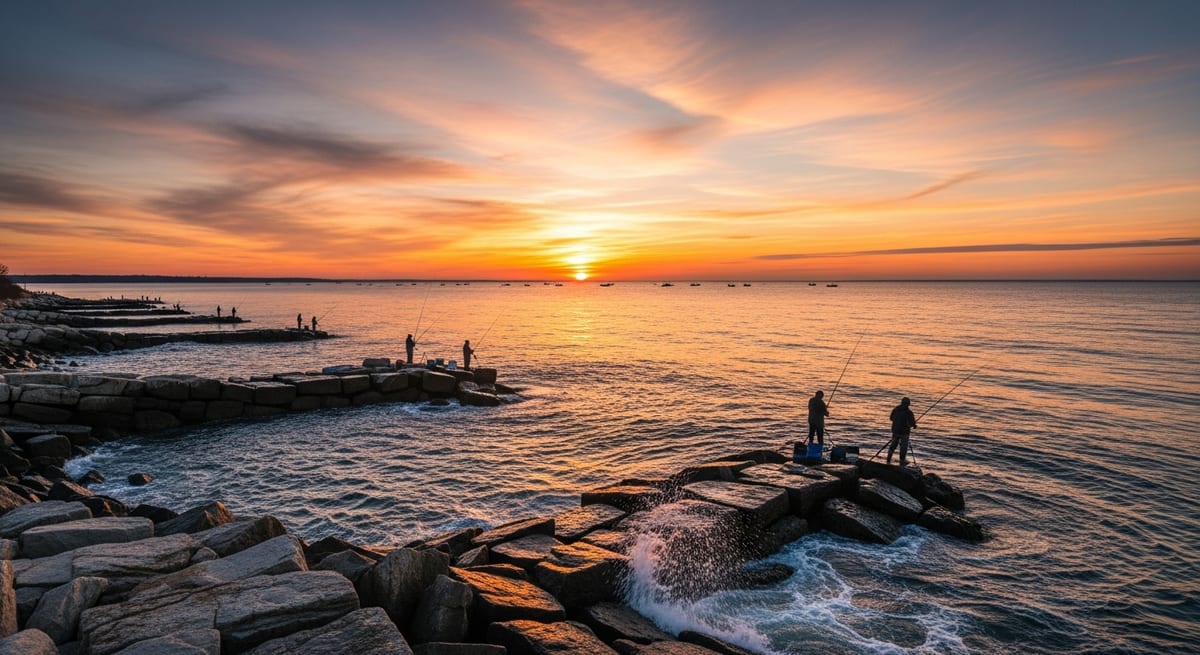
Shore anglers who fish Hammonasset's western end and the Niantic Bay jetties through July and August describe the same sequence: birds stacking tight over a moving surface disturbance, water breaking white with glass-eyed baitfish, and a window of roughly five to ten minutes before the bait disperses and blues drop back into the column. The anglers who get casts into those blitzes aren't always the ones who spot them first. They're the ones who were already positioned near productive structure when the tide turned. That pattern, pre-positioning over chasing, is what the CT shore bluefish fishing community consistently returns to when describing what separates productive trips from near-misses.
When Blues Enter the Sound, and What Size Fish Shore Anglers Actually See
Bluefish enter Long Island Sound from the Atlantic in late May or early June, following schools of bunker (menhaden), sand eels, and other forage. According to ASMFC stock assessment surveys and Northeast fisheries monitoring data, the run builds through June and peaks through July and August. A fall migration pushes back out through the Sound in September and October, though CT anglers report that the timing of the fall push varies year to year with water temperature and bait availability. It is not a fixed calendar event.
Snapper blues vs. choppers: The CT shore fishing community distinguishes clearly between two different fish. Snapper blues, juvenile fish running 6-12 inches, appear in harbors, tidal creeks, and river mouths typically from late July through August. Adult fish (commonly called "choppers") run with bunker schools in deeper water and push to the beach when they corner bait in the shallows.
Realistic size expectations: Shore-caught adult bluefish in Connecticut typically run in the 2-8 lb range, based on CT DEEP marine creel sampling data and consistent reports from anglers fishing the open Sound beaches. Fish in the 10+ lb range are documented but are far more commonly reported by boat anglers working bunker schools in open water than by shore casters. Most CT beach anglers treat a 6-lb blue as a solid catch, because it is.
The Tidal Windows and Bait-Reading Pattern Behind Shore Blitzes
The timing information that separates consistently productive CT shore bluefish anglers from occasional ones is not seasonal. It is tidal. The pattern reported repeatedly across CT fishing forums and in DEEP recreational angler surveys is this: blitzes at jetties and rocky points concentrate during the last 60-90 minutes of the outgoing tide, when current accelerates through narrow structure and compresses bait schools against it.
At jetty tips and river mouths: As the tide drops and current funnels through a jetty gap or river mouth, bait schools get pushed into narrowing water. Blues that have been holding just off structure move in to feed. Anglers fishing the Thames River jetties and the Niantic River mouth report that arriving at the jetty tip before the final outgoing push, and waiting, consistently produces more hookups than chasing a visible blitz once it has already started and scrambling to get into position.
At open beach: Incoming tide pushing over sandbars concentrates sand eels and silversides in the nearshore zone. Hammonasset regulars report that the first two hours of incoming tide along the western beach end can produce surface action when bunker schools are nearby, particularly in August.
Visual cues: Terns and laughing gulls diving steeply, not circling high, are the primary surface indicator. CT shore anglers consistently report that low, fast-moving bird activity directly over a dark water patch is more reliable than scattered high bird activity. A "boil" of small silver fish breaking the surface means blues are feeding below and at the edges of the bait school.
Conditions: The CT shore community reports that flat, calm conditions at dawn and dusk correlate with the most visible surface feeds. Wind above 15 mph tends to scatter bait and break up the tight surface activity that makes blitzes readable from the beach, though fish may still be present and catchable below the chop.
Shore Access Points With Documented Consistent Production
Hammonasset Beach State Park (Madison): Connecticut's largest shoreline state park, with miles of direct Sound access. Bluefish blitzes have been documented throughout the summer at both the western and eastern ends of the beach, where sand meets structure. The park's scale lets shore anglers move along the beach to follow visible bait movement. A significant advantage compared to fixed jetty spots where you commit to a position.
Niantic Bay and Niantic River Mouth: The river mouth creates a tidal bait funnel that CT Sound anglers have fished for generations. Blues hold outside the mouth waiting for bait to stage. Jetty access on both sides of the mouth provides structure-adjacent casting positions. Community reports consistently identify this area as one of the most reliable shore bluefish locations in eastern Connecticut.
Thames River Jetties (New London/Groton): The jetties at the Thames River mouth see documented bluefish activity, particularly during outgoing tides in summer. Access from both the New London and Groton sides is noted in state angler reports and DEEP public fishing access guides.
Bluff Point State Park (Groton): Rocky shoreline and point structure concentrate bait differently than open beach. Less accessible than Hammonasset. The walk to the point is roughly 1.5 miles each way, but anglers who fish here regularly describe it as reliably productive for bluefish when fish are in the area.
Harkness Memorial State Park (Waterford): Rocky shoreline with open Sound exposure and direct access to productive water. A less-crowded alternative to Hammonasset during peak summer weekends.
A note on Mystic River jetty reports: Some online sources list the Mystic River jetty as a bluefish spot. Community documentation on this location is more limited than for the Thames or Niantic jetties. Anglers planning a trip specifically to this spot are encouraged to verify recent activity on CT fishing forums or check DEEP angler reports before making the drive.
The Leader Debate and What CT Shore Veterans Actually Rig
Bluefish teeth are serrated and can cut through conventional fluorocarbon leader when a fish turns during the fight and the line contacts the teeth directly. CT shore anglers report losing fish this way, especially on larger choppers, consistently enough that it shapes the standard rigging approach across the community.
What experienced shore anglers run: The consensus across CT fishing forums and angler comments in DEEP creel survey data is a 12-18 inch section of 50-60 lb monofilament or heavy fluorocarbon as a minimum leader. Most CT shore anglers report this holds adequately on fish up to 6-7 lbs with proper knots and no wind knots in the leader.
Wire vs. heavy mono on bigger fish: For larger choppers, some CT shore veterans run 8-12 inch sections of coffee-colored coated wire at 40-60 lb. The tradeoff, documented in third-party lure testing and widely acknowledged in the shore fishing community, is reduced action on soft plastics and thinner metal jigs. The anglers who use wire tend to reserve it for conditions where they are specifically targeting large fish, not general mixed-school action.
Rod and reel: A medium-heavy to heavy 9-11 ft spinning rod rated for 1-4 oz is what CT shore bluefish anglers use most consistently. A 4000-6000 series spinning reel with a smooth drag is standard; bluefish make strong initial runs, and a jerky drag is cited frequently in lost-fish reports from CT shore anglers. Most spool with 20-30 lb braid.
Lures and Retrieve Cadence CT Shore Anglers Rely On
Metal jigs: The Kastmaster, Hopkins Shorty, and Point Jude are the lures CT shore anglers return to most consistently for bluefish. At 1-2 oz in silver or blue-and-white, these cast far from the beach and work at any depth without requiring careful presentation. The retrieve speed that experienced CT shore anglers flag repeatedly, across forum reports and tackle shop accounts, is faster than most anglers' default instinct. The phrase that comes up again and again in CT shore bluefish reports: "if you think you're going too fast, speed up."
Poppers: When blues are visibly surface-feeding, a 3-4 inch, 1.5-2 oz popper worked aggressively matches the surface commotion of the bait school. CT shore anglers who fish blitzes regularly tend to favor heavier poppers for distance, reaching the edge of a blitz 40+ yards offshore from the beach is frequently the difference between catching and watching.
Soft plastic paddle tails: A 5-6 inch paddle tail on a 1-2 oz jig head retrieved quickly produces bluefish strikes. Durability is the consistent complaint from CT shore anglers: blues shred soft plastics, typically requiring replacement every few fish. The approach that has become standard practice in the CT shore community is threading the soft plastic further up the hook shank to reduce how easily it strips during a strike, and carrying six to eight replacements per session rather than treating extras as optional.
Bucktail jigs: A classic surf lure that produces in current seams and rips. CT shore anglers who use bucktails for bluefish typically add a soft plastic or pork rind trailer for action in moving water.
Color: CT shore anglers generally report that feeding bluefish are not selective. Most moving lures draw strikes during an active blitz. In clearer Sound water, blue-and-white and silver most closely match sand eels and silversides. In stained water or low light, chartreuse is the high-visibility choice cited most consistently across CT shore fishing accounts.
CT DEEP Regulations, verify Before the Season Opens
Bluefish in Connecticut are managed under the Atlantic States Marine Fisheries Commission (ASMFC) bluefish management plan, which Connecticut follows. The recreational bag limit has tightened significantly under ASMFC stock rebuilding measures in recent years.
As of the 2024 season, the federal recreational bag limit for bluefish was 3 fish per angler per day, with no minimum size limit under the federal framework. Connecticut typically adopts the ASMFC-recommended measures, but state-specific adjustments are possible and the limit has changed year-over-year recently.
Verify current regulations at ct.gov/deep before fishing each season. The DEEP Marine Fisheries division publishes current recreational saltwater regulations, including any in-season adjustments. The 2024 bag limit figure may not carry forward unchanged, checking before the season opens takes two minutes and avoids a preventable citation.
Connecticut anglers 16 and older fishing from shore in tidal waters are required to hold a recreational saltwater fishing license. Registration and current license information are available through ct.gov/deep.
EVERY SATURDAY MORNING
Weekly fishing intelligence
Nationwide conditions, what's biting, and honest gear deals. One email, no noise.
No spam. Unsubscribe anytime.