
CT Fall Stripers Follow the 55-Degree Line, Not the Calendar. Most Shore Anglers Are Timing It Wrong.
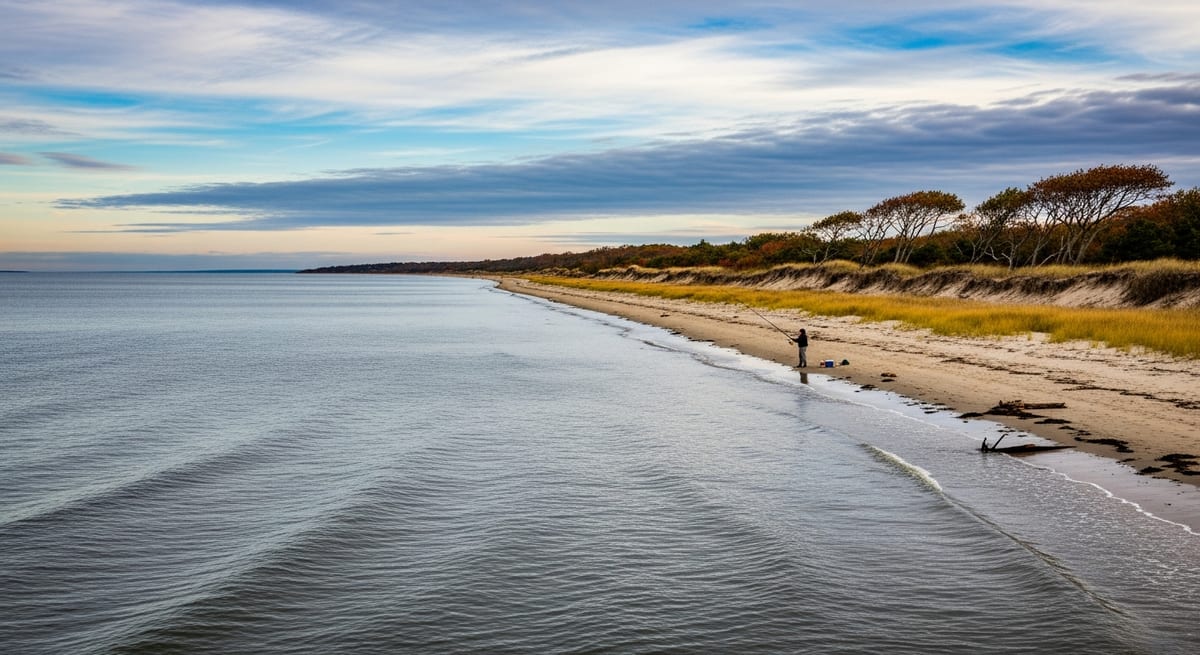
Experienced CT surf casters track two numbers in the fall: the date of the first significant nor'easter and the Long Island Sound surface temperature. When NOAA buoy readings for the Sound drop toward 55°F, the main migration push is underway, and anglers who haven't already pre-positioned at the river mouths are typically a week behind the fish. The fall run isn't a single event. It's a progression across roughly 8-10 weeks, with each stage demanding different locations, different lure sizes, and different timing. Anglers who fish all three windows consistently describe it as the most productive stretch of the saltwater year on the CT coast, bigger fish than summer, and far less pressure on the shore-accessible spots.
Three Windows, Not One Season
The fall striper migration in Connecticut unfolds over 8-10 weeks from late September through mid-November. Each window fishes differently, same coastline, different fish behavior, different tactics.
Late September. The advance guard: Larger bass (28-40+ inches) typically appear along the CT shoreline before smaller fish do. These are the migratory fish that spent the summer in Maine and Massachusetts waters. Water temperatures are still in the low-to-mid 60s, baitfish schools (bunker, peanut bunker, herring) are visible near the surface, and the fish are feeding. CT surf casters who fish this early window describe it as consistently underrated, crowds are thin and bass are active before the October pressure builds.
October, staging and concentration: Charter captains and longtime shore anglers describe October as when fish stage before the push toward Montauk and their southern wintering grounds. Surface feeds are visible from shore, diving birds, bass busting baitfish from below. The action during bait-school events can be fast and sustained, particularly on falling tides at river mouths.
November, river mouth holding: Later fish move through in smaller numbers as water temps drop into the low-to-mid 50s. The Connecticut River, Housatonic, and Thames all hold fall bass into November, with fish stacking at river mouths as bait is flushed by tidal flow. Anglers who target this window specifically report that tide timing matters more than lure selection. The hour before and after a falling tide consistently outproduces everything else.
Track water temperature, not the calendar: When Long Island Sound surface temperatures drop below 52-55°F, the main migration push typically winds down. NOAA maintains real-time buoy data for the Sound (Station 44097 is widely referenced by CT surf casters). Many consider it more reliable than any fixed calendar date for gauging where the run stands.
The Shore Spots CT Surf Casters Return to Every Fall
Connecticut's fall run shore access is unusually good for a densely populated state. River mouths, headlands, jetties, and bridge structure all concentrate migrating fish, and many of the most productive spots are walk-in public access.
River mouths: Fish stage at the transition between fresh and salt water, feeding on bait flushed by tidal flow. The Connecticut River mouth at Old Lyme and Old Saybrook, the Housatonic mouth at Stratford and Milford, and the Thames River mouth at New London and Groton are the three locations CT surf casters most consistently return to through October and into November. The hour before and after a falling tide typically produces the most surface activity at all three.
Points and headlands: Any shoreline feature that extends into Long Island Sound concentrates current, baitfish, and bass. Hammonasset Beach State Park in Madison, Harkness Memorial State Park in Waterford, and Seaside Park in Bridgeport all have shore-accessible casting positions with documented fall run production. CT DEEP's public fishing access maps (at ct.gov/deep) are the most reliable resource for confirming current access at each location.
Jetties: The rock jetties at river mouths create current seams that concentrate bait and hold bass, particularly after dark. Night fishing from jetties in October is widely regarded among CT surf casters as among the most productive sessions of the fall season. Wet rock footing is a genuine hazard, cleated soles (Korkers and similar systems are frequently discussed on CT surf fishing forums as the standard for slick granite) are worth having before you commit to a night jetty session.
Bridge structure over tidal water: Route 1 crossings over several CT tidal rivers have bank-accessible positions near abutments where current and structure hold bass. Tide changes are the productive windows here. The bite often goes quiet between them.
Matching the Bait: What the Experienced CT Shore Crowd Does Differently
Fall stripers are feeding actively, but the adjustment experienced CT shore anglers consistently emphasize is matching lure size and profile to the baitfish actually in the water, not defaulting to a favorite lure regardless of what's present.
When bunker are present (adult menhaden, 8-12 inches): Large swimbaits, big Deceiver patterns on the fly, and chunked bunker on 8/0 circle hooks all produce. CT charter captains who work the October window regularly emphasize this bait-match principle above all else, showing a 3-inch soft plastic to bass eating 10-inch bunker rarely works, regardless of how productive that lure is in other conditions.
When peanut bunker dominate (juvenile menhaden, 3-4 inches): Downsize to smaller soft plastics on spinning gear. A 3-inch Storm Swim Shad, a Hogy paddle tail in white or white-and-chartreuse, or a small metal-lip swimmer in natural baitfish colors. Peanut bunker blitzes are among the most distinctive fall run events on the CT shore. The surface boils are unmistakable from the beach.
Topwater at dawn and dusk: A Yo-Zuri Mag Popper or Gibbs Danny plug worked over surface-feeding bass produces explosive strikes. The consensus among CT surf casters is to walk-the-dog with deliberate pauses, strikes typically come on the pause, not the retrieve. Rushing the cadence is the most common error.
Metal jigs when fish are deep: Kastmaster, AVA jigs, and similar metals cast far and sink fast, allowing systematic coverage of the water column. Effective when birds aren't working and fish need to be located at depth rather than intercepted at the surface.
What the 2023 ASMFC Slot Rule Actually Means for Your CT Fall Trip
Connecticut striped bass regulations follow the Atlantic States Marine Fisheries Commission (ASMFC) framework. Under Amendment 7, adopted in 2022 and in effect for the 2023 and 2024 seasons, connecticut recreational anglers are limited to one fish per day within a 28-31 inch slot size. Fish outside the slot must be released.
The slot structure protects both ends of the population: sub-slot fish are released to grow into the spawning class, and fish over 31 inches. The mature females carrying the bulk of egg production, are protected from recreational harvest. ASMFC's 2022 stock assessment found the striped bass population still below the target spawning stock biomass threshold, which drove adoption of the more restrictive slot structure over previous single-minimum-size rules.
Regulations can change based on ASMFC emergency action. Verify current rules at ct.gov/deep before each trip: DEEP posts updates promptly when ASMFC makes adjustments, and those updates can happen mid-season. Fines for possession violations are significant.
Most serious CT fall run anglers practice catch-and-release or keep one slot-size fish for the table. ASMFC tracks coastwide harvest compliance as part of the ongoing stock assessment cycle, and continued recovery toward biomass targets depends on that compliance holding across all coastal states, not just Connecticut.
EVERY SATURDAY MORNING
Weekly fishing intelligence
Nationwide conditions, what's biting, and honest gear deals. One email, no noise.
No spam. Unsubscribe anytime.