
CT Shore Casters at Old Saybrook, Hammonasset, and the Connecticut River Mouth Report That the Largest Stripers Show After Dark, what Tidal Windows, Lighted Bridges, and the Shore-Plugging Community Reveal About Night Fishing Long Island Sound
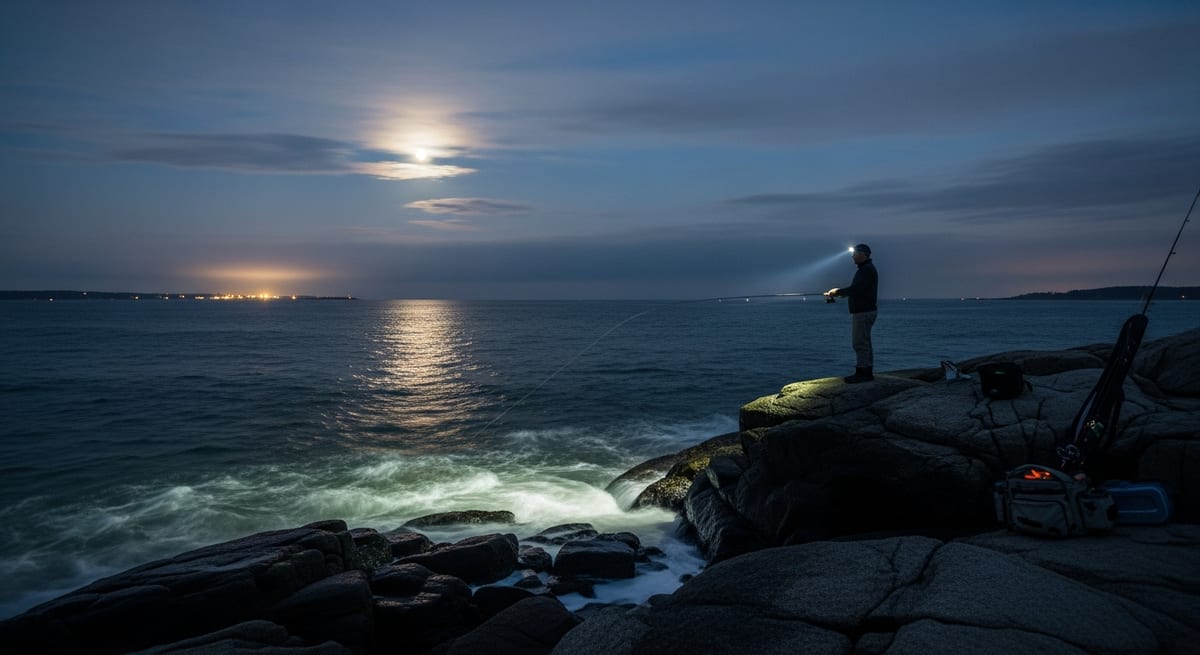
The light-dark boundary beneath the Baldwin Bridge where Route 9 crosses the Connecticut River at Old Saybrook concentrates baitfish on outgoing night tides and draws stripers that shore casters rarely contact on the same structure during daylight. That pattern, described consistently by Connecticut shore-plugging regulars at Hammonasset Beach State Park, the Old Saybrook jetties, and estuary entrances along the Niantic and Mystic Rivers, repeats across lighted bridge crossings and tidal river banks throughout the state. The consensus among CT night shore casters is that bass in the larger size classes spend daylight hours in deeper water or holding tight to structure, then push into shallow feeding zones once boat traffic clears and light levels drop. CT DEEP sets the current minimum size for striped bass at 28 inches under the 2025 ASMFC management framework, and shore regulars who commit to after-dark tides consistently report that fish in the 30-inch-and-above class appear more frequently on night sessions than during equivalent time spent on the same water in daylight.
The After-Dark Shift, what CT Shore Casters Observe About Striper Behavior on Night Tides
The Long Island Sound shore-plugging community has developed a working model of why night tides produce larger fish, and more of them, than daytime sessions on the same water.
Shallow-water confidence in low light: Shore regulars at Hammonasset and the Saybrook jetties describe large bass appearing on shallow gravel banks and along tidal river edges after dark that they rarely contact during the day. The explanation consistent with striper biology research is that large fish use depth and structure as cover against visual predators during daylight hours, and low-light conditions allow them to move shallow and feed without that exposure.
Lateral line advantage over baitfish: Stripers are well-equipped for low-light hunting. Their lateral line detects pressure waves and vibration with high sensitivity, giving them a reliable tracking tool that functions independently of vision. Shore-plugging community reports note that the most aggressive feeding windows often occur on the darkest nights, consistent with what the lateral line advantage predicts.
Bait concentration near bridge lights: Shore casters at the Baldwin Bridge and the Route 156 crossing over the Lieutenant River in Old Lyme describe predictable feeding lanes forming where lit water meets dark water on outgoing tides. Baitfish are drawn to illuminated zones and become disoriented at the transition edge, and stripers set up along that boundary to intercept them.
Temperature relief after dark in summer: Anglers fishing Long Island Sound in July and August note that shallow water temperatures frequently climb above the comfortable range for stripers during peak afternoon heat. Community reports from the Madison and Old Saybrook shorelines describe fish moving back into shallow coves and points after 9 or 10 PM as surface temperatures drop.
Where CT Night Anglers Position, lighted Bridges, Estuary Mouths, and Tidal River Banks
The shore-plugging community has sorted its night spots by reliability across seasons, and certain location types consistently surface in CT community reports.
Lighted bridges over tidal rivers: Bridges crossing active tidal water are the most consistently cited night striper locations in Connecticut. The Baldwin Bridge at Old Saybrook, the Route 156 crossing over the Lieutenant River in Old Lyme, and similar structures on the Niantic and Mystic Rivers all appear in shore-plugging community reports for after-dark striper contact. The current seams beneath bridge pilings create ambush positions that large stripers use once bait concentrations build in the lit water.
Connecticut River mouth and Saybrook Point: During the fall migration, typically September through November, shore casters work the rip lines and tidal points at the river mouth on both incoming and outgoing water. Old Saybrook regulars cite the early-morning outgoing tide, often between 1 and 4 AM, as frequently the most productive window of the entire night session.
Hammonasset Beach State Park: The park is accessible around the clock, and shore-plugging community reports identify the Meig's Point area and the rocky eastern sections of the beach as consistent night producers on incoming water. Tidal flow is strongest on those sections, and striper contact in community reports concentrates there rather than along the flat central beach.
New moon versus full moon: Shore regulars report both moon phases producing, but for different reasons. New-moon tides push fish furthest into shallow water, with total darkness eliminating visual pressure. Full-moon nights provide enough ambient light for surface lures to create a visible silhouette from below, and the community consensus is that surface presentations produce better on brighter nights than during new-moon conditions.
What the Shore-Plugging Community Puts in the Night Lure Box
Night lure selection among Connecticut shore casters prioritizes vibration and silhouette over color, a departure from the daytime approach that the community consistently reinforces in session reporting.
Rigged eels: Live or rigged eels are the most frequently cited bait in night-fishing community reports from the Connecticut shore. Fished on a weighted hook or a small jig head, eels are allowed to swing in tidal current with minimal retrieve. The natural motion in moving water does most of the work. CT DEEP marine regulations govern eel possession and bait transport; anglers are advised to verify current rules on the CT DEEP Marine Fisheries webpage each season, as possession limits and transport rules are subject to annual ASMFC-driven updates.
Metal-lip swimmers: Wide-wobbling metal-lip swimmers are a night classic in the Long Island Sound plugging community. Models including the Gibbs Danny and Roberts Ranger are mentioned consistently in CT shore-plugging discussions for after-dark striper work. The community consensus on retrieve speed is unusually specific: 1 to 2 mph maximum, far slower than a daytime retrieve. The heavy wobble generates lateral line stimulation; retrieving faster reduces that signal.
Dark-colored plugs: The CT night plugging community's working theory is that dark lures, particularly black, deep olive, and dark purple, create a more defined silhouette against the lighter sky surface when viewed from below than natural or bright colors that blend with it. Many regulars carry a box dedicated to dark night patterns and leave daytime lure selections in the truck.
Surface presentations near light sources: On calm water adjacent to bridge lights and illuminated piers, surface walkers and needlefish profiles appear in CT community reports. The Atom Striper Swiper is mentioned in CT shore threads for this application. The presentation relies on the surface disturbance being visible as a silhouette, which requires calm or lightly rippled water to function as described.
The One Retrieve Adjustment That CT Night Shore Casters Report Changes Everything
Among the adjustments that shore-plugging regulars describe when transitioning from daytime to night fishing, retrieve speed is cited most often, and the direction is always the same: slow down further than feels natural.
Daytime striper fishing can reward reaction-triggering retrieves. Night fishing works differently, according to community reports from CT shore sessions. Fish are often positioned closer to the angler than expected, feeding deliberately rather than chasing. A lure moving at daytime retrieve speeds passes through the strike zone before the fish commits.
The practical adjustment described by CT shore regulars is to pause after the cast lands, counting three to five seconds before beginning the retrieve. Then retrieve at a pace just fast enough to feel the lure's action. On a metal-lip swimmer, the plug wobbles rather than glides through the water. On an eel, the retrieve is often zero, with the angler holding line tension while the current does the swinging.
Many experienced night pluggers also describe mending casts on tidal rivers, throwing a slight upstream curve into the line so the lure swings across the current on a natural arc rather than dragging straight back. This swing presentation keeps the lure in the feeding zone longer and at the slow speed that community reports associate with night-tide takes.
Safety Practices CT Night Shore Casters Use Before They Leave the Truck
Fishing Connecticut's tidal water after dark involves specific hazards that the shore-plugging community addresses consistently in trip-report discussions and long-running forum threads.
PFD at the water's edge: A fall into tidal water at night is more serious than the same fall during daylight. Disorientation in dark water significantly increases risk, and the shore-plugging community's standard practice on jetties and rocky points is a wearable, fastened PFD, not one stored in a bag.
Red-light headlamp, with backup: A headlamp running red-light mode is the standard tool for rigging, landing fish, and navigating after dark. White light eliminates night vision for 15 to 20 minutes, removing the low-light advantage that effective night fishing depends on. Shore regulars routinely carry a second headlamp in the bag as backup.
Scout unfamiliar water in daylight first: The shore-plugging community consistently advises against fishing unfamiliar rocky areas for the first time at night. Foot hazards, unexpected drop-offs, and access paths that read clearly in daylight become serious hazards after dark. A brief scouting pass of any new location during daylight before the night session is standard practice among CT shore regulars.
Navigation lights for kayak and small-boat anglers: For anglers accessing night striper water from a kayak or small craft, Connecticut requires functioning navigation lights after dark. Running without lights on active tidal water, including the Connecticut River mouth and the Saybrook Breakwater area, is both a legal violation and a collision hazard with powerboat traffic that continues well into the night during peak season.
Float plan for solo sessions: Leaving a contact name, target location, and expected return time with someone reliable is cited as standard operating procedure in solo night-fishing discussions among CT shore regulars, particularly for remote sections of Hammonasset Beach or the outer Saybrook jetty after midnight.
EVERY SATURDAY MORNING
Weekly fishing intelligence
Nationwide conditions, what's biting, and honest gear deals. One email, no noise.
No spam. Unsubscribe anytime.