
Wading the Farmington River: Gear, Safety, and Access
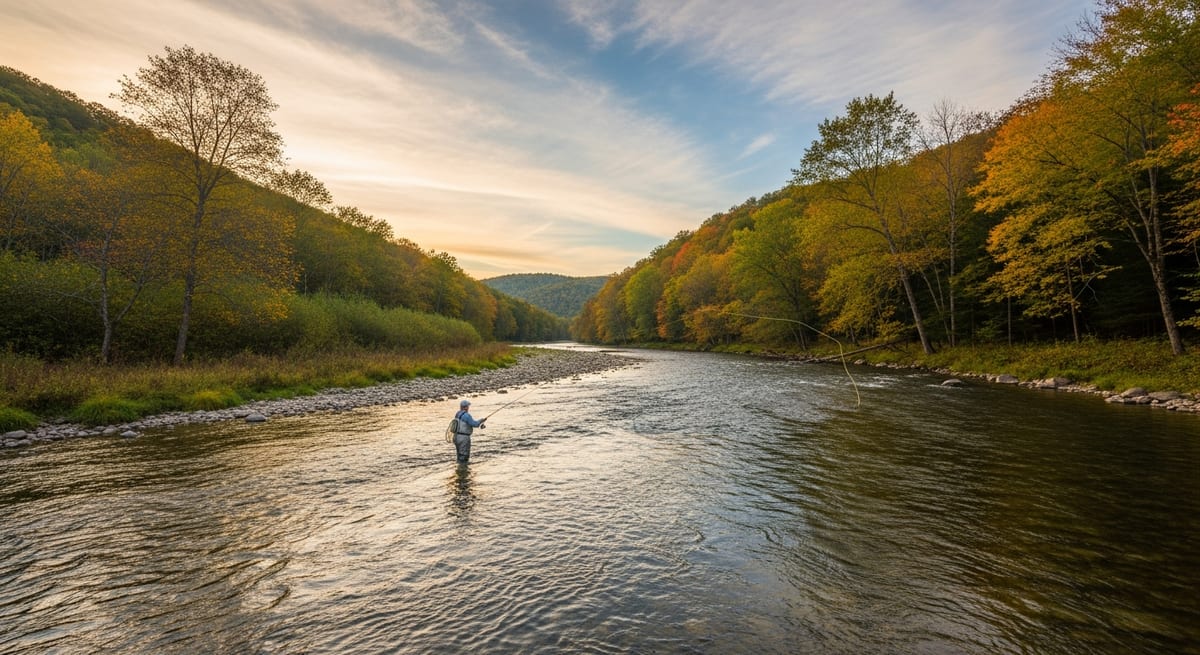
Wading a river opens water that's unreachable from shore and positions you to present flies or lures accurately without the casting limitations of bank fishing. The Farmington River is CT's most popular wading fishery, but the techniques apply to the Housatonic, Connecticut River, Salmon River, and any moving water. Here's how to wade safely and effectively.
Wader Selection
Neoprene vs. Breathable: Most CT river anglers fish breathable waders (Gore-Tex or similar) for three-season use. Breathable waders are lighter, less fatiguing for all-day wading, and pack down for travel. They're appropriate for water temperatures above 45°F. Below that, or for extended cold-water wading (early April, late November), neoprene waders provide warmth that breathables can't match. Many CT anglers own both.
Bootfoot vs. Stockingfoot:
- Bootfoot waders (wading boot built in) are convenient and warm but offer less ankle support and are harder to dry. Better for casual anglers or wade-fishing in heavy current.
- Stockingfoot waders (neoprene sock attached, wading boots separate) provide better ankle support, more comfortable walking, and better drying. The standard choice for dedicated river anglers.
Budget guidance: Waders are a gear category where durability matters. A $200 pair of waders will fail in one to two seasons of regular use. Orvis, Simms, and Patagonia make waders in the $350-$600 range that last 5-10 years with proper care. The math favors investing in quality. Entry-level breathable waders from Hodgman or Frogg Toggs in the $150-$250 range work for occasional anglers.
Fit: Waders should fit snug enough to not bunch behind the knees but loose enough to high-step comfortably. Try them on with the underlayers you'd actually fish in, fleece pants or wool mid-layer adds bulk.
Wading Boots
Sole types. The important decision: Wading boot sole selection involves a tradeoff between grip on slippery streambed and biosecurity (preventing the spread of aquatic invasives).
- Felt soles: The traditional choice. Felt provides excellent grip on slick algae-covered rocks. The best traction available. However, felt retains moisture and can transport aquatic invasive species (didymo, milfoil, etc.) from water body to water body. Some states have banned felt soles; CT currently allows them but check current DEEP regulations.
- Rubber soles with studs (Vibram or similar): The current best practice from a biosecurity standpoint. Modern rubber-with-metal-studs soles approach the grip of felt on most surfaces. Cleated rubber adds traction but can feel "grippy" on smooth rock in a way that feels different from felt. Korkers boots with interchangeable soles let you swap between felt and rubber depending on regulations and conditions.
Ankle support: High-cut wading boots provide ankle support critical for safe wading in fast, uneven streambed. Don't wade fast water in low-cut footwear.
Breaking in: New wading boots are stiff and can cause blisters. Wear them for short wading sessions first, and wear the same wool or synthetic wading socks you'll use in the field.
Reading the Farmington River for Wading Safety
The Farmington River changes character significantly with flow rate. The USGS stream gauge at Tariffville (gauge #01186000) gives real-time data. Interpret it this way:
- Below 200 cfs: Very low, easy wading. Many sections are ankle to knee deep. Best summer conditions for wading the TMA and stocked sections.
- 200-500 cfs: Ideal wading levels. Knee to thigh deep in most sections. Fish are concentrated and accessible.
- 500-800 cfs: Moderate wading. Thigh to waist deep in the main current. Stay to the edges and shallower braided channels. Use a wading staff.
- 800-1,200 cfs: High water. Wade with extreme caution or fish from the bank. Stick to the inside of bends and shallow margins.
- Above 1,200 cfs: Do not wade. Bank fish from high, safe positions if fishing at all.
Reading the structure from the bank: Before entering the water, study the river from the bank for 5 minutes. Identify: Where are the riffles (faster, shallow, aerated water)? Where are the pools (deeper, slower, darker)? Where are the seams (the transition line between fast current and slow eddy)? Enter the water at a riffle where you can see the bottom, then work into position.
Safe wading technique: Shuffle feet along the bottom rather than lifting them, feel for the next foothold before committing weight. Face upstream in fast current (your legs form a V-brace). Keep one hand free for balance. Move slowly. Never wade to the point where the current is pushing you. That's the line where a stumble becomes a swim.
Essential Safety Gear
Wading staff: Non-negotiable in fast water above 500 cfs. A wading staff provides a third point of contact and can prevent a stumble from becoming a dangerous fall. Folding wading staffs clip to a chest pack or vest and deploy quickly. A heavy wooden staff is effective but less convenient.
Wading belt: The waist belt on your waders should always be cinched tight. If you fall in, the belt traps air in the legs, providing buoyancy and slowing water entry, critical extra seconds to regain your footing.
Cold water immersion risk: CT rivers in April are cold: 45-55°F. Cold water shock (sudden cold water contact) causes gasping and involuntary inhalation. Even strong swimmers can drown in cold water within minutes of immersion. Wear a personal flotation device (PFD) as an inflatable belt or vest when wading high, cold water in spring.
Never fish alone in fast water: Always fish with a partner when wading swift currents. Cell service can be spotty on the Farmington's wooded sections. A wading accident in an isolated stretch is serious without someone present.
Tell someone where you're going: Before a solo wading trip, tell someone your location and when to expect you back.
Wading Etiquette on the Farmington
The Farmington TMA gets crowded, especially on spring weekends during hatches. The etiquette norms that keep fishing pleasant for everyone:
Give other anglers space: The general guideline is that you shouldn't enter a pool another angler is actively fishing without asking. 50-100 yards of separation is appropriate.
Don't push upstream through another angler's water: If an angler is working upstream ahead of you, don't wade around them and position above. Work different water or wait until they've moved on.
Step out to pass: When you need to walk past another angler, step entirely out of the water and walk along the bank rather than wading through water they may be fishing.
Downstream yield: The general convention is that the upstream angler has right-of-way. If you're fishing downstream and an angler below you is working up toward you, hold position or work to the side to let them pass.
No splash wading: In a pool where fish are rising, entering the water with splashing and commotion spooks the fish and ruins the pool for everyone. Enter quietly, move slowly, and keep any wading disturbance minimal.
EVERY SATURDAY MORNING
Weekly fishing intelligence
Nationwide conditions, what's biting, and honest gear deals. One email, no noise.
No spam. Unsubscribe anytime.