
CT Trout Season Runs Four Distinct Phases Between Late March and Early June. The Farmington TMA, Salmon River, and DEEP Stocking Reports Break Down What Changes, and When.
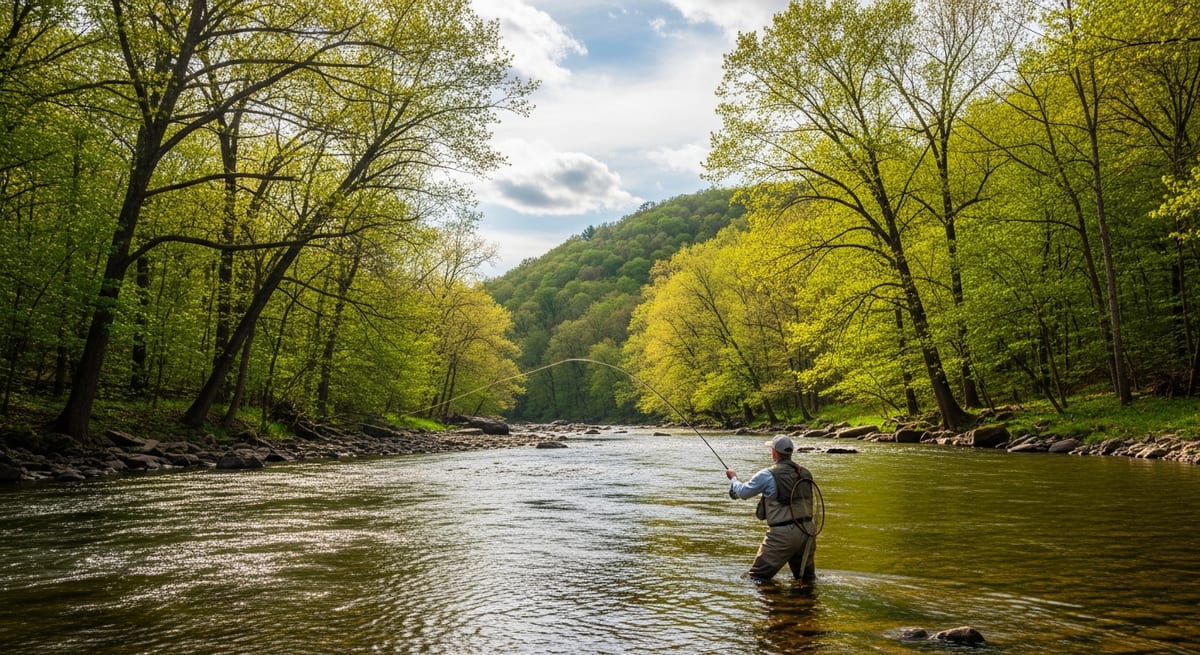
CT trout anglers who fish the Farmington TMA on opening day routinely describe the accessible pools, particularly the stretch from the Whittemore Road access down through the People's State Forest bend, filling to fifteen or more anglers per run by 6 AM, with foot traffic through the shallows pushing fish downstream before most rods have made a first cast. Connecticut's stocked trout season runs from late March through early June under DEEP regulations and breaks into four overlapping phases: pre-season stockings before the third Saturday in April opener, the opening day crowd itself, a quieter mid-season window with continued stockings through June, and a late-season holdover period on cold-water rivers. Anglers who fish the Farmington, Salmon, and Natchaug across all four consistently describe each window behaving differently enough to warrant different tactics, and lower pressure in every phase but the first.
How the DEEP's Multi-Wave Stocking Schedule Actually Works
The Connecticut DEEP's spring stocking program is a rolling schedule, not a single opening-day release, published weekly at portal.ct.gov/DEEP. CT trout anglers who follow the new reports each week treat each Thursday posting as a fishing calendar, cross-referencing it before trips to the Salmon, Natchaug, and Farmington.
Pre-season stockings (late March through mid-April): Per the DEEP's published stocking cadence, rivers and streams scheduled for the opener receive initial stockings one to two weeks before the third Saturday in April. The official trout season opening date under 2024-2025 Connecticut Fishing Regulations. CT trout anglers who monitor the portal confirm fresh fish in target pools days before the opener, which accounts for some of the pre-dawn opening day crowds.
Opening day, third Saturday in April: The most heavily fished single day of the year on Connecticut trout waters. The consensus among CT trout anglers who have fished the Farmington and Salmon on opening day for multiple seasons is consistent: the most accessible pools log disproportionately high rod-hours compared to any other section, and by late morning the fish in those pools have largely been caught or displaced into the next run downstream.
Subsequent stockings through early June: The DEEP continues stocking at Trout Management Areas, heritage streams, and general trout waters through early June. The weekly stocking report identifies which specific waters received fish. Anglers fishing the Salmon River corridor in Colchester or the Natchaug through Chaplin regularly use this report to confirm recent stocking activity before making the drive.
Holdover fish: Some stocked browns, and occasionally rainbows, survive through summer in rivers with cold dam-release water. CT fly fishers most frequently cite the Farmington TMA, where cold water drawn from Hogback Reservoir keeps temperatures fishable well into July. Anglers who have targeted holdovers on the TMA describe significantly more selective fish requiring precise presentations, a marked contrast from fresh stockings earlier in the season.
Five Waters CT Trout Anglers Return to Every April, with Access Details
Farmington River TMA (Barkhamsted to New Hartford): Per 2024-2025 CT DEEP regulations, the Trout Management Area runs from below Hogback Dam downstream through New Hartford, with catch-and-release, artificial-lure-only, and single barbless hook rules in effect throughout the section. Cold dam-release water keeps temperatures fishable into July.
Key access points CT trout anglers rely on: Whittemore Road in Barkhamsted for the upper TMA and the Hogback tailwater pools, People's State Forest parking off Route 318 for the mid-river bend sections, and the Route 44 bridge area in New Hartford for the lower TMA. Anglers familiar with the river note that the Hogback tailwater and Route 44 sections receive the heaviest opening day pressure. The People's Forest stretch off Route 318 tends to run quieter with comparable fish density throughout April.
Salmon River (Colchester/East Hampton): Public access through Salmon River State Forest in Colchester and East Hampton covers most of the productive early-season water. Anglers who fish the Salmon in April typically describe it as more accessible for spin anglers than the TMA, spinners and live bait produce well through the season without the fly-fishing-only restriction. The Salmon appears regularly on DEEP stocking records and carries lower weekend pressure than the Farmington for most of the post-opening window.
Natchaug River (Chaplin/Hampton): The consensus among CT trout anglers who fish the Natchaug is that it carries less pressure than either the Farmington or Salmon despite receiving consistent DEEP stocking. Primary access is through Natchaug State Forest off Route 198 in Chaplin. The Hampton section above the Still River confluence offers solid wading with noticeably fewer weekend anglers than the downstream stretches.
Willimantic River (Windham County): Appears on DEEP stocking schedules consistently and is described by anglers who fish it as an underutilized option relative to its fish density. Multiple public access points through the Windham County corridor. Weekend pressure is low compared to the better-known rivers.
Lakes and ponds: Bantam Lake, Tyler Lake, and Highland Lake receive regular stocked trout per DEEP reports. Shore fishing with bait from public access points is most productive in the 48-72 hours following a confirmed stocking, cT trout anglers who check the weekly DEEP portal before a lake trip report noticeably better results than those who fish on a fixed day-of-week schedule regardless of recent stocking activity.
What Opening Day Actually Looks Like, and Where Displaced Fish End Up
Opening day crowd dynamics on the Farmington TMA are well-documented in CT angler accounts: accessible pools near Whittemore Road and the Route 44 bridge area fill quickly, and foot traffic through the shallows begins pushing fish downstream before most anglers have settled into position.
Walk past the first two pools: CT trout anglers who have fished the TMA on multiple opening days consistently describe a simple adjustment that improves their results. A 20-minute walk from any parking area puts them in water with one to three anglers rather than ten to fifteen. Fish density in those further sections is similar; pressure is not.
Where pressure-displaced fish go: Stocked trout disturbed by wading and casting pressure move downstream into the next riffle or holding run. Anglers fishing the section just below a heavily worked pool on opening day frequently report better mid-morning action than those working the crowded water upstream. The fish are there. They've just moved.
Bait rigs in the first 48 hours: The consensus among CT trout anglers who fish opening day is that recently stocked fish are less selective than fish that have been in the river for a week. A nightcrawler or salmon egg on a size 8-10 hook with light split shot, drifted at current speed through a run, tends to out-produce more complex presentations in the immediate post-stocking window before fish have oriented to natural feeding lanes.
Cover water, don't hold a position: Stocked fish orient to current similar to wild trout. They spread across runs and riffles rather than concentrating in a single pool. Anglers who move through water systematically rather than holding a fixed position report finding more fish throughout the day on high-pressure opening day conditions.
Why Farmington TMA Regulars Treat the Two Weeks After Opening Day as the Real Season
Crowd pressure on CT trout waters drops sharply in the days following opening day, additional DEEP stockings arrive at many stretches, and fish that have been in the river for five to seven days shift into natural feeding behavior. The combination consistently produces better fishing per rod-hour than opening day itself, per CT trout angler reports across the Farmington, Salmon, and Natchaug.
How fish behavior changes after the first week: CT trout anglers who fish the Farmington TMA in the days after opening consistently describe a behavioral shift, fresh stockings respond to nearly anything in the first 24-48 hours, but fish that have settled into the river for a week are actively feeding on aquatic insects, minnows, and drift food. Presentations become more important, but fish are predictably positioned in current seams rather than scattered randomly through the water column.
Spinners and soft plastics in the feeding window: Once fish have settled into current lanes, anglers fishing the Salmon River and Natchaug report that small spinners (1/8 to 1/4 oz, silver or gold finish) and soft plastic jigs produce reliable reaction strikes. A 1/8 oz jig head with a small paddletail worked at current speed through a run is a setup CT trout anglers consistently mention in spring forum discussions for this mid-season window.
The Hendrickson hatch on the Farmington TMA (late April through early May): The Hendrickson emergence is the most discussed hatch event in CT fly fishing communities, and the Farmington TMA's cold, consistent flows make it one of the more predictable venues for it in the Northeast. Anglers who fish the TMA during peak Hendrickson activity, typically late-afternoon emergence windows on warm April days and into early May, describe concentrated, visible surface feeding throughout the river. Fly fishers on the CT forum threads that track this hatch annually note that Hendrickson dry fly patterns and soft hackles are the primary producers during the emergence.
Low-light windows: The consensus across CT trout angler accounts on the Farmington, Salmon, and Willimantic is that first-light to 9 AM and late afternoon produce significantly more activity than midday fishing on bright spring days, when shallow-water fish in clear rivers become notably less active.
What CT Trout Anglers Are Running in April and May
Spinning setups: A 6-7 foot light to medium-light spinning rod rated for 4-8 lb line handles the range of CT spring trout scenarios, drifting bait, casting spinners, working soft plastic jigs. CT trout anglers on the Salmon and Natchaug most commonly describe this class of setup in spring trip reports.
Fly fishing on the Farmington TMA: Fly fishing with a single barbless artificial is a regulatory requirement in the TMA section per current DEEP regulations. Among CT fly fishers who post regularly about the TMA, 9-foot rods in the 4-weight to 5-weight range come up most often, though angler setups on the river vary considerably. Hendrickson dry fly patterns, soft hackle nymphs (Hares Ear, Pheasant Tail variants), and small streamers are the most-cited patterns in CT fly fishing forum discussions around the April-May window.
Bait rigs and lures: Nightcrawlers are the most-cited bait in CT trout angler accounts for spring stocked-water fishing. PowerBait is widely used for lake fishing from shore, chartreuse and green variants come up most often in CT angler forum discussions for recently stocked fish, though anglers note that results vary and color preference is inconsistent across waters. Small spinners in silver and gold, size 6-10 bait hooks, and light split shot cover most spring bait and lure applications.
Spring water temperatures: USGS stream gauge data at the Farmington River near Tariffville typically shows April water temperatures in the low-to-mid 40s°F, with the TMA section's dam-release water often running cooler than the lower river. CT trout anglers who check USGS gauge data before a spring trip report it helps calibrate expectations for fish activity and depth, colder water generally means slower presentations fished deeper in the water column.
Waders: Spring CT river levels and temperatures make chest waders a meaningful access tool. Anglers who fish without waders in April and May on the Farmington and Salmon describe being limited to bank sections where pressure is already higher, wading access opens up mid-river runs and crossing points that see far fewer anglers on any given day.
EVERY SATURDAY MORNING
Weekly fishing intelligence
Nationwide conditions, what's biting, and honest gear deals. One email, no noise.
No spam. Unsubscribe anytime.