
CT Trout Anglers Who Check the DEEP Report Before Every Trip Don't Fish Blind. What Farmington, Willimantic, and Salmon River Communities Report About the Timing Window, Technique Shifts, and Which Waters Hold Fish Longest
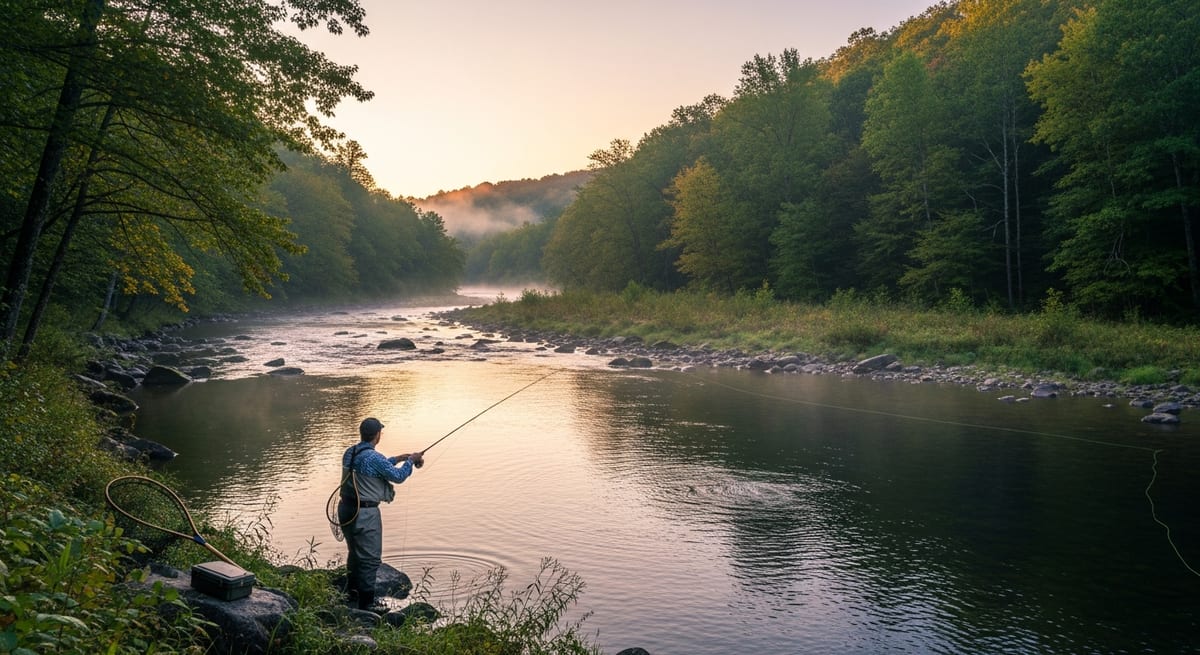
Anglers who fish the Farmington or Willimantic the day or two after a stocking describe finding pods of trout in predictable holding lies. Fish that haven't encountered a lure yet. Connecticut plants hundreds of thousands of trout across river systems and lakes each season, and the DEEP posts which waters were just hit, and when, in a report posted again each week throughout the season. Regulars who track it consistently describe getting to productive water before it shows up on a weekend trip report.
What the DEEP Report Shows and How Regulars Use It
The Connecticut DEEP publishes stocking data at ct.gov/deep under Fishing > Stocking Reports, posted again each week during stocking season.
What each entry includes:
- Water body name and town
- Date stocked
- Species (brown trout, rainbow trout, brook trout, tiger trout)
- Number of fish stocked
- General size category
The stocking calendar: Connecticut's primary stocking period typically runs from the third Saturday in April through June, with a secondary fall stocking focused on brown trout running September through October. A smaller winter stocking program operates in select designated areas.
How CT regulars use the report: Anglers who fish the Farmington, Willimantic, and Salmon River consistently describe the same workflow, check the report Thursday or Friday, cross-reference against recent posts in CT fishing forums or local Facebook groups, and target waters stocked within the past two to three days. DEEP also posts stocking updates on their social channels. Regulars who follow both sources describe consistently reaching productive water before weekend pressure builds.
The Timing Window CT Trout Communities Agree On
CT trout regulars who fish around stocking dates report a consistent pattern: the first two to three days after a planting are the highest-percentage window. Fish hold near their release points in predictable lies, and anglers on CT fishing forums consistently describe this early window as the period when trout take presentations they'd ignore later in the season.
After the first week: What CT communities report shifts noticeably here. Surviving fish have spread from initial holding water and encountered multiple presentations across the pool. Forum threads on CT fishing communities regularly document the same behavioral shift, dough baits slow down, fish hold in tighter cover, and natural presentations start outperforming. Regulars on the Farmington and Willimantic describe this as the transition window: still worth fishing, but requiring more refined approaches.
Two weeks out and beyond: Anglers who return to the same stretches consistently describe the remaining fish as significantly warier than in the first few days. CT trout forums are direct about this: the easy-catch fish are gone, and what remains tends to hold in harder-to-reach water or key on natural food sources. This is the window that rewards wading to less-pressured lies or switching to fly gear.
On fresh trout behavior: CT fishing communities routinely describe newly stocked trout as less wary in their first days on the water. Most regulars attribute this to hatchery conditioning. Fish raised on pellet food in a crowded environment haven't yet developed caution about anglers or presentations. The practical consensus among CT trout communities is that the early window produces more fish per hour of effort, and experienced anglers plan their schedules around it.
What Fresh-Stocked Trout Hit, and the Shift Regulars Report After Week One
PowerBait dough bait: CT trout communities consistently point to PowerBait as the most productive presentation in the first days after a stocking. Anglers describe a pea-sized ball on a size 10-14 treble hook, fished on an egg sinker rig in a pool where the bait floats just above bottom. Chartreuse and yellow are the colors CT regulars reach for first. The consensus on CT forums is clear: PowerBait's productivity drops off noticeably after the first week as fish shift away from hatchery conditioning, making it an early-window go-to rather than a holdover approach.
Inline spinners: Panther Martin and Mepps in #0-2 sizes come up regularly in CT stocking threads. Anglers who fish them describe casting upstream through pools and runs at a medium retrieve pace. CT regulars note that spinners often draw strikes from the same pool where dough bait has gone quiet. The different action triggers a different response from fish that have already seen stationary bait.
Worms: A nightcrawler section on a size 10-12 hook, drifted on a split-shot rig through a pool, is what CT trout communities describe as the most adaptable presentation across the full stocking window. Effective in the first days and still producing two weeks after a planting when PowerBait has slowed. Most CT regulars who fish both bait and naturals carry both.
Small spoons: Gold and silver spoons in 1/8-1/4 oz (Thomas Buoyant, Little Cleo) appear consistently in CT gear recommendations for stocked rivers and lakes. Anglers describe casting across a pool, letting the spoon sink, then retrieving with occasional rod twitches to vary depth and flash. The approach draws more consistent mention for lake-stocked trout than river applications, particularly in May on CT impoundments.
Fly fishing: CT fly anglers who target stocked trout in the first few days describe fresh fish as non-selective, nearly any pattern draws attention. The more interesting window, based on Connecticut Fly Fisherman Association trip reports and CT fly forums, is holdover fish in late May and June: trout that have survived several weeks and begun keying on natural insects. A size 14 elk hair caddis or Adams on calm evenings earns regular mention in CT holdover accounts across multiple rivers.
CT Rivers and Lakes Regulars Return to After a Stocking
Connecticut plants trout across a wide range of water bodies each season. Several earn consistent mention in CT fishing communities:
Farmington River (Avon to Collinsville): More CT trout community discussion centers on the Farmington than any other freshwater system in the state. Wild brown trout supplement annual stockings, and the regulated quality sections draw significant fly fishing pressure from across southern New England. The Trout Management Area (TMA) on the Farmington is a catch-and-release, artificial-lures-only stretch. Anglers new to the river should verify current boundaries and regulations at ct.gov/deep before fishing, as the DEEP updates rules periodically.
Willimantic River (Windham County): CT trout communities describe the Willimantic as a consistent alternative to the Farmington, solid public access, strong spring stockings, and wild trout present in the upper sections. Anglers who fish both rivers regularly describe the Willimantic as markedly less pressured during peak April and May weeks, particularly on weekdays after a recent stocking.
Salmon River (Colchester): The Salmon River Wildlife Area includes a state-designated catch-and-release stretch. Regulars who fish it describe the Salmon as holding fish well into the season, with wild trout supplementing stockings. Current boundary details and applicable regulations are listed at ct.gov/deep.
Lakes for spring stocked trout: Several CT lakes receive spring rainbow and brown trout stockings. Bantam Lake, Lake Waramaug, and East Twin Lake come up regularly in spring stocking threads. Anglers who fish these lakes after a recent stocking describe trolling small spoons and spinners in May, before warm water pushes fish deeper, as the most reliably productive approach on open water.
EVERY SATURDAY MORNING
Weekly fishing intelligence
Nationwide conditions, what's biting, and honest gear deals. One email, no noise.
No spam. Unsubscribe anytime.