
CT Bass Anglers Who Fish Candlewood Laydowns and Bantam's Weed Mats Default to One Rig in Heavy Cover. What They've Figured Out About Weight, Plastic, and Seasonal Timing.
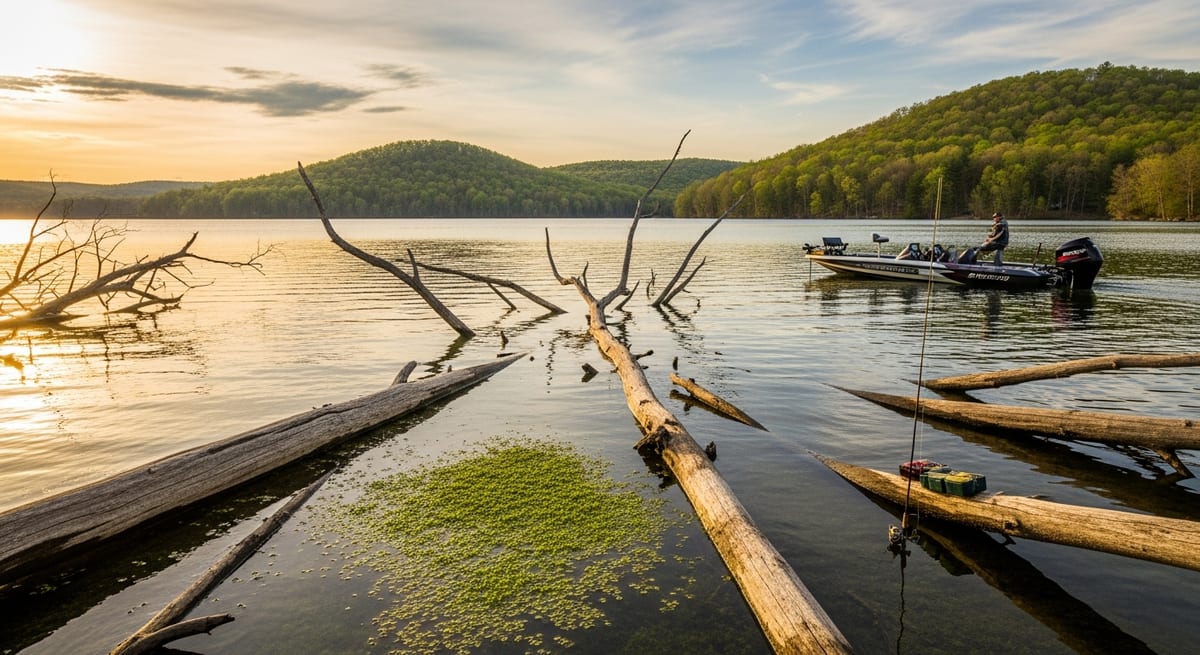
Candlewood Lake's drowned timber runs thick enough in certain coves that anglers fishing the Route 37 shoreline report snagging a standard hook every other cast. Bantam Lake's late-summer hydrilla mats push largemouth so far into vegetation that most surface and crankbait presentations can't reach them. CT bass fishing communities broadly regard the Texas rig. A weedless soft plastic rigged with a buried hook, as the most reliable solution in exactly these situations. It works not because it's universally superior to other setups, but because it's the one presentation that consistently gets through the kind of cover where Connecticut bass actually stack. Anglers targeting Moodus Reservoir brush piles, Connecticut River tidal backwater coves, and the submerged structure on Barkhamsted Reservoir report similar results: when the cover gets heavy enough to eliminate other options, this is the rig they tie on.
Why CT Cover Makes a Weedless Presentation More Than Optional
A Texas rig is a soft plastic, worm, creature bait, craw, or lizard, mounted on an offset wide-gap hook with the point buried inside the plastic. A bullet-shaped weight slides freely on the line above the hook. That buried point is what matters: it lets the bait enter laydowns, weed edges, brush piles, and dock pilings that would snag a standard hook on contact.
CT DEEP's public access data shows Candlewood alone has over 60 miles of shoreline, much of it bordered by drowned timber and rocky points that hold bass through the summer thermocline period. Bantam Lake: 915 acres, historically productive for largemouth, develops dense weed growth by mid-July that anglers in CT bass fishing communities describe as the kind of cover that makes a weedless presentation mandatory rather than preferable.
Components:
- Offset wide-gap hook: 3/0 for 6-inch worms, 4/0 for 7-8 inch, 5/0 for larger creature baits
- Bullet weight: 1/8 oz for shallow clear water (Bantam in June, many DEEP-access ponds), 3/16-1/4 oz for general purposes, 3/8-1/2 oz for deeper structure or current
- Soft plastic: 5-7 inch straight tail worm, 4-inch Senko-style stickbait, or creature bait
- Optional: bobber stop or toothpick to peg the weight against the hook in thick mats
Post-spawn timing matters on CT lakes. Anglers fishing Bantam and Moodus in late May and early June report that bass move from beds into the nearest cover, laydowns, weed edges, dock pilings, within days of the spawn wrapping. That transition window, based on consistent reporting in CT bass fishing communities, is when flipping into close-quarters structure becomes particularly productive.
Rigging It: Weight Selection, Hook Placement, and the Pegging Decision
Slide the bullet weight onto the main line with the point toward the hook. Tie the hook. A 3/0-5/0 offset wide-gap from Gamakatsu, Owner, or Mustad is what most CT anglers are running, using a Palomar knot, which is preferred by most bass anglers for its consistent strength under repeated casting. Some CT anglers use a Trilene or Uni knot with equal confidence, particularly with heavier fluorocarbon; any of these holds reliably when tied carefully.
Push the hook point into the worm's nose about 1/4 inch, rotate 180 degrees, and push through until the eye sits flush with the worm's head. Lay the hook alongside the worm to find where the point naturally exits, then bring it through so it rests just under the surface, not exposed, not buried deep. A worm that hangs with an S-curve is usually a sign the hook isn't centered through the body.
Pegging the weight: Thread a toothpick through the weight opening after it's on the line and snap it flush. This fixes the weight to the hook rather than letting it slide up the line on the cast. CT anglers fishing Candlewood's timber report that pegged weights produce a cleaner presentation in tight cover, bait and weight stay together on the drop rather than separating as the rig enters structure.
Line: Anglers fishing clear CT lakes like Bantam and Barkhamsted typically run 12-15 lb fluorocarbon for the lower visibility. Stained water. Many DEEP-permit reservoirs and the tidal backwaters off the Connecticut River, allows heavier braid (30-50 lb) with a short fluorocarbon leader when flipping close to structure.
What CT Bass Anglers Put on the Hook
Senko (Gary Yamamoto, 5-inch): Watermelon Seed, Green Pumpkin, and Black/Blue are the colors CT bass anglers report most consistently across fishing forums and community reports. Texas-rigged with a light 3/16 oz weight, the Senko falls with a shimmy that frequently draws strikes before the bait ever reaches bottom. The catch rate on varied CT structure is widely regarded as exceptional among the anglers who use it regularly, though some argue the wacky rig edges it out in open water, making cover type the deciding factor.
Straight tail worms (5-7 inch): Roboworm, Zoom Trick Worm, Culprit Original in Red Shad or Junebug. The tail action on the fall and pause is a time-tested presentation CT anglers have relied on across Candlewood, Moodus, and the Connecticut River backwaters for decades. Straightforward and consistently productive across conditions.
Creature baits: Zoom Brush Hog, Beaver-style baits. Larger profile and more water displacement make these effective when flipping into Bantam's late-summer hydrilla or the brush piles along Candlewood's eastern shoreline. CT bass anglers targeting spawning areas in May often reach for creature baits around visible beds.
Craw imitations: Strike King Rage Craw, Zoom Z-Craw. Claw flutter on the fall and a natural bottom posture make these effective on rocky CT structure. The points and boulder fields on Barkhamsted Reservoir and rock-bottom sections of the Connecticut River are the spots where CT anglers report the most confidence in this profile.
Lizards (6-inch): Pre-spawn and spawn specialists. CT bass communities report lizards are most effective near beds in May. Bass are notably aggressive around them during the spawn window. Light weight and a slow presentation are the standard approach.
Working It Through Candlewood Laydowns, Bantam Weeds, and Tidal Backwaters
Cast past the target and let it fall: Cast beyond your target. A laydown, dock edge, or weed pocket, and let the bait fall on semi-slack line while watching the line. A significant share of strikes comes on the initial fall, registering as a line jump, sideways twitch, or the line going slack when it shouldn't. When the bait hits bottom, drag it slowly with gentle rod lifts, reel down, and repeat. CT anglers fishing Moodus Reservoir brush piles describe most of their fish as coming immediately after the bait lands or on the first pause after a drag.
Flipping close-quarters structure: For dock posts, Candlewood's drowned timber, and Bantam's mat edges, anglers flip or pitch at close range. The lure drops nearly vertically into tight openings rather than being cast. Use a heavier weight (3/8-1/2 oz for standard flipping; 3/4 oz is typically reserved for punching specifically through thick floating mats) and heavier line. Hold the rod high and control the drop.
Shaking in place: With a 1/8-3/16 oz weight, maintain contact with the bottom and shake the rod tip to quiver the bait without moving it far. CT anglers on clear lakes like Bantam and Wononscopomuc report this technique produces when fish are visible but reluctant. A bait that sits and shakes will often draw strikes from fish that won't chase a moving presentation.
Reading the bite: Most Texas rig strikes aren't aggressive. A slight weight change, a sideways line movement, or the line going slack unexpectedly. Those are the signals. Keep the rod at 9-10 o'clock during the retrieve and watch the line entry point at the water. Set the hook hard with a full sweep when anything feels off.
CT DEEP regulates largemouth bass at a 12-inch minimum with no closed season on most public waters, but the DEEP Fishing Guide should be checked for specific reservoir permit conditions. Some managed bodies have additional rules. Anglers who mark productive laydown coordinates on Candlewood or Moodus with GPS tend to return to those exact spots season over season, a pattern that shows up repeatedly in CT bass fishing community reports.
EVERY SATURDAY MORNING
Weekly fishing intelligence
Nationwide conditions, what's biting, and honest gear deals. One email, no noise.
No spam. Unsubscribe anytime.