
CT Albie Chasers at the Race, Niantic Bay, and Watch Hill Report a Fall Window Measured in Days, what LIS Charter Reports, ASMFC Little Tunny Notes, and Eastern Sound Anglers Reveal About False Albacore in Connecticut
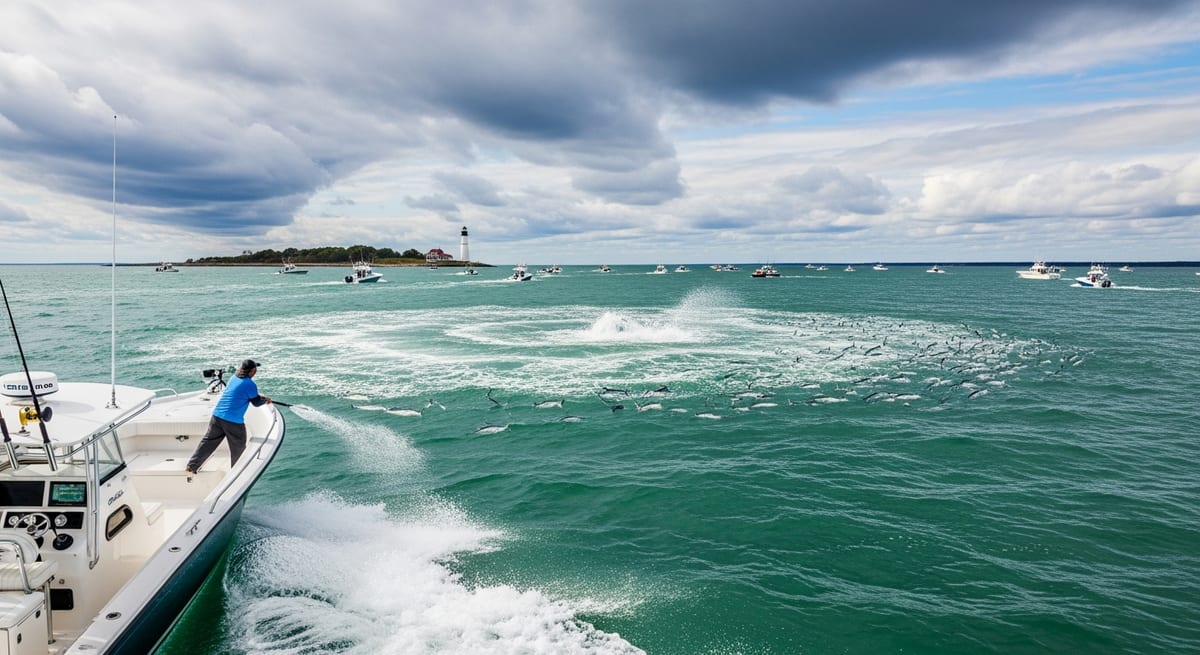
False albacore appear in Long Island Sound for a window that LIS charter captains track annually as anywhere from two to four weeks, and a single cold front can close it before most anglers realize the fish were there. Every September, as peanut bunker and sand eels compress into the current seams off the eastern CT coast, little tunny follow from warmer offshore water. Anglers who fish the fall albie run in Connecticut describe a species that moves too fast to chase, feeds too selectively to fool with the wrong presentation, and fights too hard for its size to compare with anything except offshore tuna. Based on reports from eastern CT charter captains and the CT Saltwater Fishing community, the best years bring consistent surface activity from mid-September through mid-October. The window is short, the fish are demanding, and the anglers who find them at the Race or off Watch Hill come back every fall.
What Makes False Albacore Different From Every Other Fish in LIS
False albacore (Euthynnus alletteratus), called 'albies' or 'little tunny' throughout the Northeast, belong to the tuna family, though many anglers confuse them with bonito or skipjack, both of which appear in similar LIS water in fall. The distinction matters for tactics: albies are typically heavier than bonito at comparable lengths and fight with more sustained power. At 5-15 lbs, they carry more speed and endurance than their weight suggests.
The physiology behind the chase: False albacore are endothermic (warm-blooded), unlike most fish, which allows their muscles to operate at high efficiency regardless of water temperature. Their bullet-shaped body and deeply forked tail are adapted for speed over endurance. Published speed estimates vary. Some sources cite sprint bursts for the species in the 35-plus mph range, though those figures are often unverified or attributed to yellowfin tuna and repeated without original sourcing. LIS anglers who have watched albies blitz bait at close range describe the speed as credible regardless of the exact number. They can peel 50 or more yards of braid on an initial run, per accounts from LIS kayak anglers who target them in the Race area each fall.
The migration and bait connection: Albies follow sand eels, peanut bunker (juvenile menhaden), and silversides that concentrate in CT nearshore waters each fall. DEEP forage surveys of LIS have documented peanut bunker concentrations in eastern Sound from late August onward. The timing that precedes albie arrivals LIS captains have reported for decades. CT charter captains and albie-focused fly anglers describe a fish so keyed on specific bait sizes that the wrong lure in the right location produces zero strikes. Getting into the presence of feeding fish is the first challenge. Convincing them to eat is the second, and harder, problem.
Where CT Anglers Find Albies: The Race, Watch Hill, Niantic Bay, and the Eastern Sound Pattern
False albacore are visually detectable when feeding, which is both the advantage and the challenge. They can be seen from a distance, but they move faster than most boats can reliably intercept.
The eastern Sound concentration: Reports from CT charter captains and the CT Saltwater Fishing community consistently identify eastern LIS as the most productive albie territory in CT waters. The Race. The deep, fast-moving channel between Fishers Island and the eastern CT coast, sees albie activity early in the fall migration, driven by the strong tidal currents and proximity to Block Island Sound. Watch Hill (just over the RI line, accessible from the Stonington area) and the Stonington breakwall are noted staging points for anglers who can get boats into the current seams where bait concentrates. Saunders Reef and the offshore ledges east of New London are mid-season holding areas reported by eastern CT charter captains when the Race bite slows or fish scatter.
Niantic Bay and mid-Sound structure: The Niantic Bay area, including the river mouth and the reefs offshore, sees albie activity in years when baitfish push into the central Sound. The CT albie community on fishing forums tracks gannet activity in the Niantic and Millstone areas as a leading indicator from late August onward.
Reading the signs: Diving northern gannets, large seabirds that fold their wings and plunge-dive, are the most reliable surface indicator of albie schools in LIS. When albies blitz on surface bait, the sound of hundreds of fish crashing at speed carries across water before the spray is visible from the helm.
Approach: The consensus among LIS albie chasers is that boat position matters more than any lure choice. Run through a feeding school once and it disperses. The approach is from downwind and downtide, getting ahead of the moving school and letting fish come to the boat rather than chasing them.
The LIS Albie Setup: What Experienced Anglers Carry and Why Leader Length Is the Variable Most Likely to Explain a Refusal Day
LIS albie anglers who fish the run regularly converge on a fairly narrow gear consensus, not because the species requires exotic equipment, but because the fish are fast enough and leader-shy enough that errors in either category cost fish.
Spinning setup: A 7-7.5 foot medium-fast spinning rod rated for 1/4-3/4 oz, paired with a 4000-5000 size spinning reel spooled with 300-plus yards of 20 lb braid. Backing capacity matters, albies have run anglers to the spool on reels that felt adequate for stripers. 20 lb braid to a 24-36 inch section of 20-25 lb fluorocarbon is the most commonly reported LIS albie rig across the CT saltwater community.
The leader conversation: Anglers on CT saltwater forums consistently flag leader diameter as the single variable most likely to explain a refusal day. In the clear water of eastern LIS, heavy monofilament or fluorocarbon above 25 lb produces marked declines in strike ratio, per the consensus from the CT albie community. Some anglers fishing clear late-October conditions drop to 15 lb fluorocarbon. Knot quality at both ends of the leader is worth testing before launching. An albie's first run reveals connections that feel solid at the dock.
Drag setup: LIS albie anglers set drag lighter than most saltwater species require for the initial run, then increase progressively as the fish tires. A drag locked down on the first run is how 20 lb braid breaks.
Fly fishing: A 9-weight to 11-weight fly rod with fast-sinking or intermediate lines and a large-arbor spool carrying 300-plus yards of 30 lb backing is the standard for LIS albie fly fishing. Eastern CT guides who target albies describe 9-weight albie fly fishing as among the most demanding saltwater experiences available without a long-range offshore trip.
Matching the Hatch: Lure and Fly Selection When Albies Lock on a Specific Bait
Albie selectivity generates more CT saltwater fishing forum threads each fall than any other single topic. The consistent finding: when albies are locked on a specific bait size, the wrong lure in the right location produces nothing. Bait identification before the first cast is the step the CT albie community describes as the one most anglers skip.
Small metals and epoxy jigs for sand eels: When albies are on sand eels. A primary fall forage in eastern LIS. A 1-1.5 inch metal or epoxy jig in silver/chrome is the most-reported producer among the CT community. Lures cited repeatedly in CT albie reports: Deadly Dick, small Kastmaster, and purpose-built sand eel epoxy jigs. Size match is the priority over color.
Slightly larger for peanut bunker: When the school is chasing peanut bunker (juvenile menhaden), anglers who fish the Race area report stepping up to a 2-3 inch presentation in white or silver. The difference in strike ratio between a size-matched and a mismatched lure, per CT albie reports, is not marginal.
Retrieve speed: Unlike most lure fishing, albies respond to the fastest retrieve the angler can sustain. LIS albie anglers describe a maximum-speed crank with zero pauses as the baseline. A stalled lure in most conditions produces follows without commits. The retrieve-speed rule applies to flies. A slow-stripped Deceiver in an albie blitz produces the frustrating follow-and-refuse that the CT fly fishing community treats as a rite of passage.
Fly choices: Lefty's Deceiver (size 2 in white/green), Clouser Minnow (chartreuse/white), Mushmouth pattern, and small epoxy glass-bead flies are the reported standards from CT fly anglers who target albies. Fly size must match the forage. A 3-inch fly when albies are on 1-inch sand eels is the most commonly described fly-fishing mistake in CT albie circles.
Persistence: Albies follow lures and flies to the boat without striking. The CT albie community describes this quality. The follow-and-refuse, as what makes the species simultaneously maddening and worth returning to every fall.
The Fight, the Revival, and What CT and ASMFC Regulations Say About False Albacore
False albacore fights are unlike anything in New England saltwater fishing except offshore bluefin. Anglers who have fished both describe a similar structure: a first run that cannot be stopped, followed by lateral passes and secondary bursts that test drag consistency.
The first run: When an albie takes the hook, it makes an initial run of 50 or more yards at a speed that surprises anglers experiencing it for the first time. The drag does the work, attempting to stop the first run is how tackle breaks. After the initial burst, the fish typically turns and runs laterally across the current; line control without forcing is the technique LIS albie anglers describe for that phase.
Fight duration and pace: Albies fight in bursts with partial recovery periods. LIS albie anglers describe a typical fight as 3-5 minutes of active running before the fish is workable at the boat. They produce another strong run near the surface if brought up too quickly, patience in the final third of the fight is the detail experienced anglers in the CT albie community consistently flag.
Revival is part of the catch: Albies that have been fought hard need active in-water revival before release. LIS catch-and-release albie anglers describe holding the fish upright in the water, facing into current or moving the boat slowly forward, until it kicks away under its own power. Fish left floating without revival after a hard fight do not consistently survive, per accounts from the CT saltwater community.
Regulations: False albacore (little tunny) are not managed under a federal fishery management plan as of the 2025 season, aSMFC's framework for Atlantic Bonito and Little Tunny acknowledges the species but no coastwide bag or size limits apply. CT DEEP marine regulations do not impose a bag limit on little tunny as of the 2025-2026 marine season; anglers should verify current DEEP marine regulations before the trip. The species is treated as catch-and-release by strong community consensus rather than legal requirement. The flesh is considered poor eating by most accounts, and revival is treated as standard practice, not optional, among the CT albie community.
EVERY SATURDAY MORNING
Weekly fishing intelligence
Nationwide conditions, what's biting, and honest gear deals. One email, no noise.
No spam. Unsubscribe anytime.