
New CT Fly Anglers on the Farmington and Salmon Creek Report the Same First-Season Wall. What the Local Fly Shop Community, TMA Regulars, and DEEP Stocking Maps Reveal About Starter Gear, the Overhead Cast, and Where to Catch the First Trout
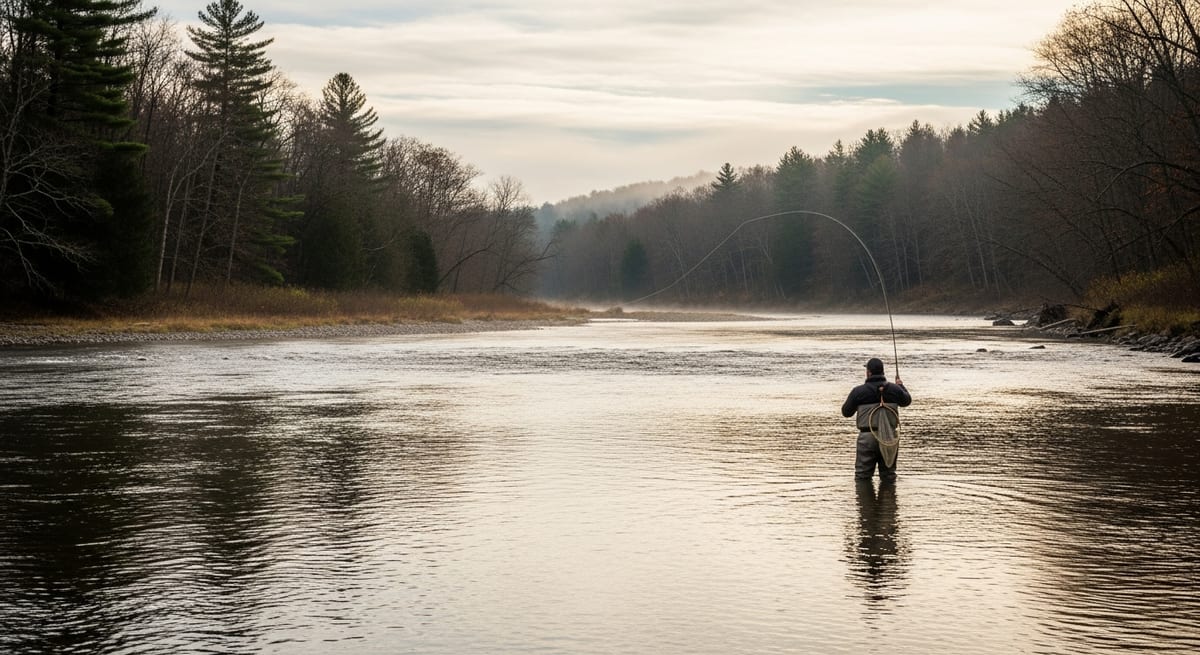
The Farmington River's catch-and-release TMA near New Hartford is one of the most densely fished fly-fishing corridors in New England. Based on what regional fly shop communities report, it's also one of the more efficient places to start: high trout density means beginners get frequent reads without relocating between spots. New fly anglers who start there describe the same early pattern: the overhead cast that felt solid on grass collapses on moving water, drag kills more drifts than bad fly selection, and wading into the pool from the wrong direction spooks fish before the first cast lands. What follows draws on what CT fly shop instructors, Farmington and Housatonic TMA regulars, and DEEP's public stocking and regulation framework provide to new fly anglers in Connecticut.
What CT Fly Shop Instructors Steer First-Timers Toward (And What They Say to Skip)
The fly fishing gear market produces more specialized equipment than most first-season anglers can evaluate. The setup CT fly shop staff consistently steer beginners toward is simpler than the catalog suggests.
Rod: A 9-foot, 5-weight rod handles the majority of freshwater trout situations in Connecticut, from brook trout on Salmon Creek's tight runs to the longer drifts the Farmington requires. The weight designation (5) matches the rod to the correct line weight. Staff at UpCountry Sportfishing in New Hartford, a primary instruction resource on the Farmington corridor, consistently recommend against starting on a 3-weight: it's too specialized for a first rod, punishes casting errors harshly, and limits where you can fish. A 5-weight covers enough water to grow into.
Starter outfit cost: A serviceable rod-reel-line combo from Orvis, Redington, or Echo runs $150-$250 new. Anglers who've completed CT fly shop lesson programs report that a used mid-range rod from a known brand often outperforms a new budget rod from a mass retailer in tip sensitivity. Many CT fly shops carry used demo outfits in the $80-$120 range.
Reel: For CT trout, the reel's job is storing line and providing light drag when a fish runs. A basic disc-drag reel in the $40-$80 range is adequate; overspending on the reel at the start is a pattern local instructors note regularly. Line and leader: A weight-forward floating line in 5-weight is the standard, and most kits include it. Attach a 9-foot tapered knotless leader in 4X or 5X and carry a spool of matching tippet material to extend the leader as fly changes shorten it.
The Overhead Cast: What Farmington TMA Regulars Say Gets New Fly Anglers Stuck
Fly casters who've worked through instruction describe a consistent early frustration: the cast that worked in a driveway or field collapses on moving water. The most frequent culprit, based on what CT fly shop instructors report correcting most often, is the stop, not the swing.
What the cast is actually doing: Unlike spin casting, you're casting the weight of the line. The fly weighs almost nothing. The rod loads on the backcast: lift the line off the water with accelerating speed, then stop the rod abruptly at roughly 1 o'clock, just past vertical. The rod tip's flex stores energy. The forward cast mirrors this: accelerate and stop at 10 o'clock, letting the line unroll forward. Without a hard stop in both directions, no energy transfers and the line piles up.
The most common first-season error: Rushing the forward stroke before the backcast fully extends behind you. Many instructors in the Farmington-area fly shop community suggest listening for the line to straighten, a faint whoosh, before starting the forward stroke. On windier days along the Farmington or Housatonic, the sound disappears; experienced anglers recommend watching the shadow on the ground until the feel develops.
Before wading: Anglers who've completed intro lessons at CT fly shops consistently describe 30-45 minutes of practice on grass, with yarn tied to the leader in place of a hook, as directly transferable to on-water mechanics. Grass removes the current variable and lets the cast itself be the only problem to solve.
What CT Trout Anglers Actually Carry for a First Season on the Fly
Fly selection intimidates most beginners, but what experienced CT trout anglers report reaching for most often when conditions aren't well-defined comes down to a short list.
Dry flies (surface): An Elk Hair Caddis (sizes 14-16) and a Parachute Adams (sizes 14-18) together cover most of the visible hatch activity a first-season angler will encounter on CT streams in spring and early summer. The Farmington River's spring caddis hatches are well-documented in UpCountry's weekly conditions updates and regional angling reports through the spring 2026 season. Fish dry flies only when trout are visibly rising. Otherwise, fish are typically feeding subsurface regardless of what's hatching.
Nymphs (subsurface): A bead-head Hare's Ear and a Pheasant Tail in sizes 14-16 produce across every season on CT trout water and cover the most common invertebrate types in both freestone and tailwater streams. Fish them under a small strike indicator set at roughly 1.5 times the water depth above the fly.
Streamer: A size 8-10 Woolly Bugger in olive or black imitates a small baitfish or large invertebrate. Farmington regulars report reaching for it when no rise is visible and covering water quickly matters more than precise presentation.
These six patterns in a small box are enough to fish any CT trout stream productively through a first season. Local instructors and experienced Farmington anglers consistently report that adding more flies before the basics are dialed in produces diminishing returns.
The CT Water New Fly Anglers Return to First, and Why
Farmington River (Catch-and-Release TMA, New Hartford to Canton): DEEP designates this stretch as a Trout Management Area with additional restrictions, including single barbless hooks and artificial lures only in portions, that support holdover and wild trout year-round. It's the most accessible quality fly water in Connecticut, with UpCountry Sportfishing's weekly hatch and conditions reports making current information readily available. TMA regulars note consistently that weekend pressure in April and May, following DEEP's spring stocking runs, produces significantly different fishing than early-morning weekday sessions on the same water.
Salmon Creek (Litchfield area): A smaller tributary with wild brook trout that CT angling communities describe as technically demanding: tight casts, quiet wading, careful approach. More useful for developing accuracy and stalk discipline than for building early confidence. Most local instructors recommend getting comfortable on the Farmington before moving to Salmon Creek.
DEEP stocked ponds (Family Waters and general stocking): DEEP's annual stocking schedule, publicly available at ct.gov/deep, lists public water receiving rainbow trout, brown trout, and brook trout from early April onward. Stocked pond fish are less wary than pressured river trout and allow a first-season angler to focus on casting form without worrying about presentation subtleties. Checking the stocking report before a first trip is worth the two minutes.
Guided instruction: CT fly shop instructors, at UpCountry and at shops along the Housatonic corridor, report that two hours of in-person casting instruction typically eliminates errors that would otherwise persist through an entire first season. Intro lessons run $75-$150 and provide casting feedback that video cannot replicate.
The Presentation Errors CT Trout Water Punishes Most
Starting with too much line: Anglers who've worked through structured instruction programs consistently report that starting with 20-25 feet of line and building a clean loop first produces mechanics that hold up on fast water. Adding distance before the loop is consistent compounds errors rather than resolving them.
Rushing the backcast on high-water days: On the Farmington during spring runoff, current pulling the fly downstream creates urgency that new fly anglers report translates directly into rushed forward strokes and collapsed loops. Waiting for the backcast to fully extend matters more on moving water, not less.
Wading into the water you're about to fish: New fly anglers often wade to the center of a pool and cast downstream into the water they just walked through. Trout in the Farmington's heavily pressured catch-and-release section respond quickly to wading silhouettes. Farmington regulars describe the correct approach as entering from the tailout, staying low, and casting upstream into the body of the pool without crossing it.
Ignoring drag: A dry fly or nymph moving faster or slower than the current it's drifting through looks wrong to trout. When the fly line belly catches faster current and pulls the fly, the drift fails. Mending, flipping a loop of line upstream to reset the drift, is the skill CT tailwater anglers report most separates consistent fish-catchers from anglers watching fish ignore a well-placed fly. Farmington regulars describe it as the single highest-return adjustment available to first-season fly anglers.
EVERY SATURDAY MORNING
Weekly fishing intelligence
Nationwide conditions, what's biting, and honest gear deals. One email, no noise.
No spam. Unsubscribe anytime.