
CT Bass Anglers Who Fish the Hours Around a Storm Report the Pre-Front Window and Post-Rain Creek Mouths Outproduce Calm-Weather Days. What Candlewood, Bantam, and Farmington Communities Report About Pressure Timing, Runoff Structure, and Reading Muddy Water
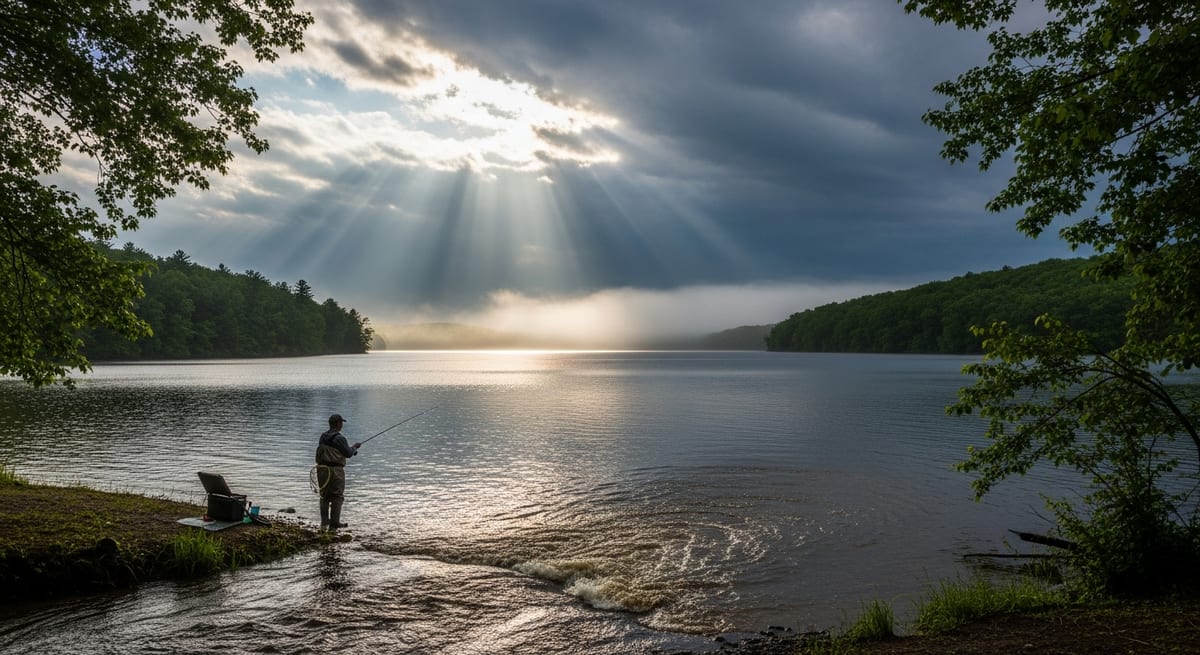
CT bass anglers fishing Bantam Lake's western creek mouths after a half-inch rain in May and June report stacked largemouth within 20 yards of the inflow, a pattern that holds across Connecticut impoundments wherever runoff drains into warm, shallow water. What anglers who first fish through storms rather than around them notice is how sharply the productive windows split. The 2 to 4 hours before the rain arrives, when the barometer is dropping steadily, consistently produces aggressive surface bites that calm-weather mornings rarely deliver. Then a second window opens 12 to 24 hours after the rain, at the creek mouths. The period in between, during heavy sustained rain, is often the slowest fishing of the week. CT impoundment and tailwater communities report this three-phase pattern reliably, and knowing where each window falls is the difference between a memorable session and a soaked afternoon with nothing to show.
The Barometric Drop Window: 2 to 4 Hours Before the Rain Hits
CT impoundment anglers who track the pressure clock consistently report a feeding window tied to the falling barometer, not the rain itself. As a front moves in and pressure drops, largemouth and smallmouth bass become noticeably more active. Candlewood regulars note that topwater presentations that would not draw a strike during a stable high-pressure morning produce committed blow-ups during this window. The biology is well-documented in freshwater research: falling pressure signals fish to feed opportunistically before conditions shift. Communities fishing Bantam, Moodus, and Lillinonah all describe the same behavior: aggressive, open-water fish that move away from structure and cover more ground than they do on stable days. Fishing this window on a cloudy, still morning before a front arrives, rather than waiting for skies to clear afterward, is one of the more consistent adjustments CT bass anglers report making. If a significant rain is forecast for midday or afternoon, anglers familiar with this pattern are already on the water by dawn.
What CT Anglers Actually Fish During Light Rain (and What They Skip)
Light rain on the surface reduces fish wariness. The surface disturbance masks angler presence and reduces line visibility from below, and CT impoundment anglers report that bass that were finicky during a calm, bright morning become more willing to commit during a light steady rain. Spinnerbaits, shallow-running crankbaits, and topwater lures tend to produce better during light rain than during glass-calm conditions on many CT lakes. Heavy and sustained rain is a different situation. River communities on the Housatonic and Salmon River note that heavy rain disturbs the streambed, suspends silt, and makes drift-fishing difficult. During hard rain, trout hold tight in deep pools and feeding activity through riffle sections slows significantly. For impoundment anglers, heavy rain means rapidly shifting water temperatures and a sustained barometric shift that suppresses feeding. Many CT anglers fish the pre-storm window hard, then wait out heavy rain from the truck before returning for the post-rain creek-mouth bite.
Post-Rain Creek Mouths: Where Candlewood and Bantam Bass Stack
After a substantial rain (anglers generally use 0.5 inches or more in 24 hours as the threshold), freshwater inflow creeks dump warm, sediment-laden water into impoundments. This creates a predictable concentration point. Find the creek mouths: Candlewood Lake has multiple inflow creeks along its western arm; Bantam Lake's two primary inflows are well-known to local shore and boat anglers. After significant rain, bass stack within 20 to 30 yards of where dirty water meets cleaner lake water, intercepting worms, insects, and crayfish washed in with the flow. CT anglers describe the stacking as tighter than most expect: the fish are clustered at the transition zone itself, not spread across a cove. Bright colors and vibration: In turbid water near runoff, CT impoundment anglers report that chartreuse, orange, and white outperform natural colors. Spinnerbaits and lipless crankbaits with rattles are the most-cited choices. The vibration allows fish to locate lures in off-color water where a purely visual presentation struggles.
Farmington and Salmon River: What CT Trout Communities Report in High-Water Conditions
Rain's effect on CT trout streams depends heavily on intensity and whether the stream is tailwater or freestone. On the Farmington River below Hogback Dam, which has regulated flows year-round, tailwater communities report that light rain often improves fishing by washing terrestrial insects into the water. Ant and beetle patterns on a fly rod produce well during and immediately after light rain, a pattern Farmington regulars note consistently through late spring and summer. As flows rise with moderate rain, fish shift from riffle feeding to holding deeper in pools and along current seams. Nymphs and wet flies fished near the bottom become the more productive choice as clarity drops. Anglers fishing the Farmington's no-kill and special-regulation stretches should verify current boundaries against the CT DEEP Inland Fishing Guide (the 2024 to 2025 edition covers current designations) before each trip. On freestone streams like the Salmon River, heavy rain raises safety concerns quickly. The river can rise and become dangerous in under an hour after significant upstream rain. CT anglers fishing the Salmon River after storms commonly reference the real-time Colchester gauge (USGS 01193500) to assess conditions before committing to a wade session.
When Muddy Water Lasts: Tailwaters vs. Impoundments After a Major Storm
Not every post-rain window is productive. CT lakes in watersheds with significant agricultural land or active construction, including some Litchfield County impoundments and portions of the Moodus Reservoir watershed, can stay turbid for 3 to 5 days after a major storm. CT impoundment anglers describe targeting cleaner water in these conditions: the main basin away from inflow points, north-facing coves that are not receiving direct runoff, or deeper water where silt settles faster. For river anglers, the Farmington tailwater below Hogback Dam often holds better post-storm conditions than nearby freestone streams because regulated flow keeps the water clearer during high-runoff events. Tailwater sections below managed dams are among the most-cited high-water alternatives among CT trout communities. The contrast between a blown-out freestone stream and a clear Farmington tailwater on the same afternoon is often dramatic enough that anglers who know the option plan specifically for it when a major storm is in the forecast.
EVERY SATURDAY MORNING
Weekly fishing intelligence
Nationwide conditions, what's biting, and honest gear deals. One email, no noise.
No spam. Unsubscribe anytime.