
Rainy Days on the Farmington and Housatonic Produce. Most Anglers Never Find Out.
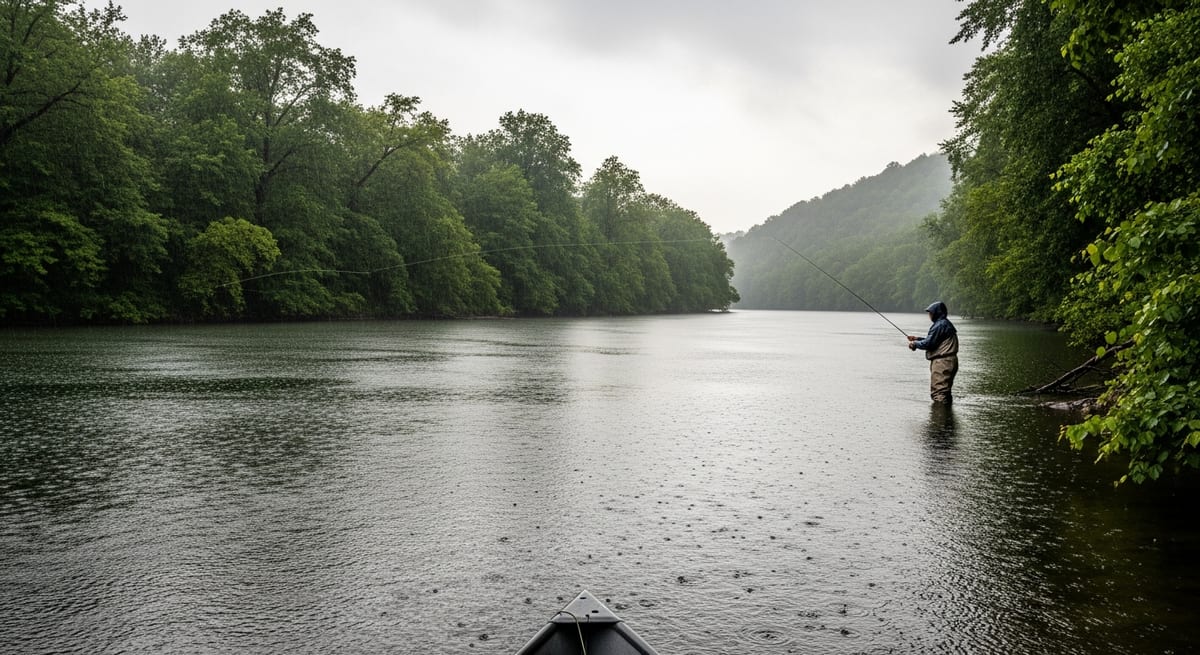
Anglers who fish the regulated catch-and-release water on the Farmington River below Collinsville consistently describe June rain events as some of the most reliable dry-fly windows of the season, wild browns working beetle and ant patterns through the afternoon on days when most of the parking lot has already cleared out. The pattern holds across CT waters. Bass anglers on Candlewood Lake report that a late-summer rain system will pull largemouth off mid-lake structure and onto shallow coves faster than almost any other trigger. Smallmouth regulars on the Housatonic describe wet, overcast days as their most productive bank-fishing sessions of the season. Understanding why rain changes the bite, and knowing the regulation overlaps that catch unprepared anglers, is what separates those who capitalize on wet weather from those waiting for a better forecast.
The Pressure Drop Starts the Bite. Rain Is Just the Signal.
The mechanism CT anglers most consistently point to isn't the rain itself. It's the falling barometric pressure that precedes a system.
Fish respond to dropping pressure with increased activity. The consensus among CT bass anglers is that the best bite of a rainy day often happens in the hours before the first drops arrive, pressure falling, sky building, parking lot still full. Anglers who run the lower Connecticut River corridor near Middletown describe this window as one of the more reliable late-spring patterns they track.
Once rain arrives, additional factors compound the effect. Cloud cover extends the low-light feeding window fish normally have only at dawn and dusk throughout the day, particularly relevant for line-shy species in clear water. Rainfall aerates the surface, temporarily boosting dissolved oxygen near the top of the water column. On warmer, stratified lakes like Candlewood and Bantam where oxygen levels can stress fish toward depth in late summer, anglers report that rain events often shift fish noticeably shallower within a few hours.
Rain also washes terrestrial food, worms, beetles, grubs, off banks and into the water. Trout in stream current seams respond to this the way they respond to a hatch. Rain on the water surface creates ambient noise that masks boat and wading sounds in ways calm conditions don't. A meaningful edge when fishing pressured water.
Farmington Trout, Housatonic Smallmouth, Candlewood Bass: CT Species in the Rain
Farmington River (Collinsville to Riverton): Light to moderate rain is widely regarded among Farmington regulars as the best terrestrial fishing window of the season. Wild browns will take beetle and ant patterns on the surface throughout the day during steady June and July rain, behavior that largely disappears on bright, calm days. Heavy rain that turns the water brown typically ends the surface bite. The window most regulars target is steady light rain with no significant runoff from upstream.
Housatonic River: Smallmouth on the Housatonic respond well to overcast, rainy conditions throughout the season, moving onto the shallow rocky structure they abandon under direct sun. Crayfish-pattern crankbaits and tubes worked along boulder fields and shale shelves produce consistently on wet days. Note: the Housatonic carries an active fish consumption advisory, check CT DEEP's current guidance at ct.gov/deep before keeping any fish.
Candlewood Lake: Largemouth on CT's largest lake move onto flats and into coves during rain events. Anglers fishing the lake's north-end coves and shoreline pockets report that topwater, poppers, walking baits, produces during warm-season rain in ways it rarely does on bright days. Downed timber and dock pilings are the highest-percentage targets.
Bantam Lake and Gardner Lake: Bass and panfish on CT's interior lakes respond similarly, moving shallower and feeding through longer windows under cloud and rain. Bluegill and crappie near shoreline structure with small jigs or live bait consistently outperform what those same spots produce on sunny days.
Walleye: Present in select CT impoundments, walleye tend to feed more actively under cloud and rain. The extended low-light window generally works in their favor. Those who pursue walleye in CT note that overcast, rainy days often extend the morning bite into midday in ways a bright day won't.
Catfish: Channel catfish in the Connecticut and Thames rivers and their major tributaries feed actively when rain increases flow and washes organic material off stream banks. Cut bait and prepared baits fished near current edges and channel drop-offs are productive during and after rain events.
What to Carry: Gear Built for CT Wet-Weather Fishing
Rain jacket: Most anglers who fish regularly through wet weather settle on jackets rated at 10,000mm waterproofing or higher. The threshold where sustained rain typically stops soaking through in the field. Breathability matters as much as the waterproof rating: a non-breathable shell soaks you from the inside during any physical wading or paddling. Third-party gear reviews (OutdoorGearLab and similar sources) consistently rate Frogg Toggs as the value option; Simms and Grundéns rate higher for durability in heavier-use conditions.
Spring layering: Wet at 50°F in April is a different problem than wet at 72°F in July. For early-season CT rain, a moisture-wicking base and insulating mid-layer fleece under your shell maintains warmth through a long session on the water. Avoid cotton in cold rain. It loses insulating value when soaked and stays cold.
Lure selection: Bright and noisy is the standard move in cloud and rain. Chartreuse, white, and orange tend to outperform natural colors in reduced-light conditions. Bladed jigs, chatterbaits, and rattling crankbaits are productive when fish are actively covering water. Topwater, poppers and walking baits, can be exceptional during warm-season rain events, particularly on Candlewood, Bantam, and the wider pools on the Housatonic.
Lightning: NWS recommends seeking shelter when the interval between lightning and thunder is 30 seconds or less, and waiting a minimum of 30 minutes after the last thunder before returning to open water. A graphite fishing rod conducts electricity efficiently. Don't time this one close.
Regulation Windows That Overlap With CT's Best Rain Fishing
Rain fishing in CT has a regulatory dimension that catches unprepared anglers, particularly in spring, when some of the most productive rain windows fall during early-season rule periods.
Trout season: The general statewide trout season typically opens in April in CT, with specific dates and rules published annually in the CT Fishing Guide at ct.gov/deep. Certain regulated sections, including portions of the Farmington River, carry catch-and-release-only periods or special gear restrictions that run through different dates than the general season. Anglers fishing these stretches in early spring should confirm current rules before heading out.
Brook trout: Select CT streams carry specific brook trout regulations with closures that don't align with the general trout season. If a rain system pushes fish into a productive tributary that has a closed window for brook trout, you need to know before you get there. CT DEEP publishes brook trout-specific regulations at ct.gov/deep.
River levels: Real-time flow data for CT rivers is available through the USGS CT Water Science Center at waterdata.usgs.gov/ct. Checking flows before a rain-day outing tells you both whether conditions are fishable and whether wading safety is a concern, two separate questions worth answering before you leave the house.
When CT Rain Events Shut the Bite Down
Not every rain event improves fishing. Several conditions reliably work against it.
Heavy runoff killing visibility: Once water clarity drops significantly. The Housatonic and Connecticut River will run visibly brown after heavy rain on saturated ground. Most conventional presentations become ineffective. Bass with loud, vibrating lures and catfish on cut bait near current edges can still produce by lateral line sense; trout and panfish fishing typically does not.
Cold frontal rain in early spring: A cold front that drops water temperatures sharply can put fish into lockdown, particularly relevant in April and early May on CT streams when water temps are already on the low end of the active feeding range. Watch temperature trends more than rainfall totals. A sustained temperature drop tends to suppress feeding more than the storm itself.
Post-flood conditions in rivers: Extended high water after heavy rain makes CT rivers unsafe to wade and scatters fish into floodplain areas that aren't accessible. The USGS CT gauge network is the practical tool for tracking when flows are returning toward fishable levels.
Anglers who fish CT systems through rain events regularly describe the productive window as the build-up to a system, the steady moderate rain while pressure is still falling, and the first few hours of clearing. Once high pressure fully rebuilds and skies go blue, the window tends to close, which is often right around the time most anglers are finally heading back to the water.
EVERY SATURDAY MORNING
Weekly fishing intelligence
Nationwide conditions, what's biting, and honest gear deals. One email, no noise.
No spam. Unsubscribe anytime.