
Fishing Electronics Buyer's Guide: Fish Finders, GPS, and Marine Electronics
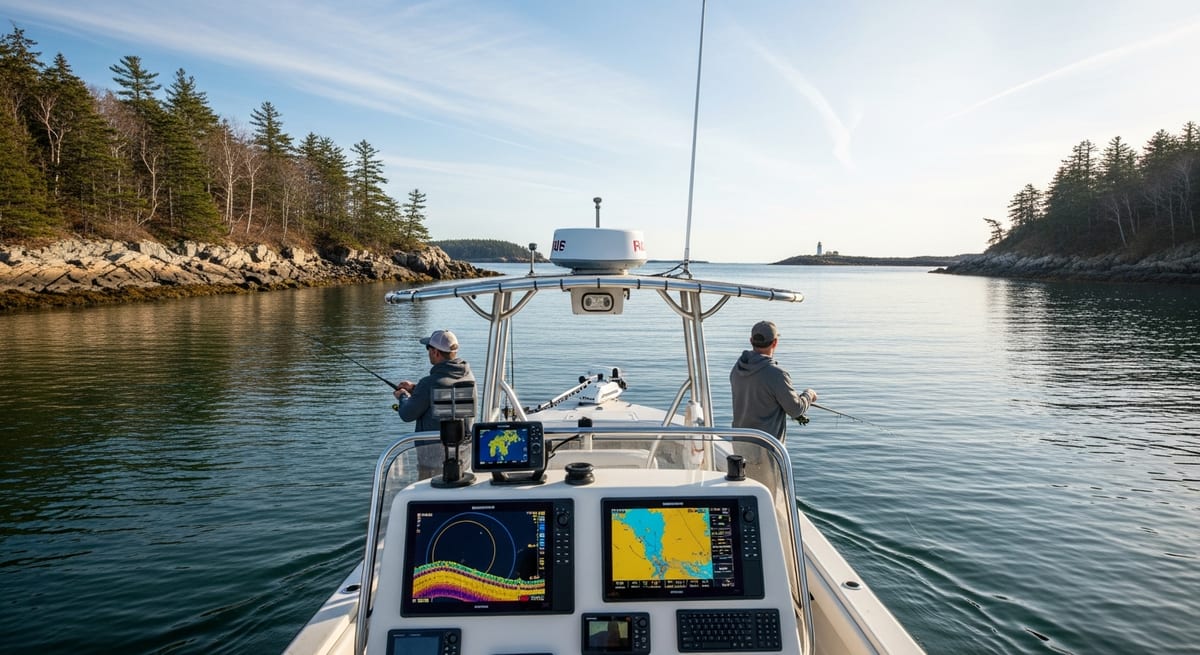
Marine electronics have transformed fishing in the past decade. The ability to see fish, understand bottom structure, and mark productive waypoints has moved from luxury to expectation for serious anglers. Here's a clear-eyed guide to what the technology actually does, what matters, and what's marketing.
Fish Finders: How Sonar Works
A fish finder sends a sonar pulse downward from a transducer mounted on the hull. The pulse bounces off objects (bottom, fish, structure) and returns to the transducer, which measures how long the echo took to return and converts this to depth. What you see on screen: a scrolling picture of what's below the boat. The bottom appears as a solid line (varying thickness and color indicates hardness). Fish appear as arches (classic) or marks depending on the display mode and transducer movement. CHIRP sonar (vs. traditional single-frequency): CHIRP sends a range of frequencies rather than a single frequency, producing sharper, more detailed images with better target separation. CHIRP is standard on any quality unit above entry-level. Down Imaging and Side Imaging: advanced transducer configurations that display detailed picture-quality images of bottom structure and fish directly below (Down Imaging) or to the sides (Side Imaging) of the boat. Extremely useful for finding structure.
GPS and Chartplotting
Modern fish finders almost universally include GPS. The GPS component allows you to mark waypoints (exact coordinates of productive spots), display the lake/ocean chart as a map, and show your movement track. What this means practically: you can mark the exact boulder pile where you caught bass, return to it next week within 20 feet, and start fishing immediately without searching. You can overlay your track on the lake chart and see which sections you've covered. Charts: Navionics and Lakemaster are the two primary chart providers for freshwater. Navionics has broader coverage including detailed saltwater charts. Lakemaster has extremely detailed freshwater lake contour maps for most CT lakes. Charts are typically purchased as an SD card or subscription and loaded into your fish finder unit.
What to Look For: Key Specifications
Screen size: larger is better for usability. 5-inch is the minimum for comfortable use; 7-inch is the recommended starting point for a boat installation. Brightness: rated in NITS. Minimum 1000 NITS for outdoor use in direct sunlight; 1500+ is better. A dim screen is unusable in bright daylight. CHIRP sonar: look for this specifically. Non-CHIRP units are outdated at any price. Transducer: the transducer is as important as the unit. A good unit with a cheap transducer underperforms. Match the transducer to the application (lake fishing vs. deep ocean trolling requires different configurations). Networking: higher-end units share data (GPS, sonar) between multiple devices. Useful on larger boats with a dedicated chartplotter at the helm and a sonar unit at the bow. Waterproofing: all marine electronics should be IPX7 or better. Screen surfaces need UV resistance to prevent clouding.
Recommended Units at Each Level
Budget ($100-$200): Garmin Striker 4 (3.5-inch, CHIRP, GPS). The best entry point. Adequate for CT kayak and small boat use. Mid-range ($200-$500): Humminbird Helix 5 G3 or Helix 7 G3N. The standard recommendation for CT lake fishing. The Helix 7 G3N (7-inch, CHIRP, GPS, SI/DI) with a Lakemaster chip covers everything a CT bass or trout angler needs. Mid-range saltwater ($300-$600): Garmin ECHOMAP UHD 73sv (7-inch, CHIRP, GT56UHD transducer), excellent for CT Sound fishing. Detailed saltwater charts included with Navionics subscription. Premium ($600+): Humminbird HELIX 10 series, Lowrance HDS Live series, Garmin GPSMAP 923xsv. Overkill for day trips on CT lakes; appropriate for dedicated boat anglers who fish regularly.
Reading the Screen: What to Look For
Bottom hardness: a thick, bright bottom return indicates hard bottom (rock, gravel). A thin, less bright return indicates soft bottom (mud, sand). Bass hold on hard structure; catfish prefer soft bottom. Fish arches: a classic fish arch appears when a fish swims through the sonar cone as the boat moves. The arch width indicates time in the cone (depth + fish speed). A wide arch = slow-moving fish or a large, slowly passing fish. Temperature display: many transducers include a temperature sensor. This is genuinely useful, find where 65-68°F water is in a thermally stratified lake in summer and you'll find trout. Suspended fish: fish appearing off the bottom at a specific depth indicate suspended bait schools or schooling predators. Target that depth range. Structure identification: ledges, humps, creek channel edges, bridge pilings, all appear distinctly on a quality sonar unit with good chart overlay.
Installation and Maintenance
Transducer mounting: on most small boats, a transom mount (bracket on the stern) works well. Through-hull mounts provide better performance at speed but require drilling. In-hull mounts work through fiberglass hulls (not aluminum) and avoid drilling but lose some signal quality. Cable runs: plan cable routes before drilling any holes. Marine-grade cable routing clips and wire loom protect cables from chafing and UV degradation. Power: most fish finders run directly from the boat's 12V electrical system. Connecting to the main battery and fusing with the correct amperage fuse is the standard approach. Maintenance: clean the screen with appropriate screen cleaner (not ammonia-based products). Inspect transducer face for barnacles/fouling on saltwater boats. Update firmware annually through the manufacturer's software.
EVERY SATURDAY MORNING
Weekly fishing intelligence
Nationwide conditions, what's biting, and honest gear deals. One email, no noise.
No spam. Unsubscribe anytime.