
CT Perch Ice Anglers at Candlewood and Bantam Report 20-Fish Sessions When the School Is Found, what CT DEEP Freshwater Surveys and Seasonal Triggers Reveal About Yellow Perch in Connecticut Lakes
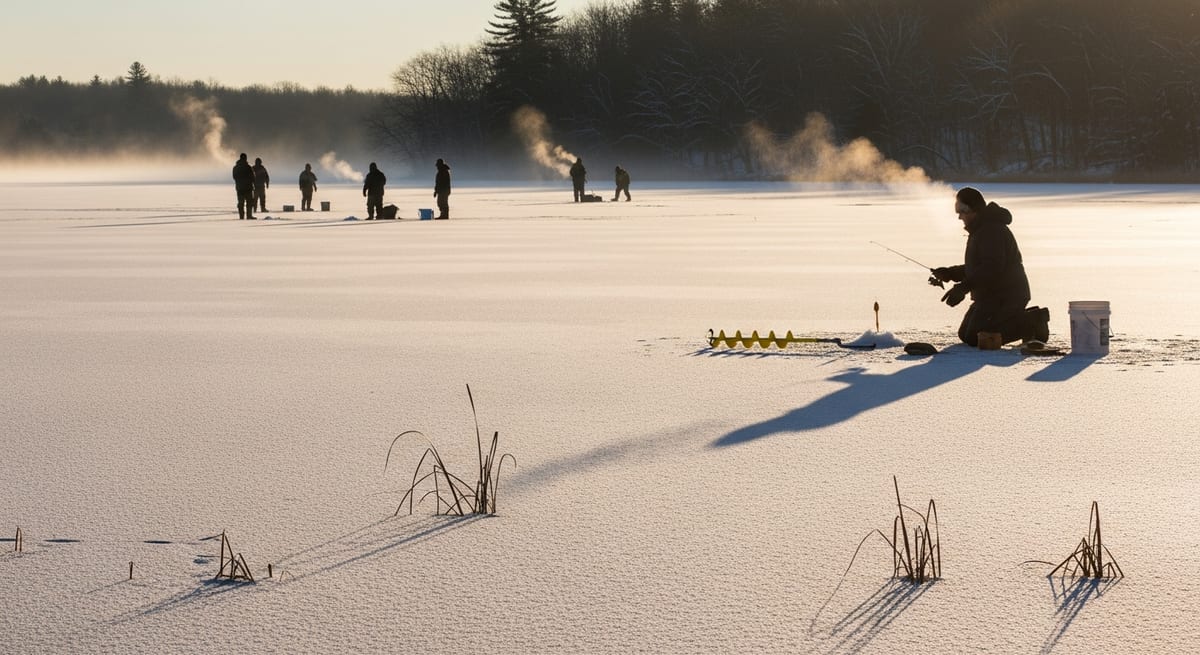
CT DEEP freshwater survey data documents yellow perch in hundreds of the state's natural lakes and ponds, yet most open-water anglers pass them over in pursuit of bass and trout. The picture changes in winter. Among ice fishermen who work Candlewood Lake, Bantam Lake in Litchfield, and Beseck Lake in Middlefield, perch are the primary seasonal target. Anglers who locate a tight school in 8-15 feet report hitting the current CT DEEP daily limit of 15 fish in sessions that can run under two hours. The species also produces a genuine pre-spawn window in early spring, a findable open-water run in summer over deeper structure, and a fall feeding stretch that reliably falls between Labor Day and Thanksgiving. CT kayak anglers who track the perch calendar across multiple lakes describe it as the most consistent freshwater bite the state offers, not the most dramatic, but the most repeatable.
The CT Lakes Where DEEP Survey Data Confirms Perch Density
CT DEEP freshwater survey reports, available through the agency's public portal at portal.ct.gov/DEEP, confirm yellow perch populations in scores of the state's lakes. Survey catch-per-effort data and angler reports from regional fishing groups point to a consistent set of waters with the most reliable concentrations.
Candlewood Lake in the New Fairfield/Sherman area holds some of the state's densest perch populations, particularly in coves off the Route 37 access point in Sherman and the New Milford town launch. Bantam Lake in Litchfield, connecticut's largest natural lake, produces perch throughout the season; the public ramp off Bantam Road gives boat anglers reach over the lake's deeper central basin where schools hold at 10-18 feet. Beseck Lake in Middlefield and Crystal Lake in Ellington appear frequently in CT DEEP creel census data with above-average perch catch rates relative to lake acreage.
Quaddick Reservoir in Thompson and Coventry Lake draw less pressure than Candlewood while still producing solid perch populations. Community reports from northeast CT fishing groups describe Quaddick as especially productive during ice season. Rogers Lake in Lyme and Black Pond in Meriden round out a list of southern CT waters where perch show reliably in public reports.
Lakes that combine submerged vegetation, rocky shoreline transitions, and basin depths in the 10-25 foot range tend to hold perch year-round. A profile that matches a large share of Connecticut's natural glacial lakes.
Pre-Spawn Shallows and Winter Ice Schools: The CT Perch Seasonal Calendar
Spring (March-May): CT kayak anglers and shore fishermen who track perch through ice-out report the largest fish of the year moving into 2-8 feet of water over sand and gravel as water temperatures climb through the low 50s°F. Pre-spawn perch in April often concentrate near tributary inflows and shallow sand flats adjacent to deeper water. The window for the largest spring perch. Fish in the 10-12 inch range that regulars at Bantam and Candlewood describe as genuine trophies by CT standards, tends to run three to four weeks before the spawn disperses the schools.
Summer: Once surface temperatures push into the 70s, perch retreat to 10-20 feet and hold over submerged weed edges and rock structure. Community reports from Candlewood and Coventry Lake regulars consistently note that midday summer fishing slows. Early morning and evening over structure edges produce more reliably, and locating the school requires working depth changes methodically rather than covering water.
Fall (September-November): A second productive period opens as water temperatures drop back through the 60s and 50s. Perch in fall feed more actively throughout the day compared to summer. Anglers who fish Beseck Lake and Rogers Lake in October report that fall schools often hold near the same structure where spring fish were found. A reliable starting point when revisiting a known lake.
Winter ice fishing: Yellow perch are the primary target species for CT ice fishermen statewide. CT DEEP regulations apply the same 15-fish daily bag limit year-round with no minimum size requirement. There is no separate ice fishing season rule for perch. Anglers drilling into 8-15 feet over weed edge structure on Candlewood, Bantam, and Beseck report that once a school is confirmed on sonar, the bite can be immediate and sustained for 45 minutes to an hour before the fish move.
What CT Ice Regulars Do Differently: The School-Finding Problem and Presentation That Works
The most common difficulty for anglers new to CT perch ice fishing is location, not presentation. Perch school tightly and those schools move. Ice regulars at Candlewood and Bantam describe drilling eight to twelve holes on a new section of lake before committing, working depth contours from 8 to 18 feet and moving every 15 minutes until a school is confirmed on sonar. A flasher-style unit (Vexilar FL-8 and Marcum M1 come up most often in CT ice fishing forum discussions) compresses the search considerably compared to jigging blind.
The standard CT ice perch setup: a 1/32 to 1/16 oz tungsten ice jig, vMC Tungsten Tear Drop and HT Pimple series are cited most consistently in community gear threads, tipped with two to three wax worms or spikes. Tungsten outperforms lead at 12-15 feet because it sinks faster and transmits more vibration to the rod tip on a light-action ice rod. Chartreuse and orange are the default starting colors; natural white or silver tends to work better on clear lakes like Crystal Lake in Ellington.
For open-water jigging, a 1/16 oz jig head tipped with a 1.5-2 inch curly tail or paddle-tail soft plastic (Zoom Tiny Fluke, Kalin's Grub) covers most situations. The retrieve stays subtle, small hops and slow lifts, not aggressive sweeps. When live bait is in play, a small piece of worm on a size 6 or 8 Aberdeen hook under a small bobber, set to keep the bait 1-2 feet off bottom near structure edges, produces perch consistently regardless of conditions.
CT Perch Gear: Ice Rods, Flasher Sonar, and Open-Water Light Tackle
For ice fishing, a 24-28 inch medium-light ice rod paired with a small inline reel or fly reel loaded with 4-6 lb monofilament is the standard CT perch setup. HT Polar Fire and St. Croix Mojo Ice rods in the $40-80 range appear most often when CT ice anglers discuss perch rigs in regional groups and forums. Clam Pro Tackle options in the same range are a widely cited alternative.
Flasher sonar is close to universal among serious CT perch ice anglers. A Vexilar FL-8 or Marcum M1 lets anglers confirm school depth, track jig presentation in real time, and distinguish perch from bluegill or bass sharing the same structure. The tool pays back on any lake where perch school depth varies across the basin.
For open-water: a 6-7 foot ultra-light spinning rod with 4-6 lb monofilament, or 6 lb braid with a 4 lb fluorocarbon leader, is the standard setup. Heavier gear reduces sensitivity and makes it harder to detect perch's often subtle take. Carry jig heads from 1/64 oz to 1/8 oz, perch can be size- and color-selective within a single session.
For live bait: size 6-8 Aberdeen light-wire hooks paired with a small slip float or fixed bobber. Light wire allows easier removal and less harm when releasing smaller fish, which CT DEEP's no-minimum-size regulation permits freely within the 15-fish daily limit.
Table Fare: Cleaning and Cooking a CT Perch Limit
Yellow perch are consistently cited in CT freshwater angling circles as among the finest-eating species in the state's lakes. The flesh is white, mild, and firm. A texture that longtime CT lake anglers compare to walleye. CT DEEP does not currently list yellow perch under general consumption advisory restrictions for most lakes, though anglers targeting Candlewood Lake should verify against the most recent CT DEEP freshwater fish consumption advisory at portal.ct.gov/DEEP/Fishing/Health-Advisories, given that lake's existing advisories for some species.
Typical CT yellow perch run 6-10 inches; fish over 11 inches represent the upper end of what most DEEP lake surveys show. A limit of 15 fish at 8-10 inches yields enough fillets for two to four people. CT ice anglers who keep limits regularly tend to use a sharp 6-7 inch fillet knife or an electric fillet knife to process fish efficiently after the session.
The most common preparation described by CT lake regulars: pan-fried in butter with lemon, or deep-fried in light cornmeal or panko breading. Cleaning is straightforward, two cuts along the spine, skin the fillet, check for pin bones near the shoulder. An electric fillet knife speeds up the process when working through a full 15-fish limit from a productive ice session.
EVERY SATURDAY MORNING
Weekly fishing intelligence
Nationwide conditions, what's biting, and honest gear deals. One email, no noise.
No spam. Unsubscribe anytime.