
CT Yellow Perch Peak in March, before Bass Opener, Before the Crowds. What Candlewood's Ice Fishing Community Has Been Quietly Working for Years.
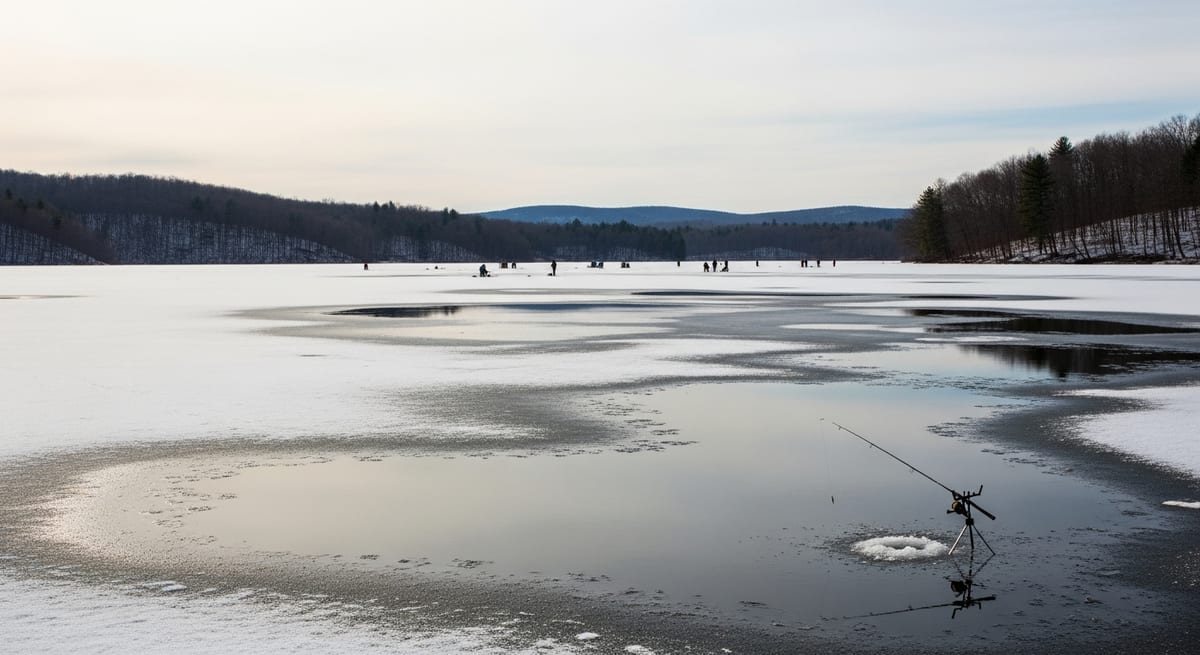
In late February and early March, while most CT freshwater anglers are still weeks away from bass opener and scanning trout stocking reports, yellow perch schools on Candlewood Lake are already stacking in 6 to 10 feet of water along the first structural transitions off retreating ice. The fish are pre-spawn and at peak weight, and according to CT ice anglers who fish the late-winter transition, biting hard enough to produce limits in a few hours before the ice softens underfoot. Yellow perch run a distinct seasonal calendar in Connecticut: ice-active through January and February, pre-spawn aggressive through March and April, accessible from shore through May, then deep and vertical through midsummer, then back to the shallows in September and October. Most freshwater anglers in the state work one or two of those windows at most, and almost never the most productive one.
The March Window, why CT Perch Peak Before Bass Opener
Yellow perch spawn when water temperatures reach the mid-40s to low 50s°F. A window that in Connecticut falls between late March and mid-May depending on elevation and ice-out timing. Pre-spawn fish are at peak weight and concentrated in tight schools that don't form again at the same density until fall.
Anglers who regularly fish CT lakes in March and April consistently report the strongest perch action of the open-water year during this window, often from shore at dawn in 5 to 10 feet of water near vegetation edges and submerged structure. The fish haven't yet scattered post-spawn, and a school can hold in a tight staging area for several days at a time.
The spawn is visible in the shallows on clear-water lakes: long ribbon-like egg strands draped over submerged branches, weed stalks, and rubble. Once those strands appear, post-spawn fish begin to disperse, but feeding continues through May as perch rebuild weight, and the spring shallow bite often remains productive well into the month.
On tidal rivers: The Quinnipiac River and the lower Salmon River see their own spring perch push in April. Anglers working these systems in early spring targeting river bass frequently encounter perch schools in the same slow-water coves and eddy seams. The Quinnipiac push is noted among New Haven County freshwater regulars as an underused early-season option that produces consistent fish during the calendar gap before bass activity picks up.
Where CT Perch Concentrate: Six Waters Worth Knowing
DEEP fish community surveys document yellow perch among the most broadly distributed species in Connecticut's inland waters, present in nearly every lake and reservoir in the state, but density and average size vary considerably. Clear-water impoundments with structural depth transitions consistently hold the strongest populations.
Candlewood Lake (New Milford/Danbury/Sherman): CT's ice fishing community has pointed to Candlewood as the state's benchmark perch water for decades. Anglers who fish the lake through winter and the pre-spawn window report consistent size across seasons. Local fishing boards and Northeast region forums cite fish in the 9 to 11-inch range as typical for open-water anglers targeting structure, with larger specimens reported along the main-lake rocky drop-offs in fall. The rocky points in the northern basin and submerged structure along the western shore are mentioned repeatedly by both ice and open-water regulars. The Candlewood perch population has held up through sustained fishing pressure, a pattern consistent with DEEP electrofishing assessments of large-impoundment panfish populations statewide.
Lake Lillinonah (Southbury/Newtown): A Housatonic River impoundment with shore access at multiple points along the perimeter. Perch are reported throughout the mid-depth basin in summer, and the spring shallow bite near weedy coves draws consistent accounts from anglers who work the lake in April and May. Schools on Lillinonah respond well to vertical jigging from anchored boats or kayaks in the 15 to 22-foot basin area.
Saugatuck Reservoir (Easton/Redding): Managed by Aquarion Water Company, which issues free fishing permits, available through Aquarion's website or customer service line. Limited pressure and clear water result in above-average fish, according to reports from anglers who regularly pull permits. Both perch and largemouth bass appear frequently in trip reports from this water, and the controlled-access character tends to produce fish less pressured than nearby public impoundments.
Bantam Lake (Morris): Connecticut's largest natural lake holds a mixed gamefish population including perch, walleye, and largemouth bass. The northwest shallows near emergent vegetation and the rocky eastern shoreline both produce perch, shallower staging in spring and fall, deeper basin in midsummer. Bantam is a Litchfield County ice destination, and perch fishing is reported alongside the lake's well-known tip-up walleye fishery through January and February.
Northern CT lakes (Windham, Tolland, Litchfield Counties): Anglers who fish the upper half of the state consistently report that any lake with clear water and sustained depth of 15-plus feet holds a viable perch population. DEEP WMA ponds, town-owned public access lakes, and state forest waters all produce fish. The density varies, but the geographic distribution is wider than most CT freshwater anglers realize.
Tidal rivers: The Quinnipiac and lower Connecticut River hold spring perch runs that overlap with the river bass season. Access is public at multiple points, and early-spring perch on tidal water provides consistent action during the calendar gap before bass and stripers fully activate.
The Summer Deep-Water Shift: Finding Perch at 18 Feet
Once water temperatures climb through the low 70s°F in late June and July, yellow perch in Connecticut's lakes relocate to cooler, deeper layers, typically 15 to 30 feet, depending on the lake's thermocline. This mid-summer pattern frustrates shore anglers who had consistent spring action in 6 to 8 feet; the fish haven't left, they've shifted depth and require a different approach entirely.
Anglers who fish CT impoundments through summer and have adjusted to vertical jigging from anchored boats consistently report finding perch schools in the 18 to 24-foot range on Candlewood and Lillinonah through July and August. Boat or dock access to deeper structure is essentially required during this period.
A consistent observation from summer perch anglers: the schools stack at the depth transition, not in the deepest open water. Finding the 15 to 20-foot edge where the bottom drops from the shallower flat outproduces dropping into open 30-foot basin. Evening activity picks up as surface temperatures ease, and the morning bite on clear-sky days tends to be more compressed in time than it is in spring.
Fall reverses the pattern. By late September and into October, perch return to 8 to 15 feet along the same structural edges that held fish in spring. Anglers targeting fish for the table frequently report the largest perch of the year in this fall feeding period, as fish build weight before winter.
The Candlewood Ice Fishing Tradition, and What Regulars Actually Use
Ice fishing for yellow perch is among the most consistent winter traditions in Connecticut, and Candlewood Lake sits at the center of it. Unlike many species that go semi-dormant under ice, yellow perch remain active in cold water, school reliably along mid-depth structure, and respond to small presentations throughout the season.
CT ice fishing regulars who fish Candlewood have refined a standard approach over many seasons: drill multiple holes along a depth contour, typically 15 to 22 feet. Fish each hole for a few minutes, and move until contact is made. Perch schools under ice can be tight and highly localized; finding the school requires mobility more than any specific pinned location.
What Candlewood regulars use:
- Tungsten jigs in the 1/32 to 1/16 oz range tipped with a wax worm, single spike, or small minnow piece, down-sized presentations consistently outperform heavier hardware in cold, clear water
- Live 2 to 3-inch shiners under tip-ups set at varying depths to locate the school before committing to a jigging depth
- 2 to 4 lb ice-rated monofilament or fluorocarbon, perch under ice on clear-water lakes like Candlewood can be line-shy in ways the same fish are not during the open-water season
Bantam and northern CT lakes also see consistent ice pressure for perch through January and February. Ice-out on smaller Litchfield County lakes typically runs earlier than Candlewood, and the post-ice-out spring bite on these waters can be strong during the window before most CT anglers shift attention to trout opener.
Presentations by Season and Depth
Yellow perch presentations divide by the depth the fish are holding. The hardware doesn't change dramatically across seasons, what changes is depth control and delivery method.
Spring and Fall (4-12 feet): Light spinning tackle covers the bulk of the CT perch season. An ultralight or light-action rod in the 5'6 to 6'6 range, 1000 to 2000-size reel, 4 to 6 lb monofilament or fluorocarbon. Small tube jigs and curly-tail grubs (1/16 to 1/8 oz) in white, yellow, chartreuse, or orange tipped with a half-nightcrawler take fish consistently. A small minnow or worm piece under a bobber at 5 to 8 feet near vegetation edges produces steadily from shore during the spring shallow window.
Live minnows: 2 to 3-inch shiners or fatheads, lightly hooked, fished a foot off the bottom, draw larger perch more reliably than worm alone. Anglers who specifically target fish for the table cite a small live minnow as the higher-percentage presentation for 9-plus-inch perch across most CT waters.
Summer (15-30 feet): A drop shot with a 2-inch finesse worm or grub 12 to 18 inches above the weight is the standard summer approach described by CT anglers who pursue perch through the warmwater period. The rig holds bait precisely at the school's depth and allows a near-motionless presentation that summer perch respond to more readily than dragged horizontal lures. Combined with sonar to confirm school location and depth, the drop shot consistently outperforms other methods in this depth range.
Fly fishing in spring: Anglers working shallow spring coves on CT lakes report consistent perch catches on small Woolly Bugger patterns, beadhead nymphs, and soft-hackle wet flies on 3 to 4-weight rods. CT fly fishing communities note yellow perch as a productive species during the calendar gap between trout season and bass activity. The spring shallow habitat overlaps precisely with what a light fly rod is built to fish.
Table Fare and CT DEEP Regulations
Yellow perch are consistently cited among the best-eating panfish in Connecticut, mild, white, and flaky, with a flavor frequently compared to walleye by anglers who fish both. CT ice anglers who pursue walleye on Bantam and Lillinonah often keep perch alongside them when size allows; the table quality holds up well to the comparison.
Fillet size: Anglers who clean perch regularly note that fish under 8 inches produce fragmented, thin fillets not worth the effort. The consensus among CT perch anglers targeting table fish is 9 inches and up. Saugatuck, Candlewood, and Lillinonah all produce fish in this range with regularity for anglers fishing structure.
Preparation: Pan-fried in butter with a light seasoned flour coating is the most cited preparation among CT perch anglers. The mild flavor adapts well to fish tacos, chowder, and simple baked preparations. The fillets hold up better than more delicate panfish.
CT DEEP regulations (verify before fishing): As of the most recent DEEP Inland Fisheries Guide, yellow perch carry no minimum size limit on general Connecticut waters, with a 15-fish daily bag limit. Regulations are revised each year and do change, always verify current season rules at ct.gov/deep before fishing a specific water. Individual water bodies, including managed watershed reservoirs like Saugatuck, may carry special provisions. The current DEEP Anglers Guide is the only reliable source; do not rely on prior-season information for any CT inland water.
EVERY SATURDAY MORNING
Weekly fishing intelligence
Nationwide conditions, what's biting, and honest gear deals. One email, no noise.
No spam. Unsubscribe anytime.