
CT Has Miles of Tidal Backwater and Bass Coves That Powerboats Can't Enter and Shore Anglers Can't Reach. What Kayak Anglers Who Fish the Niantic, Thames, and Connecticut River Sloughs Have Learned About Rigging, Launch Points, and DEEP Registration.
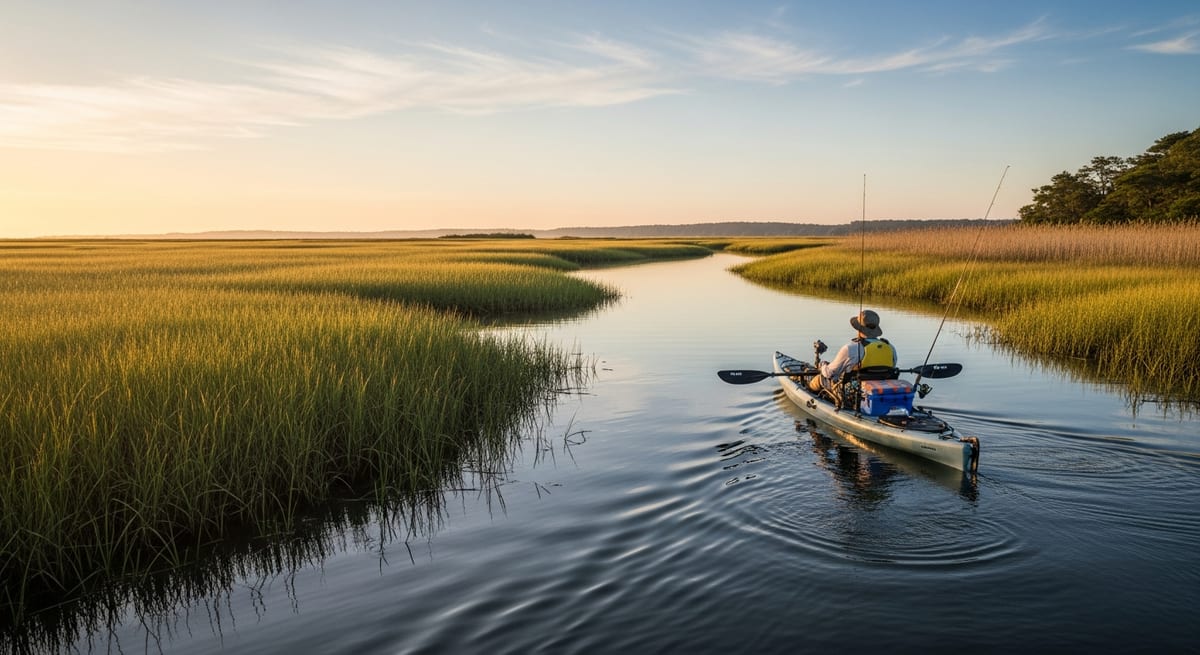
Kayak anglers who work the tidal marsh behind Griswold Point in Old Lyme routinely reach stripers stacked in eighteen inches of water, water powerboats can't enter and shore anglers can't cast into from the barrier beach. That's the pattern CT kayak anglers describe consistently across forums and fishing reports: the most productive spots aren't inaccessible because they're obscure, they're inaccessible because of draft and access, and a sit-on-top kayak at roughly $600-$1,400 (as of 2025) removes both barriers at once.
Stability or Speed: What CT Sit-on-Top Anglers Actually Choose
The two fundamental kayak designs are sit-on-top (SOT) and sit-inside (SIK). For CT's mix of tidal flats, river backwaters, and freshwater ponds, the consensus among local kayak anglers runs strongly toward sit-on-top, and for consistent reasons.
Why sit-on-top dominates for fishing: Self-draining scuppers handle spray and splash without bailing. After a capsize in shallow tidal water, re-entry is straightforward. Long days on the Connecticut River or Housatonic tidal flats are more comfortable without a cockpit surrounding you, and mounting rod holders, crates, and fish finders is far easier on a flat deck. Anglers who have fished both styles in CT conditions consistently land on SOT for all-day fishing use.
Length: 10-12 feet is the working consensus for a versatile CT fishing kayak. Shorter hulls (under 10 feet) turn more easily in tight tidal creeks but lose ground on larger water and in wind. Longer hulls (13+ feet) track better across open water but load and unload harder at the unimproved access points that define the best tidal backwater launches.
Width (beam): Anglers who stand to cast, common on shallow tidal flats and bass ponds, consistently recommend 32 inches or wider. Narrower hulls are faster but require more bracing when leaning to net a fish or pivot on an anchor.
Weight capacity: Owners report noticeably sluggish performance when loaded within 20 pounds of rated capacity. A 50-pound margin below the rating is the practical target when you factor in body weight, tackle, anchor gear, and kept fish.
Seats: The difference between a $650 and a $950 sit-on-top is often almost entirely in the seat and outfitting quality. Anglers who upgraded from entry-level models consistently cite seat comfort as the primary driver of the switch. For all-day fishing, the seat investment pays off.
Models CT anglers mention frequently in Northeast forums: The Perception Pescador Pro 12 comes up regularly as a mid-range option suited to CT's varied conditions; the Jackson Kayak Coosa is frequently mentioned by anglers prioritizing river current and standing stability. Manufacturer lineups shift year to year, verify current model names, availability, and pricing before purchasing, as specific SKUs are regularly renamed or replaced.
How CT Kayak Anglers Actually Rig for Tidal and Freshwater
Rod holders: Flush-mount rod holders angled toward the rear keep rods clear while paddling. Anglers trolling the Connecticut River main channel or working the lower Niantic typically add adjustable side-mount holders for a secondary rod. Most fishing kayaks ship with two; additional holders mount easily via standard track systems already built into most fishing-model decks.
Anchor system: A 1.5-3 lb folding grapple anchor on a 50-foot line handles most CT conditions, tidal backwaters, river edges, and pond fishing. The anchor trolley (a cord-and-pulley loop running the kayak's length) lets you shift the anchor attachment point from bow to stern while seated. CT kayak anglers who fish the tidal Thames and lower Connecticut River consider the trolley non-negotiable: without it, the hull aligns with current rather than letting you control your angle to it.
Paddle leash: Clip the paddle to the kayak before a fish is hooked, not after. Anglers who have fought stripers in tidal current without a leashed paddle report losing paddling position and, in some cases, the paddle itself to current.
Dry storage: Sealed hatches and dry bags for phone, keys, and wallet. CT kayakers capsize. It happens on calm-looking tidal water when a wake catches you off-angle. Budget for a dry bag even if the kayak has hatches; hatch gaskets degrade with UV exposure and age.
Tackle storage: A milk crate in the rear tankwell is the dominant solution among CT kayak anglers for good reason. It's modular, inexpensive, and transferable between hulls. Mount rod holders through it, drop Plano trays inside for lures, and swap the whole crate if you fish multiple kayaks. Anglers who've tested elaborate tackle management systems on the water tend to return to the crate.
Fish finder (optional): Compact units like the Garmin Striker 4 or equivalent mounted on a RAM ball mount add real utility for deeper bass ponds such as Bantam Lake and Candlewood, where structure and depth transitions aren't visible from the surface. Power options range from lithium AA packs for lighter units to a small sealed lead-acid battery for models with backlit displays and CHIRP transducers.
Cold Water Is the Hidden Risk: What CT Anglers Know About Dressing for Spring Launch Season
Wear the PFD, on your body, not clipped to the deck. A Type III fishing PFD worn continuously is the decision that matters most. Every season, CT waterways see kayak capsizes; the survivable ones consistently involve anglers who were already wearing the vest.
Dress for water temperature, not air temperature. This is the gap that catches CT anglers most often in spring. By late April, air temperatures may be in the mid-60s, but Long Island Sound water temperatures and many CT inland lakes are still in the 45-55°F range. Cold shock from a capsize in 50°F water is immediate; loss of swimming capacity follows within minutes. CT Sea Grant and DEEP safety guidance consistently cite this temperature mismatch as a primary factor in spring paddling fatalities. The working rule among experienced CT kayak anglers: wetsuit or drysuit when water temperatures are below 60°F. A 3mm wetsuit handles most CT spring conditions adequately.
Stay within your skill level, especially early in the season. Flat ponds and sheltered freshwater lakes are the right starting point. Tidal rivers introduce current, wind exposure, and boat traffic. The progression CT kayak instructors recommend follows a clear ladder: protected ponds → slow tidal backwaters → larger lakes and tidal rivers → open coastal water. Skipping rungs on that progression is where capsizes happen.
Weather awareness: Afternoon thunderstorms build quickly across CT in summer, typically from late June through August, often developing between 1:00 and 4:00 PM. Kayak anglers on larger water like Candlewood Lake or the lower Housatonic plan to be off or under cover by early afternoon on unstable days. Wind speed matters as much as precipitation: a 15 mph headwind on a large lake turns a 20-minute paddle into an hour.
File a float plan. Tell someone where you're launching, where you're going, and when you expect to return. For solo trips on larger or tidal water, this is standard practice among experienced CT kayak anglers, not optional protocol.
CT Launch Points, Tidal Windows, and the Waters Worth Paddling
Tidal backwaters (seasonal window: June-October): The shallow marshes behind CT's barrier beaches, behind Griswold Point in Old Lyme, along the Black Hall River mouth in Essex, and in the tidal coves off the lower Niantic River, hold stripers, snapper blues, and summer flounder on both flood and early ebb tides. The flood tide fills these marshes and pushes bait in; the first two hours of ebb concentrate fish at the creek mouths. Kayak anglers working these areas on incoming tide in June and July report consistent action on lightweight soft plastics and bucktails in the 1/4 to 1/2 oz range.
Tidal rivers (spring and fall): The Thames, Connecticut, Housatonic, and Niantic Rivers all have productive backwater sloughs accessible by kayak. The Connecticut River between Haddam and Essex has multiple DEEP boat ramps with day-use parking, kayak launches at Haddam Meadows State Park and the Essex Town Dock are frequently cited by river anglers as reliable entry points. On the lower Thames, the Norwich Harbor boat launch provides access to tidal backwaters that produce stripers and snapper blues from late May through October.
Freshwater bass ponds: Bantam Lake (Morris), Coventry Lake, and Mansfield Hollow Reservoir are all publicly accessible and well-suited to kayak fishing. Bantam Lake has a town launch with dedicated parking. Anglers targeting largemouth report the most consistent action from mid-May through June in the shallow grass flats along the western shore, and again in September as water temperatures drop back toward 65-68°F and bass move off deep structure.
Candlewood Lake: The largest lake in CT and a multi-ramp fishery for bass, walleye, and yellow perch. DEEP-maintained launches at Squantz Pond State Park and Danbury's Rogers Park are the most reliable public options. Wind builds quickly on open water at this scale, experienced Candlewood kayak anglers fish early and plan for afternoon headwinds from the southwest.
Connecticut River main channel: Large enough that paddling conditions matter on any exposed reach. The DEEP's Heritage Trail boat access sites provide multiple entry points along the river. Backwater sloughs off the main channel hold largemouth and smallmouth bass through the warmer months; main channel edges and deep bends produce stripers on tidal movement from late April through early June.
CT DEEP Registration and Licensing Rules, verify for the Current Season
Kayak registration in CT: Under Connecticut General Statutes and DEEP regulations as of the 2025 season, non-motorized kayaks used on CT public waters are subject to registration requirements through the DEEP Boat Registration program. Registration is required before launching on most CT waters; multi-year options are available through the DEEP online portal.
Electric motors and kayaks: CT regulations governing electric-motor-equipped kayaks are distinct from standard non-motorized kayak registration, and the applicable rules depend on motor type, thrust rating, and hull classification. If you plan to add a trolling motor to a kayak, verify current DEEP requirements directly at ct.gov/deep before launching, do not rely on secondhand accounts, as the rules in this category have been subject to clarification in recent seasons.
Freshwater fishing license: Required for anglers 16 and older on CT freshwaters. Available through the DEEP online licensing portal. Anglers fishing tidal or coastal saltwater must also comply with current federal and state saltwater licensing requirements, check ct.gov/deep for the current season's specifics before your first salt trip.
Slot and size limits: Bass, striper, and fluke regulations change annually. The 2024 striper slot rule and the 2025 updates to size and possession limits are published in the DEEP Recreational Fishing Guide, available each spring. Kayak anglers who fish multiple target species, largemouth in the morning, stripers on the tidal push in the afternoon, need to check current regulations for each species before launching, not just once per season.
EVERY SATURDAY MORNING
Weekly fishing intelligence
Nationwide conditions, what's biting, and honest gear deals. One email, no noise.
No spam. Unsubscribe anytime.