
Kayak vs. Canoe for Fishing: Which Is Right for You?
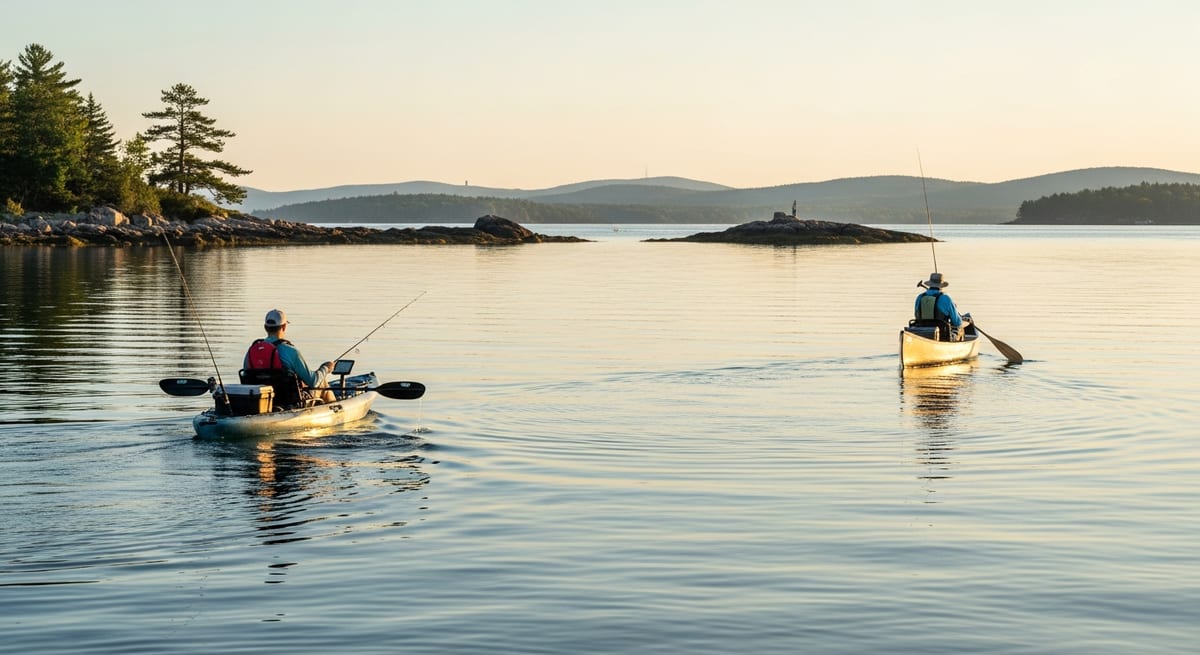
The kayak vs. canoe debate comes up constantly among CT anglers considering their first small watercraft purchase. Both will get you on the water to catch fish. But they have genuinely different characteristics that make each better suited to specific situations. Understanding those differences prevents buyer's remorse and maximizes your time on the water.
The Case for Kayaks
Sit-on-top kayaks (SOT kayaks) have dominated the fishing watercraft market for the past decade for good reasons. Stability: Modern fishing kayaks are specifically engineered for stability. Many can be stood on without capsizing. This allows sight fishing and standing casts that canoes require more care to execute. Self-bailing: SOT kayaks have scupper holes that drain water automatically. A wave or splash doesn't pool inside. Canoes require periodic bailing in rough conditions. Lower profile: In wind, a lower-profile kayak is easier to paddle than a high-sided canoe. Wind is the primary challenge in paddling both, and kayaks have a significant advantage. Dedicated rod holders and mounts: Fishing kayaks are designed with integrated rod holders, flush mounts for accessories, and tank wells for tackle storage. Retrofitting a canoe to match a purpose-built fishing kayak requires more work. Ease of solo paddling: A kayak paddle's double blade is more efficient for solo paddling than a canoe paddle. Going directly upstream or against wind is substantially easier in a kayak. Best for: Solo anglers, open water including coastal paddling, CT lakes and reservoirs where wind can be a factor.
The Case for Canoes
Canoes have advantages that dedicated fishing kayak advocates sometimes overlook. Load capacity: A standard 17-foot canoe carries 900-1,200 lbs. Even the most capable fishing kayak caps out around 450-550 lbs. For two anglers with full gear, a canoe is the only small watercraft option. Two-person fishing: Two people fishing comfortably from a canoe is natural and spacious. Two people fishing from a kayak requires a tandem kayak (which has its own trade-offs) or two separate kayaks. Cost: A quality used aluminum canoe can be purchased for $300-600 and will last decades. A quality fishing kayak of equivalent capability costs $700-1,500. Standing room: A canoe provides more natural standing room, not as stable as a flat-hull fishing kayak, but more natural for standing than a sit-in kayak. Carrying the catch: A canoe's open interior accommodates a large cooler or live well more naturally than most kayak set-ups. River versatility: Canoes were designed for river travel and handle river obstacles (shallow rapids, pull-overs, beaver dams) more practically than fishing kayaks. Best for: Two-person fishing, river travel with gear, budget-conscious purchases, freshwater lakes and rivers.
Stability Comparison
Stability is the most frequently asked question when comparing the two watercraft. Both can capsize. Modern fishing kayaks, particularly wider hull designs, have exceptional primary stability (resistance to initial tipping). A 36-inch wide fishing kayak is harder to tip than most canoes. Canoes have excellent secondary stability (resistance to complete capsizing once tipped). The broad hull catches the water and prevents complete rollover. The practical difference: For solo anglers standing to cast, a modern flat-hull fishing kayak is more stable than a canoe. For sitting and fishing, a quality canoe is quite stable, especially in calm conditions. For rough conditions (waves, strong current): Fully enclosed cockpit kayaks have the best rough-water performance. Open-cockpit fishing kayaks are more vulnerable than a well-paddled canoe in significant waves. The width of the canoe provides capsize resistance that helps in difficult conditions. Cold water safety: If you're fishing in cold water, a sit-on-top kayak's self-draining hull is safer than a canoe that fills with water in a capsize scenario.
CT-Specific Considerations
Connecticut's fishing environments favor each watercraft in specific applications. CT lakes and reservoirs (Bantam, Saugatuck, Lillinonah, Candlewood): Both work well. Wind can be a significant factor on large lakes like Candlewood. The kayak's lower profile is advantageous. For solo lake fishing, a kayak is more practical. CT rivers (Housatonic, Farmington, Salmon, Shetucket): Canoes excel on rivers, particularly for covering distance and portaging around obstacles. Fishing kayaks work on calmer river sections but portaging a 65 lb fishing kayak around a log jam is more work than portaging a 55 lb canoe. Long Island Sound coastal fishing: Kayaks only. Canoes in open LIS conditions (wind, waves, current) are inappropriate for most recreational paddlers. CT shoreline kayak fishing requires specifically designed coastal kayaks with rudder systems. Transporting to the water: Both require roof racks or truck beds. A canoe is typically easier to load solo due to its carrying handles and shape. Many fishing kayaks include carrying handles but their width makes solo loading more physically demanding.
Recommendation Summary
Choose a fishing kayak if: You fish primarily solo. You fish any coastal or open water. You want purpose-built fishing features (rod holders, sonar mounts, scupper transducers). Stability for standing is a priority. You're comfortable with the $700-1,500 entry price for a quality fishing kayak. Choose a canoe if: You regularly fish with a partner. Your primary water is rivers and inland lakes with minimal wind. Budget is a significant constraint (used aluminum canoe is the most affordable fishing watercraft). You need to carry significant gear (full cooler, camping equipment, heavy tackle). You prioritize versatility across river, lake, and pond fishing. The honest answer: Many serious CT anglers own both a fishing kayak (for solo coastal and lake fishing) and a canoe (for river trips and tandem fishing). If you can only have one, make the choice based on your primary fishing style. Solo coastal? Kayak. River and lake with a partner? Canoe.
EVERY SATURDAY MORNING
Weekly fishing intelligence
Nationwide conditions, what's biting, and honest gear deals. One email, no noise.
No spam. Unsubscribe anytime.