
Cold Water Season on Connecticut Kayak Waters. DEEP PFD Requirements, Self-Rescue Skills, and Why Most Capsizes on Long Island Sound and the Housatonic Happen Closer to Shore Than Anglers Expect.
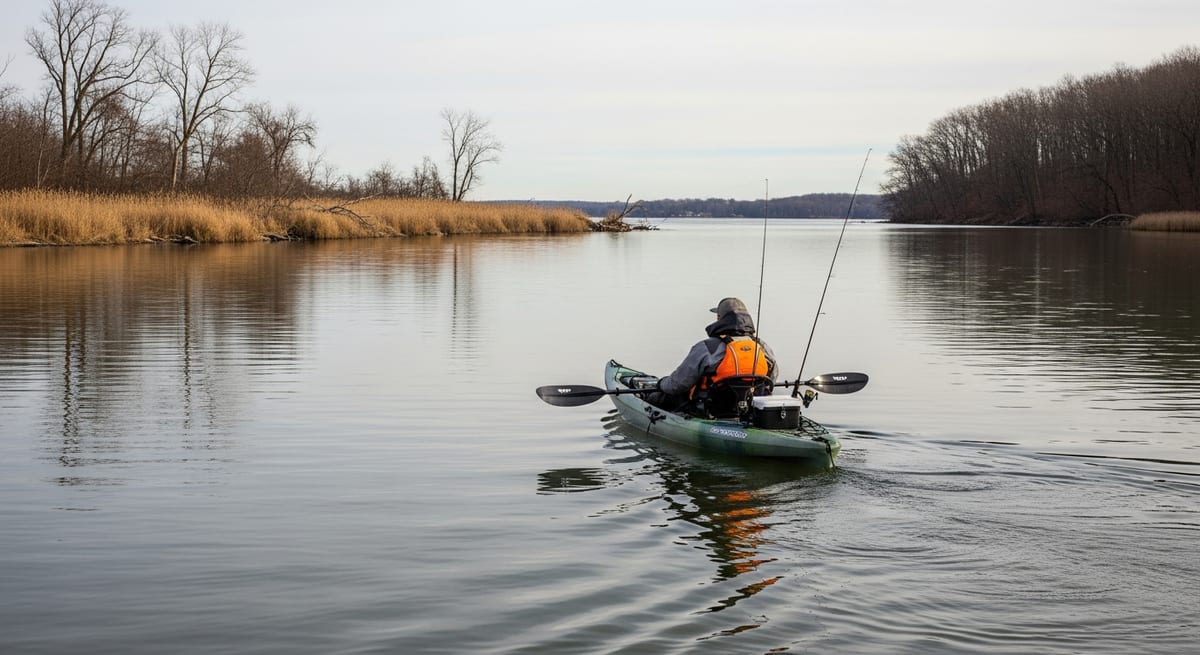
Incident reports gathered by Northeast paddle communities consistently show the same pattern in Connecticut kayak capsizes: most happen within sight of the launch point, in conditions rated calm to moderate, and most involve anglers who were not wearing their PFD at the time. Long Island Sound in March, the Housatonic River in early April, and Candlewood Lake through the first weeks of May share one characteristic: the water stays cold long after air temperatures feel fishable. The gap between 'looks safe at launch' and 'is safe after a capsize' is where serious incidents on Connecticut kayak waters concentrate, and what the Northeast paddle community, DEEP regulations, and NOAA marine data collectively say about closing that gap is what this article covers.
The Cold Water Window CT Kayak Anglers Actually Navigate
Water temperature is more consequential than air temperature for kayak safety, and it is the variable CT fishing beginners most often underestimate. Long Island Sound water temperatures typically stay below 50°F from December through late March and often through April in cooler years. Common reference points in Northeast kayak safety literature place the acute cold water shock threshold around 60°F, at which point capsizing triggers an involuntary gasping reflex and hyperventilation before hypothermia has a chance to set in.
The gasping response is the specific hazard. An angler wearing a PFD can drown in calm water if the shock reflex causes an inhale while the face is submerged. Swimming ability does not override this response; it affects experienced paddlers and beginners alike.
Candlewood Lake, Bantam Lake, and the Housatonic River carry similarly cold water through early spring. Anglers who fish the Farmington TMA in March and April report water temperatures in the low 40s°F at peak early stocked trout season. The Connecticut River at Enfield typically warms faster than still water but remains cold through mid-spring.
The guidance widely cited in the Northeast paddle community: when air temperature plus water temperature falls below approximately 120°F, a wetsuit is the recommended minimum; below roughly 100°F, a drysuit. These are not CT DEEP regulatory thresholds; they are widely cited community benchmarks. Dressing for water temperature, not air temperature, is the principle CT kayak anglers who fish year-round consistently apply.
CT DEEP PFD Requirements and What Fishing Kayak Anglers Actually Wear
Under DEEP 2025-2026 regulations, all kayaks operating on Connecticut waters must carry a Coast Guard-approved PFD for each occupant. Anglers under 13 are required to wear their PFD at all times on the water. Adults are required to have one on board; wearing it is the consensus recommendation from CT paddling communities, particularly during cold-water months.
The most common reason kayak anglers historically gave for not wearing a PFD during extended sessions was comfort, and modern fishing-specific PFD design has largely addressed this concern. CT kayak fishing communities on Long Island Sound report near-universal adoption of vest-style fishing PFDs with front tackle pockets, rod-holder loops, and low-profile back panels that allow a full seated paddle stroke. Brands including Astral, Kokatat, and NRS produce fishing-specific designs that CT anglers frequently cite in community discussions as comfortable for full-day wear.
Inflatable PFDs, which inflate on contact with water or via manual pull, are popular among experienced paddlers because they are unobtrusive during casting. The Northeast paddle community generally treats them as appropriate for experienced, confident swimmers in lower-risk conditions. Foam PFDs worn at all times are the recommended standard when launching on LIS in cold months, paddling tidal rivers like the Niantic or the lower Thames, or fishing solo in remote stretches of the Housatonic or Connecticut River.
Self-Rescue on CT Waters: What the Northeast Paddle Community Practices Before Launch Season
The most important self-rescue skill for kayak anglers is re-entering a capsized kayak from the water, and CT kayak communities broadly recommend practicing this in controlled conditions before it is needed. The calm, shallow coves on the north end of Candlewood Lake and the protected launch areas at Bantam Lake are frequently cited as practice locations in CT paddle community threads.
Sit-on-top kayaks, the standard fishing platform, self-drain and can be re-boarded without the skill threshold of a sit-inside roll. The technique used in most community demonstrations: roll the kayak upright, approach from the side at the seat well, kick legs up from the water, slide your core across the hull, and pivot legs into position. Hull width and stability directly affect how difficult this is. Wider fishing-oriented hulls from Old Town, Perception, and Jackson Kayak lines popular among CT anglers re-board more forgivingly than narrow touring kayaks.
Float plans: The most underused safety protocol in the CT paddling community. Telling someone where you are launching and when you plan to return costs nothing. A float plan has been the mechanism behind successful search-and-rescue responses on Long Island Sound and CT river systems. The CT DEEP Boating Division recommends filing one before any paddle in open or remote conditions.
Communication devices: A whistle is required by CT law on all kayaks; three blasts is the universal distress signal. Many CT LIS paddlers and anglers on remote stretches of the Housatonic and Connecticut Rivers also carry a waterproof VHF radio or personal locator beacon clipped to their PFD, separate from their phone, since cell coverage is unreliable on open water and a capsized phone may be nonfunctional.
Reading Wind, Tide, and Weather for Connecticut Launches: LIS, Tidal Rivers, and Inland Water
Weather is the primary controllable risk factor in Connecticut kayak fishing, and most preventable incidents happen in conditions that were foreseeable at launch. CT kayak fishing communities on Long Island Sound treat the National Weather Service marine forecast (weather.gov/marine, Zones ANZ330-ANZ338 for LIS) as the baseline check before any coastal paddle: wind speed and direction, wave height, and the hourly progression. Inland anglers check the standard NWS point forecast; USGS stream gauge data helps assess Housatonic and Connecticut River conditions after rain.
Wind on LIS: Anglers fishing Niantic Bay, the LIS waters off Old Saybrook, and the area around Clinton Harbor most often report being caught out by wind shifts that made the return paddle significantly harder than the outbound leg. Offshore wind is the specific pattern to recognize; what feels manageable pushing out becomes a head-on slog back. The 15 to 18 mph range is commonly cited in CT paddling discussions as the threshold above which most fishing kayaks struggle in open water.
Thunderstorms: An absolute abort condition on both LIS and inland impoundments. A paddler on Candlewood Lake or LIS during a lightning event is in a small, low-profile object on a wide flat conducting surface. Any thunderstorm in the forecast is a no-launch signal; if storms develop while on the water, move toward shore immediately.
Fog on LIS and CT harbors: Reduces visibility to near zero and makes kayaks invisible to motorized traffic in marked channels. Many CT LIS anglers report choosing motor-boat-free environments on high-fog mornings rather than navigating active boat lanes.
Tidal CT waters: Current affects launches in the Niantic River, the lower Housatonic, the Thames estuary, and along the LIS shoreline. Outgoing tides push away from shore; incoming or slack tide is the typical preferred launch window. NOAA Tides and Currents, using the Noank or New London reference stations, provides CT-specific tide tables for planning.
What CT Kayak Anglers Actually Carry: A Working Gear List From the Northeast Paddle Community
Required by CT DEEP 2025-2026 regulations on kayaks:
- Coast Guard-approved PFD for each occupant
- Audible signaling device (whistle)
- Visual distress signal if paddling at night
- Navigation lights if operating at night
Broadly recommended by CT kayak fishing communities for warm-weather launches: Dry bag for phone, keys, and wallet; assume everything gets wet. Anchor with adequate rope for fishing depth. Paddle leash, particularly on moving water or in wind. First aid kit. Bilge pump for sit-inside kayaks.
Additions cited by anglers fishing LIS, tidal rivers, or open Housatonic stretches: Waterproof VHF radio or personal locator beacon clipped to PFD. Radar-reflective tape on hull or bow. 360-degree visible LED lighting for dawn and dusk launches. A filed float plan left with someone onshore.
Cold-weather additions consistently cited by CT anglers fishing November through May: Wetsuit or drysuit sized for water temperature, not air temperature. Tow rope for remote-launch stretches of the Connecticut River or upper Housatonic. Hand warmers for sustained cold-weather sessions.
The Northeast paddle community broadly identifies a fishing partner as the single most effective safety upgrade for CT coastal and river kayak fishing in cold months. Assisted re-entry is faster and more reliable than solo self-rescue, and a partner can call for help if a capsize results in incapacitation. The consensus among anglers who fish LIS and the Housatonic solo: cold-water months shift the risk calculation enough that buddy fishing or staying within easy reach of shore is the standard practice.
EVERY SATURDAY MORNING
Weekly fishing intelligence
Nationwide conditions, what's biting, and honest gear deals. One email, no noise.
No spam. Unsubscribe anytime.