
First Freshwater Trip in Connecticut. DEEP Licensing, Squantz Pond Shore Access, and Why Bobber Depth at a Panfish Pond Matters More Than Any Gear Upgrade.
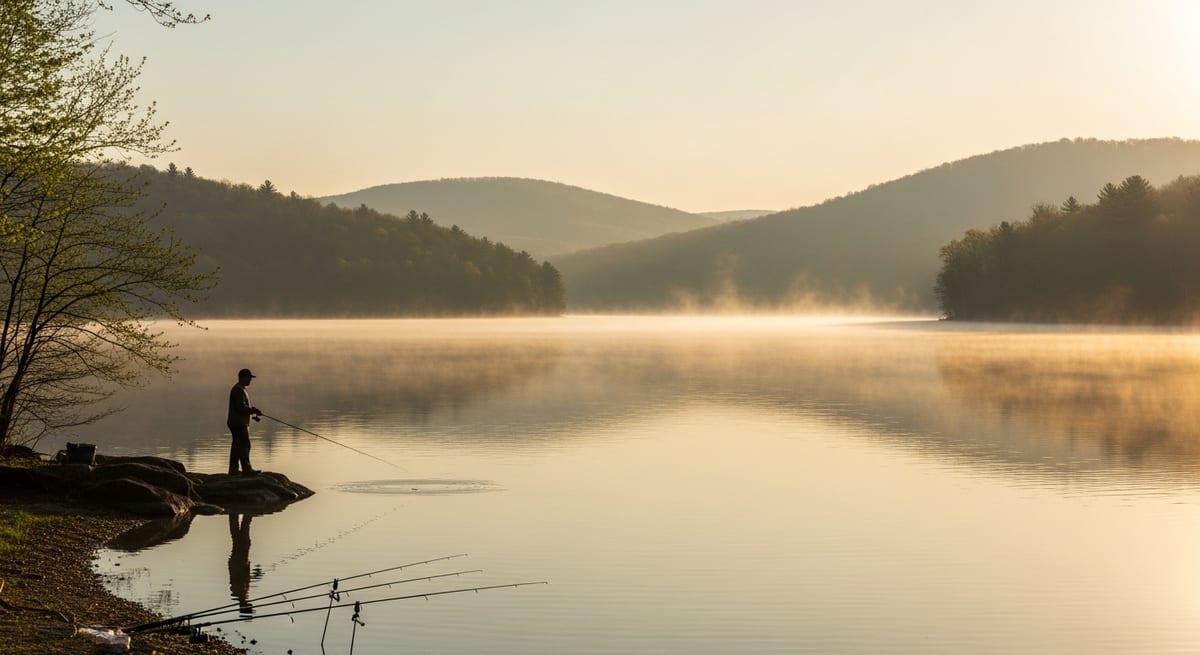
Squantz Pond in New Fairfield and Coventry Lake in Tolland appear repeatedly in Connecticut beginner fishing threads on local Facebook groups and regional forums. Anglers who fished these spots as first-timers consistently report having a sunfish or small bass in hand within an hour, largely because both locations combine accessible shore positions, shallow weedy coves, and dense panfish populations. The CT freshwater beginner community identifies two friction points that derail a first trip before it starts: the license step getting skipped or delayed, and fishing water that is too deep or too exposed for a bobber rig to produce. This guide pulls from CT DEEP's public access portal, 2025-2026 freshwater regulations, and what Connecticut beginner anglers report working, covering the license requirement, gear the local community finds adequate, named public waters with shore access, rig setup, and the size limits that apply to what first-timers are most likely to catch.
The CT License Portal Takes About Four Minutes
Connecticut residents age 16 and older need a freshwater fishing license before fishing any inland water. The CT DEEP online portal at ctoutdoorlicenses.com is the fastest path, licenses issue immediately and can be displayed on a phone if a warden asks to see one. For 2025-2026, the resident freshwater annual license runs approximately $19 for adults age 16-65 and approximately $8 for residents 66 and older. Non-resident annual licenses run approximately $55, with a shorter-term option available for visitors. Anglers under 16 fish free with no license required. Prices are set annually, verify the current fee at ct.gov/deep before purchasing.
If you plan to fish for trout, stocked brown, rainbow, or brook. A Trout and Salmon stamp is required on top of the base license. Most general license packages sold at DEEP-licensed agents (Dick's Sporting Goods, Walmart, licensed bait shops) include it bundled, but confirm at the point of purchase.
Saltwater is an entirely separate system. Fishing Long Island Sound, tidal rivers, or any Connecticut marine water requires enrollment in the CT DEEP Marine Recreational Fishing Registry, which is free but mandatory and separate from any freshwater license. Anglers fishing only inland ponds and non-tidal rivers do not need the marine registry. If you are unsure whether a particular river stretch falls under tidal influence, the DEEP marine district map at ct.gov/deep/marinefisheries clarifies the boundary.
What First-Timers Actually Need vs. What the Rack at Dick's Suggests
CT beginner fishing threads and Facebook groups consistently show the same pattern: anglers who caught fish on their first trip used a spinning combo in the $25-40 range, not specialized gear. A 6- to 6.5-foot ultralight or light-power spinning combo pre-spooled with 6-pound monofilament handles every freshwater panfish and bass situation a first-timer encounters at a Connecticut public pond. The consensus among local beginner communities is to avoid upgrading until after a few sessions, preference and technique develop faster than most new anglers expect, and gear bought before that point often gets replaced anyway.
Terminal tackle the beginner community uses:
- Size 6 or 8 Aberdeen-style wire hooks (a 10-pack runs roughly $2-4)
- Spring-snap float, 1-inch diameter (a pack of 6 costs around $3)
- BB-size split shot sinkers, small assortment card ($2-3)
- Needle-nose pliers for hook removal
Bait: Fresh nightcrawlers are the near-universal recommendation in CT freshwater beginner reports. They work on sunfish, yellow perch, bass, and stocked trout without requiring presentation skill. Bait shops near Squantz Pond, along Route 44 near Coventry Lake, and at most CT state park concessions typically carry them for approximately $3-5 per container. Many anglers keep worms in a small resealable bag with damp paper towel to extend viability through a session.
Total investment in the $40-65 range is what the local beginner community most commonly reports spending on a first functional setup, including rod, reel, terminal tackle, and bait. Specific brand recommendations matter less at this stage than getting to the water.
Where CT Beginners Report Their First Fish: Public Ponds and Trout Parks
CT DEEP's public fishing access database lists over 100 publicly accessible inland water bodies. The beginner community consistently points to panfish-loaded ponds with shore access rather than rivers or large open impoundments. The reason cited in most threads is that a stationary bobber rig fishes itself in a weedy cove, while current or open water requires technique that takes time to develop.
Public ponds with shore access (no boat required):
- Squantz Pond, New Fairfield: state park with managed shoreline access; large sunfish and perch populations in the shallow north coves. State park day-use fee applies in-season.
- Coventry Lake (Lake Wangumbaug), Coventry: DEEP-listed public launch with fishable shoreline; bluegill and bass in weedy shallows, stocked trout in spring.
- James L. Goodwin State Forest, Hampton: two ponds with walk-in access, no day fee; bass and panfish in managed state forest water.
- Chatfield Hollow State Park, Killingworth: small lake with an active panfish population, frequently referenced in beginner reports; day fee applies.
- Osbornedale State Park, Derby: smaller designated fishing pond, close to Route 34; often mentioned as a quick after-work first trip location for Naugatuck Valley beginners.
CT Trout Parks are DEEP-designated, heavily stocked locations specifically designed for public access. A daily Trout Park permit is required in addition to the base license, but the fish density in these locations is substantially higher than general stocked rivers, beginner reports from these sites skew toward faster action. CT DEEP publishes a trout stocking schedule posted again each week during stocking season at ct.gov/deep.
What the productive shore spots share: CT beginner reports describe the same structure repeatedly, visible aquatic vegetation or lily pads within 10-20 feet of shore, water depth of roughly 3-5 feet visible from the bank, and some form of shade or structural break (dock, fallen log, undercut bank). Exposed, flat, sandy-bottom areas produce fewer panfish; they concentrate around cover.
Setting Up the Float-and-Worm Rig the CT Freshwater Community Uses
The float-and-worm rig is what the CT freshwater beginner community describes using on first successful trips, and it works across every public pond species a newcomer is likely to encounter, sunfish, perch, bass, and stocked trout all take a nightcrawler suspended below a bobber. Setup takes under five minutes once practiced.
Tying the hook (Improved Clinch Knot): Thread 6 inches of line through the hook eye. Double the tag end back alongside the main line. Wrap the tag end five times around the doubled section. Thread the tag end through the small loop near the eye, then through the large loop just formed. Wet the knot, then pull both the main line and tag end simultaneously to seat it. Trim the tag close to the knot. Practice this at home before the trip. Most beginners report needing three or four reps before it holds consistently under tension.
Rigging the float: Clip a spring-snap bobber onto the main line above the hook. The distance between the bobber and hook sets fishing depth: 2 to 3 feet below the float puts the bait in the strike zone for sunfish and bass in typical 3-5-foot CT pond margins. Pinch a BB-size split shot 6-8 inches above the hook to sink the bait below the surface.
Baiting: Thread a 1-inch section of nightcrawler onto the hook, covering the hook point without leaving a long trailing tail. Sunfish are efficient bait stealers. A compact bait presentation reduces the number of worms lost without hooksets.
The Cast, the Wait, and When to Move
The underhand pendulum cast is what most CT beginner tutorials and in-person mentors recommend for a spinning rod at a pond margin. Hold the rod with your dominant hand, reel seat facing down. Flip the bail open and hold the line against the rod handle with your index finger. Swing the rod back in a smooth arc, then forward, release your finger as the rod tip passes forward. The weight of the bobber and sinker carries the rig out. Fifteen to twenty feet is adequate for a first cast; distance is not the goal at a pond margin.
Close the bail by turning the reel handle once the bobber lands. Then watch the float.
Reading the bobber: Gentle twitches or repeated dipping indicate fish mouthing the bait. A firm, sustained pull that takes the bobber fully under is the signal to set the hook, sweep the rod upward and to the side. If you feel resistance, keep the rod tip up and reel steadily. If nothing, reel in and check the hook for stolen bait.
On a panfish-active CT pond from May through August, the beginner community generally reports first bites within 5-10 minutes at a productive spot. If 15-20 minutes pass with no activity, move 20-30 feet along shore. One adjustment that comes up repeatedly in local beginner threads: if bait is being stripped without producing hooksets, try shortening the leader so the bobber is 18 inches above the hook rather than 2-3 feet. Some shallow cove spots fish better at reduced depth.
CT DEEP 2025-2026 Size Limits for What You Are Most Likely to Catch
CT DEEP's 2025-2026 freshwater regulation booklet is available at ct.gov/deep and at all licensed agents. The following limits cover the species first-time anglers at CT public ponds are most likely to encounter.
Sunfish and panfish (bluegill, pumpkinseed, yellow perch, crappie): No minimum size limit statewide; a combined daily bag limit of 30 applies to most panfish species. Panfish at CT public ponds are abundant and reproduce quickly. The beginner community largely practices catch-and-release on them regardless of legal retention rights.
Largemouth and smallmouth bass: 12-inch minimum length statewide; 5-fish daily limit. Bass under 12 inches should be released. Some designated trophy waters, including portions of Candlewood Lake and Bantam Lake, have enhanced bass regulations that differ from the statewide standard; consult the current regulation booklet before fishing those specific waters.
Stocked trout (brown, rainbow, brook trout): 9-inch minimum length; 5-fish daily limit during the regular season. Trout Management Areas (TMAs) on the Farmington River and the Housatonic River carry separate rules, catch-and-release only or single-hook requirements depending on the specific stretch. The TMA map in the current DEEP regulation booklet identifies the exact boundary markers.
Handling fish for release: Hold the fish in the water and move it gently forward and back until it swims away independently. For panfish, a firm grip around the midsection works cleanly. For bass, the lower-lip grip, thumb on the lower jaw, fingers underneath, is what CT bass anglers commonly describe as causing a natural docile response that makes hook removal straightforward. Support the body with the other hand on larger fish. Catfish have firm pectoral and dorsal spines that can puncture skin; grip from behind and underneath with fingers positioned on either side of the dorsal base.
EVERY SATURDAY MORNING
Weekly fishing intelligence
Nationwide conditions, what's biting, and honest gear deals. One email, no noise.
No spam. Unsubscribe anytime.