
CT Inshore Guides Don't Default to Fluorocarbon Leaders on Every Rig. What Anglers Fishing the Sound, the Thames, and the Niantic Report About When Leader Material Actually Changes Your Catch Rate
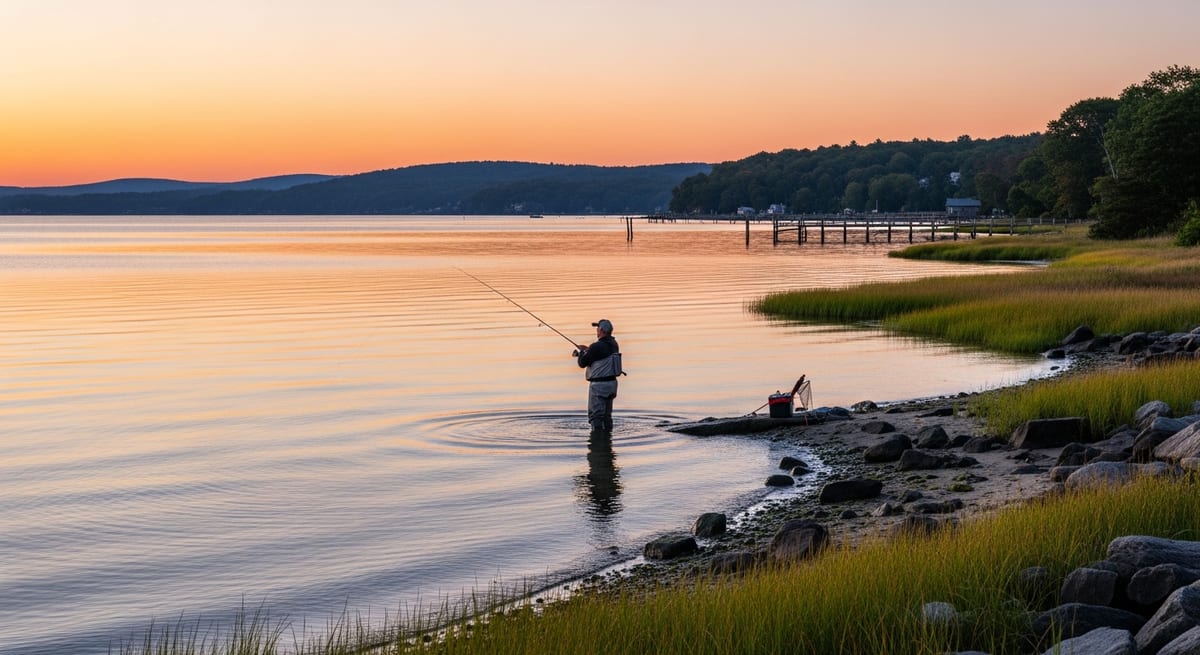
Anglers fishing the Race in late September, when the water clears post-summer and stripers stack in the eastern Sound rips before pushing west, consistently report more follows from fish on fluorocarbon leader than on equal-strength mono running the same lure on the same current edge. The leader is the last 2-3 feet of your rig, connecting your main line to your lure or hook. Its properties change what fish see in the moment before a strike, and that difference ranges from decisive to entirely irrelevant depending on the water you're fishing.
The Visibility Question, when Fluorocarbon Actually Earns Its Price
Fluorocarbon's primary advantage is optical. Its refractive index is close enough to water that it bends light similarly to the surrounding medium, in practice, it's harder to detect than monofilament in clear conditions.
CT inshore guides who fish the Race, the Niantic River mouth, and the eastern Sound in fall report that fluorocarbon leaders make a measurable difference when water clarity is high and fish are actively inspecting baits rather than reactively eating. In stained water. The Thames after a hard rain, early spring inland lakes with runoff, the lower CT River in April. The visibility advantage shrinks enough that most regulars don't bother swapping materials for it alone.
Abrasion resistance: Fluorocarbon is harder than monofilament at the same diameter. Around mussel-covered structure at Harkness, rocky ledge along the Old Lyme flats, or the jagged granite at Watch Hill access points, nicks accumulate fast. Fluorocarbon holds up longer in those situations, and the difference shows in how long a leader stays fishable before needing to be retied.
Low stretch and sink: FC stretches less than mono, which pairs well with braid main line for picking up light bites on a drop shot or ned rig fished on Candlewood or Bantam. It also sinks, which keeps bottom presentations like Carolina rigs and live-lined menhaden setups at the intended depth rather than floating the bait up off the bottom.
Where this matters most in CT: Clear western Sound conditions in fall, Candlewood and Bantam in mid-summer when boat pressure has bass scrutinizing presentations, and shallow-grass situations in the Niantic River backwaters where fish have time to look before committing.
Where Mono Stays in the Box
There are real scenarios where monofilament is the better material, and CT anglers fishing the range of local conditions encounter most of them:
Topwater fishing: Monofilament's stretch acts as a buffer on aggressive hooksets and head shakes. Anglers running Zara Spooks and poppers for bass in the tidal coves off the lower CT River report that hard-plastic topwater lures with treble hooks shed fish more readily when braid runs straight to fluorocarbon. The near-zero-stretch combination can pull hooks free before they seat. A short mono leader cushions that impulse.
Knot reliability for new anglers: Fluorocarbon is stiffer and seats knots differently than mono. Anglers learning to connect to split rings, swivels, and small bait hooks find monofilament's forgiving tie more consistent. An improved clinch in mono holds more predictably for most new fishers than the same knot in stiff fluoro.
Float fishing and surface rigs: A mono leader stays at or near the surface. Fluorocarbon sinks, useful for bottom work, counterproductive when you're fishing a float rig or trying to keep a live shiner near the surface film in a CT pond.
Toothy fish: For bluefish along the CT coast from July through October, and chain pickerel in the inland ponds, fluorocarbon isn't enough material. Thirty to fifty pound heavy mono handles moderate bluefish runs; seven-strand wire is the standard call when blues are actively slashing through a blitz. Anglers targeting chain pickerel on Moodus Reservoir and the upper Thames drainage routinely rig wire or 40-plus pound mono rather than trusting any fluoro leader.
Cost: Monofilament is considerably less expensive than fluorocarbon. In heavy structure, rocky ledge, mussel beds, dense timber, leaders get cut regularly. Mono's lower cost per leader makes frequent retying easy without any hesitation about wasting material.
Connecting Braid to Leader: Two Knots Worth Knowing
When your main line is braid, standard for most CT inshore and bass setups. You need a reliable braid-to-leader connection. Two knots dominate:
Double Uni Knot: Straightforward to learn and reliable across a range of line sizes. Create a loop in each line, overlap them, and tie each tag end around the other with five to six wraps. The finished knot is compact enough to pass through rod guides cleanly. Published knot-testing results for braid-to-fluorocarbon connections commonly place this connection in the 85-90% efficiency range relative to line breaking strength, though field results vary meaningfully with line brand, diameter, and how cleanly the knot is seated and trimmed.
FG Knot: More involved, but the result is a slimmer connection with less bulk moving through the guides, relevant on long casts or when fishing very light lines where the connection size creates friction. The braid is woven around the fluorocarbon in alternating half-hitches and locked off with a finish sequence. Third-party knot tests frequently cite this connection at 95% or above, with the consistent caveat that execution quality is the controlling variable in real-world results.
On the water: Double Uni handles freshwater bass, light inshore flounder, and most Sound setups without issue. CT anglers who surf-cast for stripers off Watch Hill or the Old Lyme beaches, where casts are long and the connection cycles through the guides repeatedly, report that the time invested in learning the FG Knot pays off in both distance and confidence that the connection holds under load.
Leader Sizing for CT Waters, by Application
Leader length is a function of water clarity, species, and rig type. The ranges CT anglers work within by situation:
Finesse freshwater (drop shot, ned rig, light spinning on Candlewood or Bantam): 12-24 inches of 6-10 lb fluorocarbon off braid. Longer in clear mid-summer conditions, shorter in stained early-season water when the visibility advantage is minimal.
General CT bass (structure fishing, flipping, Carolina rig): 18-24 inches of 10-15 lb fluorocarbon. This range covers most tournament bass fishing on Candlewood and Lillinonah across seasons, based on what local bass community threads and derby reports consistently describe.
Inshore saltwater (LIS flounder on the Niantic flats, stripers along the CT River mouth, weakfish in the eastern Sound): 18-36 inches of 15-20 lb fluorocarbon leader. Anglers fishing within CT's striper slot rules, verify current DEEP size and bag limits before each trip, as regulations have shifted in recent seasons, typically run toward the longer end of this range in September and October when fall clarity peaks and bass are more likely to follow before committing.
Surf fishing (Watch Hill, Rocky Neck jetty, the Old Lyme beach stretches): 24-36 inches of 20-30 lb fluorocarbon or heavy monofilament. Current, abrasive bottom, and the distance from angler to fish all argue for heavier material than a finesse freshwater setup would use.
Toothy fish (chain pickerel in CT's inland ponds, bluefish along the coast): 6-12 inches of 30-50 lb heavy mono or single-strand wire. Short enough not to restrict lure action; long enough to survive a strike from a fish with actual teeth.
Bottom bait rigs (live-lined menhaden for stripers, cut bunker in the surf): A 12-18 inch fluorocarbon leader off a swivel allows the bait to move naturally and keeps it at the target depth rather than floating up off the bottom as a mono leader in the same rig sometimes does.
EVERY SATURDAY MORNING
Weekly fishing intelligence
Nationwide conditions, what's biting, and honest gear deals. One email, no noise.
No spam. Unsubscribe anytime.