
CT Has More Fishable Shore Access Than Most Anglers Use. The Bank Spots Regulars Keep Coming Back to, Fresh and Salt.
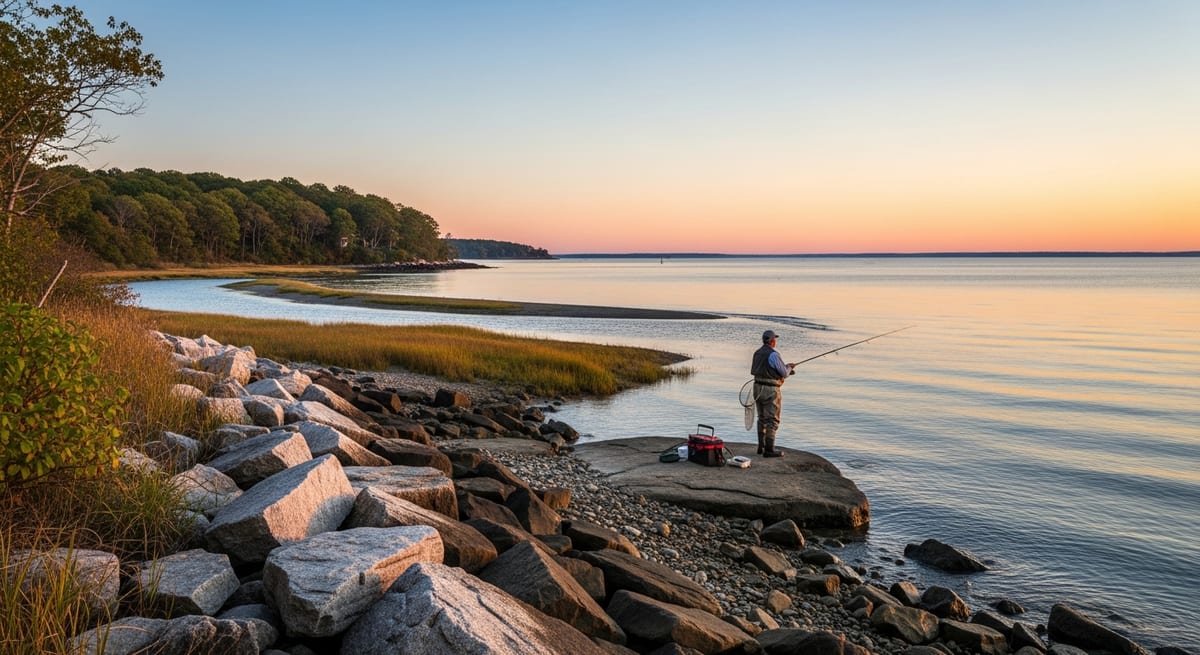
The inlet at Mansfield Hollow in late April, crappie stacked in the shallows, largemouth nosing bait along the bank edge, is a pattern CT shore anglers have documented consistently enough that it functions as a reliable seasonal benchmark. Connecticut's bank access is genuinely dense: Army Corps properties, state parks, wildlife management areas, and DEEP-designated fishing access points give shore anglers reach into serious water across the state. Rock jetties accessible on foot have hosted some of the fall striper sessions that CT shore fishing communities reference year after year. The spots below represent where bank anglers across Connecticut have repeatedly found productive water, fresh and salt, along with the setups behind the results.
CT Freshwater Bank Spots That Produce Consistently
Mansfield Hollow Lake (Mansfield): Consistently cited by CT shore anglers as one of the state's best bank-access fisheries for quality fresh water without needing a boat. The Army Corps property provides extensive shore access along the lake and the river inlet. The inlet is where spring fishing concentrates, typically from the last week of April through mid-May. Crappie stack in the shallows, largemouth track bait along the bank edge, and CT fishing communities report small jigs under a float or a slow-retrieved 3-inch swimbait as the reliable go-to rigs. CT DEEP lists official access points on their fishing access page.
Lake Pocotopaug and Moodus Reservoir (East Hampton): Both waters sit within the Salmon River watershed and offer multiple public bank access points. Summer evening topwater fishing from the Pocotopaug town-side bank is a pattern CT largemouth anglers have returned to reliably in low-light conditions, community reports consistently note it outperforms what the map suggests.
Black Pond (Meriden): A small, productive WMA that gets less attention than its quality warrants. The state management area side offers full bank access, and the shallow sections accommodate wade fishing for panfish and bass. Anglers newer to shore fishing often find the water size manageable and the panfish cooperative across most of the season. The pond appears frequently in CT beginner-friendly shore fishing discussions for that reason.
Salmon River (Colchester/Montville): The management area trail opens a significant stretch of river to shore anglers. The catch-and-release section above the hatchery draws consistent attention from CT trout anglers, verify current CT DEEP season dates and specific regulations before fishing this stretch, as rules have been updated periodically. The lower river holds smallmouth through summer, and the slower pools are frequently cited in CT fly fishing communities as among the better shore fly fishing access in the state.
Shetucket River (Norwich area): Described by CT smallmouth anglers as reliably under-fished relative to its quality. The Scotland Bridge area and Taftville access points provide solid bank access for smallmouth bass and yellow perch. Low pressure is a recurring theme in community reports. The river doesn't draw the attention the Salmon does, and that tends to show in the fishing.
Saltwater Shore Spots With a Documented Track Record
Hammonasset Beach State Park (Madison): Connecticut's largest state beach offers both open-sand access and breakwaters and rock jetties at the park entrance. CT shore anglers who have fished both consistently report the rocks as the more productive option, tautog, scup, and schoolie stripers from structure outperform blind-casting open beach when bait isn't visibly running. Parking fills early on summer weekends.
Rocky Neck State Park (East Lyme): The jetty here is among the most accessible dedicated saltwater structures open to CT shore anglers. Black sea bass, scup, and tautog from the rocks are documented throughout the season; park admission is required in summer. The post-Labor Day shoulder season is highlighted repeatedly in CT shore fishing reports as when Rocky Neck performs best, fewer anglers, tautog still active, sea bass holding before the fall offshore push.
Seaside Park Breakwater (Bridgeport): The breakwater at Seaside has produced documented catches of sea bass, scup, and tautog across multiple seasons, check current park access rules and seasonal hours before visiting, as conditions can vary. The Pleasure Beach bridge area on the east side of Bridgeport Harbor is referenced in CT striper communities as a shore access point for stripers and bluefish, though access has been inconsistent seasonally; confirm current conditions before making the trip.
Lighthouse Point Park (New Haven): The breakwater at Lighthouse Point is a well-established CT shore spot with documented catches of sea bass and stripers. Parking is typically free in the shoulder seasons, and the Morris Cove shoreline adds additional bank access along the harbor edge.
Niantic Bay Public Pier (Niantic): A public fishing pier in the Niantic River corridor is accessible to shore anglers, confirm current DEEP access listings and any seasonal restrictions before visiting, as designations can change. Scup, sea bass, and fluke are documented through summer; tautog through fall. CT tautog anglers fishing this type of structured hard bottom in October have largely standardized on green crab on a fish-finder rig, sliding egg sinker, barrel swivel, 18" of 30 lb fluorocarbon leader, worked tight to whatever hard bottom is available. The recurring note from experienced CT tautog anglers: don't fish too light; fish near fall structure don't give much ground.
Cos Cob Harbor and Greenwich Point: Town parks along the Sound hold stripers and bluefish during the fall run. Night sessions from the rocks are a documented pattern in CT striper communities when the bite is active. Resident parking is required in summer, working around that restriction is part of the local knowledge for anglers who don't hold a Greenwich address.
What the CT Shore Community Has Settled On for Setups
General freshwater: The CT freshwater shore fishing community has largely standardized on a medium spinning setup in the 6'6-7' range with 10-15 lb braid mainline and a 10 lb fluorocarbon leader as a versatile bank rig. Texas-rigged worms and creature baits for bass, inline spinners and small spoons for pickerel, small jigs and live bait under a float for panfish. Anglers who move through multiple access points in a session consistently report better results than those who stay fixed, on most CT bank water, mobility is a genuine edge.
Saltwater from rocks: CT shore anglers fishing structure have settled on a 7'-7'6 rod with 20-30 lb braid and a 20-30 lb fluorocarbon leader as the standard. A fish-finder rig, sliding egg sinker above a barrel swivel, 18" fluorocarbon leader to a 2/0-4/0 circle hook, covers most of the CT rock-fishing species mix from scup to stripers to tautog. Bait consensus among CT rock anglers runs toward clam strips, squid, sea worms, and sand eels, with preference tracking whatever is locally available and fresh.
Striper surf fishing: The CT striped bass surf fishing guide covers the full setup in detail. The short version from the CT surf community: a 10-11 ft surf rod, 20-30 lb braid, and plugs or bucktails, bomber A-Salt, SP Minnow, or a bucktail jig tipped with a teaser are all standard in the CT surf rotation.
A note on wading: Many of CT's freshwater rivers reward wade fishing. The Salmon River is most frequently cited. Connecticut prohibited felt-soled wading footwear in freshwater effective 2011 under invasive species management regulations; rubber-soled wading boots with aggressive lug soles have been the standard since. CT DEEP's regulations page carries the current language. The consistent advice from experienced CT wade anglers: slow down. Moving through water too quickly spooks fish before a cast is made, read a seam fully and fish it before stepping forward.
EVERY SATURDAY MORNING
Weekly fishing intelligence
Nationwide conditions, what's biting, and honest gear deals. One email, no noise.
No spam. Unsubscribe anytime.