
Tangled Line and Missed Targets at CT Shore Access Points Usually Trace to the Same Four Casting Mechanics. What Anglers on the Housatonic, Thames, and Long Island Sound Jetties Report.
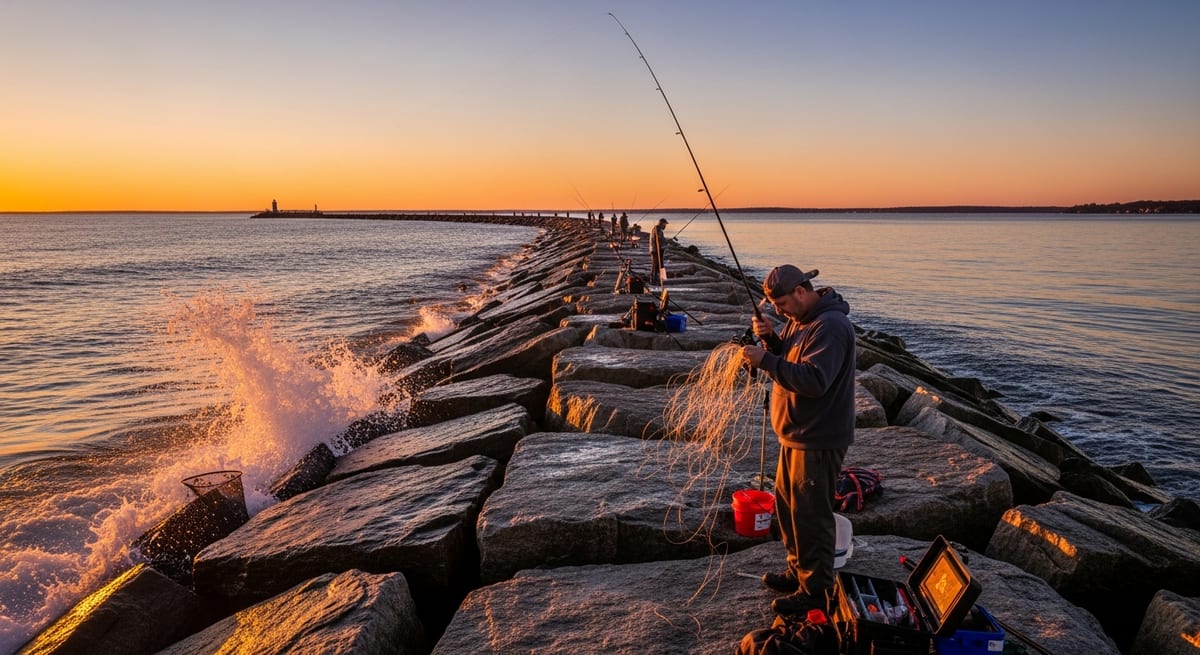
Anglers who pick up a spinning rod for the first time at Connecticut's public shore access. The jetty at Harkness Memorial State Park, the tidal flats below Derby on the Housatonic, or the rocky points along the Thames River, tend to hit the same wall: missed targets, coiling line, lures splashing down in the wrong place. The consistent report from CT fishing communities is that four mechanics errors account for most of that frustration, and the corrections for all of them come down to what's happening during the stroke, before the release point.
What the Correct Mechanics Actually Look Like
Setup: Hold the rod with your dominant hand, index finger extended to hold the line against the blank. With your other hand, open the bail. The wire arm that flips open. The line should run from the spool, over your index finger, and out through the guides.
The grip: Grip the rod so the reel foot (the leg of the reel that attaches to the rod) sits between your middle and ring fingers, not above all four fingers. This puts the reel at or below your palm and keeps the blank balanced in your hand.
The cast, four steps:
- Load: Bring the rod to the 2 o'clock position, just past vertical, tip angling slightly behind your shoulder. The lure should hang 8-12 inches below the rod tip. Anglers who fish longer Housatonic reaches where distance matters often describe practicing a deliberate pause here: feel the lure's weight load the blank before starting the forward stroke.
- Accelerate: Sweep the rod forward smoothly, letting speed build through the motion rather than jerking.
- Release: When the rod reaches the 10 o'clock position on the forward swing, roughly 45 degrees above horizontal, lift your index finger. The lure follows the rod tip's direction at that moment.
- Stop: Hold the rod at 10 o'clock. Driving past horizontal drops the cast angle and cuts distance.
Feathering: After release, lightly touch the outgoing line with your index finger to slow the lure for precise landings. When the lure is about to reach the target, press your finger against the spool fully to stop it in place.
The Four Mistakes, roughly in Order of How Often They Surface
Releasing too early The most disorienting version sends the lure straight up or back behind you. It happens when the finger comes off the line while the rod is still moving backward. The adjustment is timing, not power: keep your finger on the line until the rod has passed vertical and is clearly moving forward.
Releasing too late The lure fires into the water 15 feet in front of you at a steep downward angle. Anglers fishing tight structure on the Thames River backwaters, where a long cast would put the lure into a root tangle, often describe this as the more useful error to actually experience, because it shows how completely release timing controls trajectory. Holding one beat too long becomes straightforward to correct once you've felt what "too late" produces.
Too much wrist, not enough forearm Wrist-flick casts are short, hard to repeat, and fatiguing over a long shore session. The rod's blank is designed to load under the lure's weight on the backswing and release that energy forward. Anglers who fish rocky Long Island Sound jetties for blues and stripers, where casting all day is part of the work, describe the right feel as the rod doing most of the work while the forearm drives the arc. It's a pendulum motion, not a snap.
Casting at maximum effort Maximum effort produces maximum inconsistency. The consensus among CT shore casters is that a controlled, unhurried stroke outperforms a full-power swing for both distance and accuracy. The rod loads and unloads more cleanly when the motion isn't rushed. Many anglers report that slowing down until the blank feels like it's actually loading is the useful cue, then letting it unload without fighting it. Specific power ratios are unreliable; the feel is more transferable than any number.
Line Twist During Casting, when It's a Fill Problem
Line twist that surfaces during a casting session is almost always a spooling problem, not a casting mechanics problem. The full treatment, including fill direction for mono, braid, and fluoro, and what CT shore anglers do differently when loading each, is covered in the companion piece on line twist and spooling. For the casting context, the short version:
What causes twist to accumulate: Rotating lures, inline spinners and prop baits like Whopper Ploppers or Devil's Horse rigs, add a small amount of twist on every retrieve. If the spool was filled in the wrong rotational direction, that twist compounds from the first cast.
Quick field fix: Strip the terminal tackle off the end and drag 50-75 feet of bare line behind a moving boat or through a tidal current. The drag tension pulls accumulated twist out. In still water, let the line hang slack, twisted line spins on its own to release tension.
Prevention going forward: A small barrel swivel above any rotating lure stops twist from building up the leader. Braid's low memory resists twist more than monofilament over a long session, which is one reason anglers on the lower Connecticut River and Niantic estuary have largely shifted to braid-to-fluorocarbon leader setups for spinning applications.
Accuracy at Short Range, what CT Backwater Anglers Report
The rod tip's position at the moment of release determines direction. Pointing the rod tip toward the target at release sends the lure there. Some anglers watch the rod tip during early practice; most shift to target-focus once the mechanics become automatic.
Practice drill: Anglers who've worked on accuracy at open DEEP-access shore points along the lower Housatonic or the Connecticut River flats at Haddam Meadows State Park describe the same basic setup: a hula hoop or bucket at 20, 40, and 60 feet, stepping back only after consistent hits rather than consistent tries. The consistent report is that starting close and moving back builds target discipline faster than starting at distance and trying to work inward.
Pitching for close targets: For short casts to specific structure, under a dock piling, tight to a deadfall in a backwater cove. A pendulum pitch replaces the overhead cast. Hold the lure in your off hand with the rod loaded and bail open, then release both simultaneously. The lure flies out low and flat with considerably more accuracy at ranges under 20 feet than an overhead cast allows. Anglers working the tidal coves of the Niantic and Mystic rivers describe this as a required technique for bass that hold tight to shaded structure the shore can't reach on a high-angle cast.
Sidearm under obstacles: When overhanging trees or low banks block the overhead plane, the same mechanics apply rotated 90 degrees, load, accelerate, release at the lateral equivalent of 10 o'clock, stop. Anglers fishing the wooded Quinebaug backwaters describe this as a cast worth practicing specifically, since much of the best cover in CT river systems sits under a canopy that makes an overhead cast impossible.
EVERY SATURDAY MORNING
Weekly fishing intelligence
Nationwide conditions, what's biting, and honest gear deals. One email, no noise.
No spam. Unsubscribe anytime.