
The CT Fishing Report That Sent Anglers to the Farmington Last Saturday Was Written on Thursday. What Bait Shop Intel, DEEP Data, and Sound Communities Report About Timing, Source Weight, and Reading Yesterday's Conditions Into Tomorrow's Trip
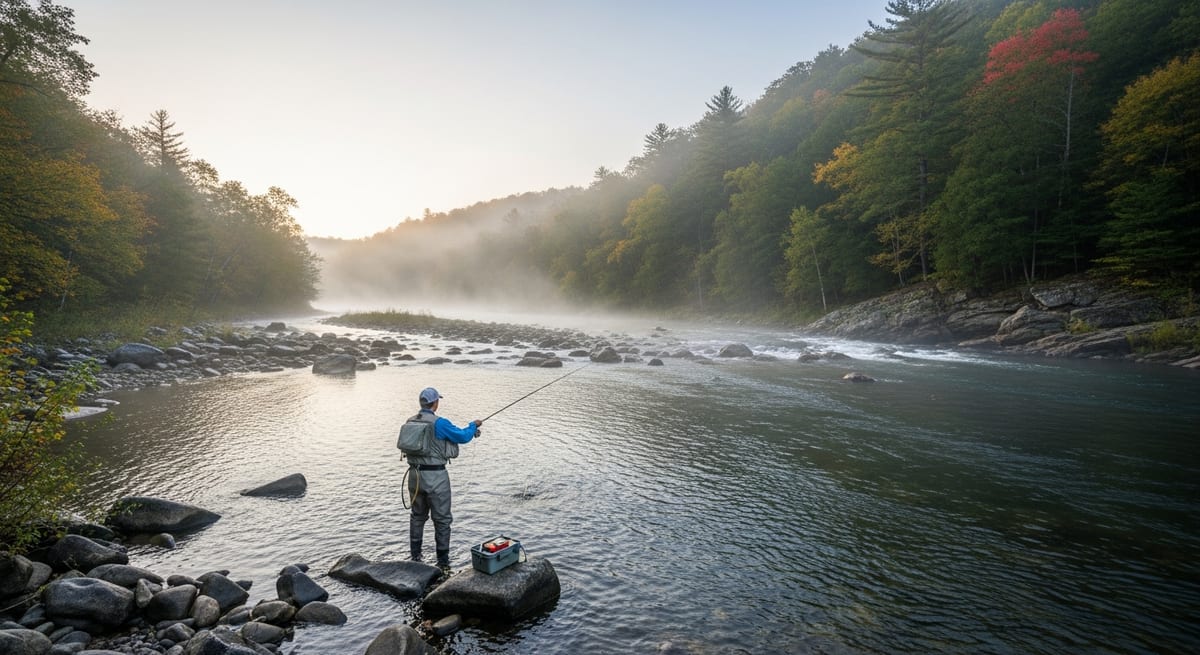
At the mouth of the Niantic River in late May, the difference between finding fish and missing them often comes down to which tidal phase the report was written during, not which day it was posted. CT anglers who fish the Sound and major freshwaters consistently describe the same translation problem: reports are a picture of conditions at one moment, and conditions move fast. The gap between what a fishing report says and what it means for the next trip is where most CT anglers lose time, and bait shops, DEEP data, and experienced community members each close that gap differently.
What Bait Shops and Charter Reports Signal (And How They Differ)
Bait shops near the lower Connecticut River corridor, the Niantic access points, and the Sound's major launch sites hear from dozens of customers a day across different tide windows and water types. The intel those shops compile is aggregated by nature, which makes it structurally more reliable than any single angler's account. CT saltwater regulars consistently describe a quick call to a local shop as a ground-truth step before longer drives to the coast, specifically because shop reports reflect multiple trips across multiple conditions rather than one person's morning.
Charter captain trip reports carry different signal. Captains work heavily pressured grounds and share productive trips as part of their marketing. The detail in those posts is often useful: depth, structure type, bait presence, tidal phase. But anglers in CT coastal communities note that charter reports rarely describe what failed or where a given day went quiet. The practical read, as the Sound community frames it, is to treat a charter post as conditions intelligence rather than a repeatable recipe.
The common thread that CT coastal communities consistently report: the most actionable reports name conditions alongside the catch. Water temperature in a specific range, a strong outgoing tide, bait bunched at a particular structure type, stripers responding to a given retrieve. A report built around conditions gives you something to match against the forecast. A report that says "limits on the Sound" describes one day without explaining why it happened or when it repeats.
Reading DEEP Data as a Report Source
CT DEEP publishes two categories of information that CT anglers use as report context rather than real-time intelligence: stocking schedules and fisheries survey data.
Stocking schedules, updated regularly on the DEEP website, list which rivers and lakes have received fish and when. Anglers who fish the Farmington below Collinsville, the Housatonic above Derby, and the smaller stocked rivers in the Northwest Corner use the stocking calendar not as a go-now signal but as a timing indicator. The working consensus among CT trout anglers is that stocked fish settle and distribute within three to five days of a fresh stocking, and that waters with a stocking two to four days prior, stable flows, and moderate pressure tend to produce better than water that was just stocked the day before.
DEEP fisheries surveys provide population and size context for major impoundments. Candlewood Lake, Bantam Lake, and Lillinonah all receive periodic creel and population surveys. CT bass anglers who fish those waters describe using DEEP survey data to calibrate expectations rather than to find fish day-to-day: what size class is typical across seasons, which basins hold the most consistent fish, what baseline catch rates look like under normal pressure. The 12-inch minimum for largemouth and smallmouth bass is confirmed in the current DEEP Angler's Guide, as are the striper size minimums and any active slot limits, which have shifted in recent seasons under ASMFC management. CT coastal anglers treat the current DEEP regulations as the definitive source on those numbers before each trip.
For saltwater, DEEP seasonal summaries combined with NOAA buoy readings from stations near the Sound give a more complete picture of CT coastal conditions than any single trip report. Those buoys are the fastest-updating public data source for the water temperature shifts that drive the striper spring run timing along the CT coast.
Community Reports: What Candlewood, Bantam, and Sound Regulars Have Figured Out
Regional Facebook groups and online forums carry the most real-time CT fishing intelligence available outside of bait shops, but experienced members in those communities are consistent about one thing: posts with photos attached are more reliable than text-only accounts, and specificity is the best signal of a trustworthy report.
CT regulars who fish Harkness State Park, Bluff Point, and the Pawcatuck mouth describe using public-access reports to confirm a pattern is active in an area, not to plan a trip to the exact posted location. Spot-burning is a real community concern on the Sound, and reports from popular public launches are intentionally vague about specific structure. The consensus among experienced CT coastal anglers is to use community posts for pattern confirmation, then apply their own water knowledge for where to actually fish.
For CT freshwaters, the Candlewood, Bantam, and Lillinonah communities have identified the same distinction themselves: reports that name depth, structure type, and presentation are significantly more actionable than general accounts of catching bass somewhere on the lake. Candlewood's five basins fish differently depending on season and wind direction, and posts that specify which area of the lake carry substantially more signal than lake-wide summaries.
One timing gap CT freshwater communities consistently flag: weekend reports arrive in volume, weekday intel is scarce. The most accurate real-time picture typically builds from Tuesday through Thursday, after the previous weekend's fishing has been processed and before the next wave of pressure arrives.
Translating What a Report Says Into Tomorrow's Trip
The consistent pattern CT anglers describe when explaining how they actually use reports is a two-step translation, not a direct copy.
Match conditions, not just the catch. A report from the Housatonic tidal section describing stripers on a strong outgoing tide at 58 degrees Fahrenheit is directly applicable when the forecast shows similar temperature and tidal timing. The same report two weeks later, after prolonged warm weather has pushed water temperatures into the mid-60s, is historical record. CT coastal anglers who fish the river mouth and Niantic Bay regularly treat temperature and tidal phase as the conditions to match, not just the species or presentation named in the report.
Account for pressure lag. The most-reported public access points, including the Thames Jetty, Niantic Bay, and the Farmington below Collinsville, receive concentrated effort within 24 to 48 hours of a positive report going public. CT anglers who fish those locations consistently describe using community reports to confirm a species or pattern is active in a general area, then finding their own access point rather than competing directly at the reported location.
Regulations are the third piece that most report-reading frameworks leave out entirely. The current DEEP Angler's Guide covers bass minimums, striper size and slot requirements, trout stocking windows, and seasonal closures by species and water type. CT anglers in both freshwater and saltwater communities flag the same oversight: anglers who rely entirely on report-to-report intel sometimes miss regulation changes that shifted after the reports they're referencing were written. Cross-checking current DEEP regulations before the trip is a step experienced CT anglers treat as non-negotiable.
EVERY SATURDAY MORNING
Weekly fishing intelligence
Nationwide conditions, what's biting, and honest gear deals. One email, no noise.
No spam. Unsubscribe anytime.