
The CT Anglers Who Fish the Farmington, the Sound, and a Bass Lake in the Same Week Don't Carry Three Tackle Boxes. They Carry Three Trays.
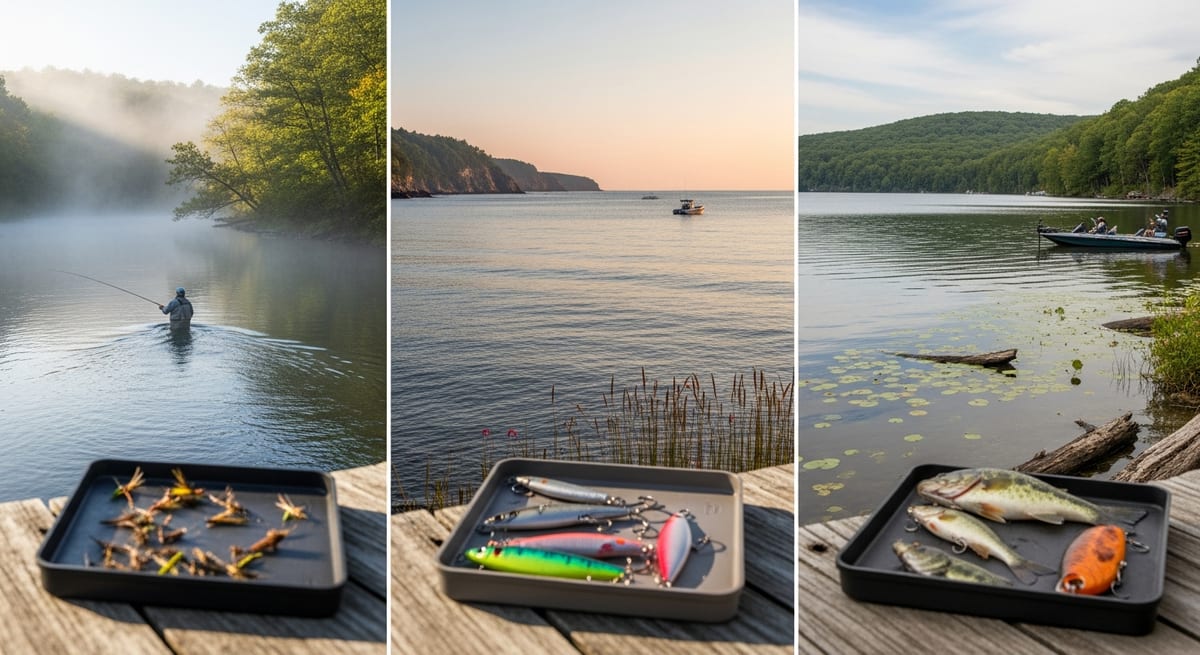
Connecticut anglers who rotate across the Farmington TMA, Long Island Sound, and a warmwater lake in the same week tend to travel lighter than less experienced anglers, not heavier. The sorting problem gets solved earlier in the system, not by adding more storage. What they run instead of the single overloaded tackle box is a tray-per-category setup that took most of them a few seasons to arrive at, usually after one too many sessions spent untangling a crankbait from a swimbait while fish were visibly feeding. The single large box is still out in the garage, mostly full of tackle they haven't touched in two years.
Why CT's Multi-Season Calendar Breaks Single-Box Systems
Connecticut's fishing calendar creates an organizational challenge that's genuinely different from what most national tackle guides address. A session on the Farmington River TMA in Hartland or Riverton calls for light fluorocarbon leaders, small presentations, and single-hook configurations. Anglers targeting stocked and holdover trout in those stretches know to check DEEP's current TMA regulations before each season, as hook configuration requirements apply in designated stretches. A striper session working rocky Sound structure off Niantic Bay or the Connecticut River mouth near Old Saybrook demands 30-40lb braid, heavy fluorocarbon leaders, circle hooks, and larger-profile swimbaits. A bass morning on Candlewood Lake or Lake Lillinonah sits somewhere in between, medium spinning or baitcasting gear with soft plastics, jigs, and crankbaits that have no business sharing tray space with either of the other setups.
Anglers who rotate across more than one of these ecosystems, and a notable share of serious CT freshwater and coastal anglers do, report the same organizational friction: the multi-purpose tackle box becomes a liability. Lure categories tangle. Hook sizes mix. Terminal tackle for one trip ends up buried under what belongs on another.
What regional fishing forum threads and tackle shop conversations in New Milford and Cromwell consistently point to is a tray-per-category system: one multi-compartment hard tray per lure type, crankbaits, soft plastics, jigs, topwater, stored in a single bag, with only the trays relevant to that trip making the drive. Multi-compartment hard trays from well-established brands run roughly $15-25 at major retailers and CT outdoor shops.
Visual inventory is immediate when a tray opens flat: every option in that category is visible at once. Hook tangles between categories disappear when soft plastics ride in their own tray and hard baits in theirs. Rotating seasonal tackle means swapping one tray rather than re-sorting an entire box. The system scales cleanly. A new tray gets added when a category earns its weight in fish, not before.
Soft Plastics: The Category That Degrades Fastest in Disorganized Storage
Soft plastics are the lure category most prone to deteriorating in storage, and the mechanisms are worth understanding. Certain soft plastic formulations, particularly softer non-PVC materials stored in prolonged contact with PVC-based plastics, can show surface degradation over time. The practical fix is keeping different brands and materials separated inside the tray, either in their original resealable packaging or in small zip-lock bags, rather than loose in a shared compartment. Original packaging also maintains the color ID and size labeling that disappears the moment plastics get dumped loose.
For CT bass anglers targeting Candlewood, Lake Lillinonah, or the river pools along the Housatonic, the useful split is unrigged soft plastics, worms, craws, tubes, stored in resealable bags grouped by color family, with pre-rigged swimbaits on jig heads kept in a separate flat tray with individual compartments. Pre-rigged baits on dedicated slots stay untangled and are faster to reach than anything loose in a communal compartment.
CT anglers who run soft plastics on the Sound, particularly those working the rocky structure along the Niantic Bay shoreline or the shallow flats near Harkness State Park, often keep a dedicated saltwater soft plastic tray separate from their freshwater stock. Salt exposure, brine rinsing, and the heavier jig head weights required in tidal current make cross-storage impractical, and the size profile for Sound fishing is different enough that mixing the two creates confusion at the worst moment.
Public fishing forum posts from CT kayak and shore anglers recommend restocking from the back of a tray and fishing from the front. A rotation discipline that prevents any color from going forgotten. Colors that never get reached across a full season are candidates to cut; the high-confidence colors that actually catch fish earn the most accessible slots.
The Night-Before Rigging Habit That Cuts On-Water Downtime
CT anglers who rotate across multiple fisheries, farmington River in April, Sound stripers through July, bass lakes into September, consistently show up in trip reports with pre-tied leaders and fresh hooks already staged. The pattern isn't coincidence. Knot failures and leader retying happen most often during active feeding windows, which is exactly when stopping to re-rig is most costly.
A home rigging station doesn't require dedicated furniture. A cleared workspace with split ring pliers, a leader spool in the relevant weight, a selection of barrel and snap swivels, and a small strip of foam for hanging pre-tied leaders covers most situations. Tying three or four fluorocarbon leaders the night before, clipped to the foam strip and marked by pound test, is a 10-minute investment that eliminates retying during active bites.
Hook condition is worth checking during the same session. Dragging a hook point lightly across a fingernail is the standard field test: a sharp point catches and grabs; a dull one slides clean. Sharpening with a hook file or ceramic stone costs nothing and restores a hook that still has material to work with. When a hook is too far gone to sharpen, particularly treble hooks on crankbaits that have taken repeated contact with rocky Sound structure or dock pilings, replacement is the right call, and doing it at home on your own schedule is cheaper than making that decision mid-session while fish are moving.
Anglers who fish rocky saltwater structure around Hammonasset, Harkness, or the Race Area consistently report faster hook point degradation than freshwater anglers typically see. The consensus in CT shore fishing forums is to rinse hard baits and all terminal tackle in fresh water immediately after any Sound session. The sharpening-versus-replacement question becomes far less urgent when salt isn't working on the metal between trips.
EVERY SATURDAY MORNING
Weekly fishing intelligence
Nationwide conditions, what's biting, and honest gear deals. One email, no noise.
No spam. Unsubscribe anytime.