
Rocky Bottom Eats Pyramid Sinkers. CT Surf Anglers Who Fish the Sound Have Known This for Years.
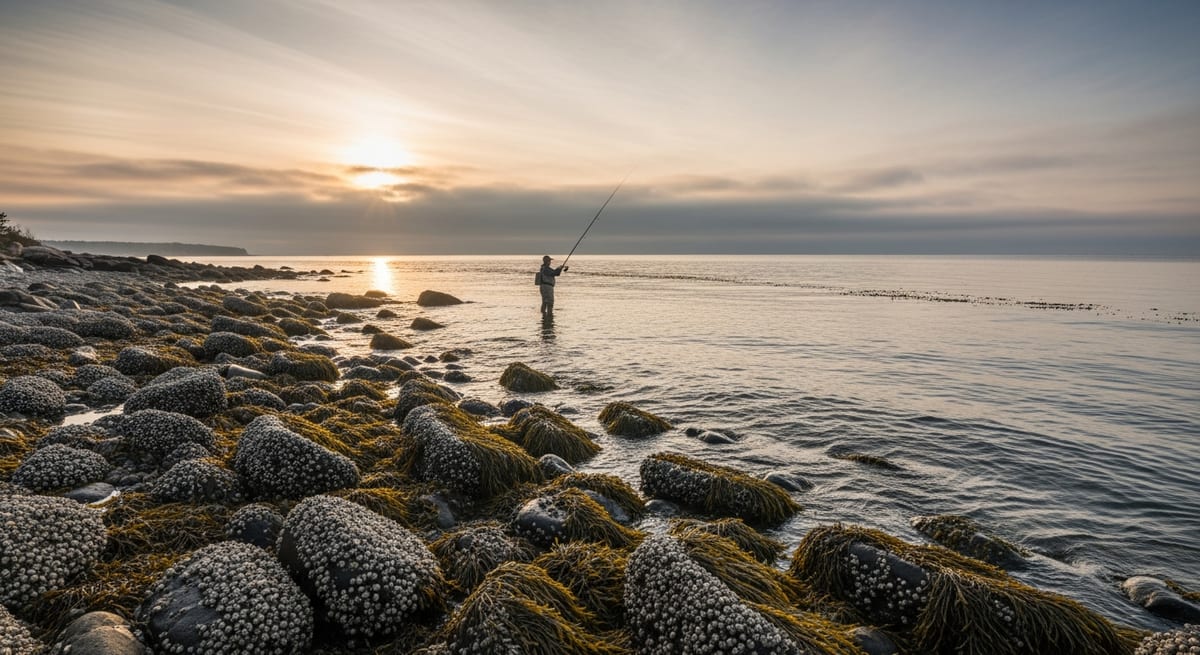
Surfcasters fishing the rocky points between Old Saybrook and Westbrook have a saying that repeats every opener: pyramids go in, bank sinkers come back. It's not just a preference. It's the accumulated result of losing expensive tackle to ledge crevices for a season and adjusting. Sinker selection is less glamorous than lure choice, but it determines whether you spend the session fishing or retying. The wrong weight for the current, the wrong shape for the bottom, the wrong rig for the species. Each one costs fish. What follows draws on what CT anglers fishing the Sound, the Farmington, the Connecticut River, and the inland bass reservoirs have worked out over time.
Rocky Sound Structure and Why Bank Sinkers Win
Pyramid sinkers were designed for sand and silt. They dig in and hold position against wave action and current, which is exactly what you need on an open Atlantic beach. On the rocky ledge structure that runs most of the Connecticut shoreline from Greenwich through Stonington, they function as tackle donations.
Surfcasters fishing Hammonasset State Beach's rocky east point, the ledges off Harkness Memorial in Waterford, and the rip points near Seaside Park in Bridgeport have largely converged on bank sinkers for rocky-bottom applications. The elongated oval body and rounded base roll over crevices instead of planting in them. You lose far fewer, and the natural drift over structure moves your bait into the zones tautog, stripers, and sea bass are actively using.
The consensus weight among CT Sound regulars runs 2-3 oz inside protected waters and behind breakwaters. Many first-season surf anglers overweight for the Sound based on experience from Cape Cod or the Jersey Shore. Those heavier setups rarely add holding power on the calmer inside structure and increase snag rate significantly. Step up to 4-5 oz only in heavy rip current or wind-driven chop; most situations inside the breakwaters don't require it.
Bank sinkers carry over to rocky river sections, too. Anglers fishing the Salmon River's pocket water and the lower Farmington report fewer snags and more time with bait in the water compared to egg sinkers on stone-bottom runs, same principle as the Sound, different setting.
Bullet Weights in CT Bass Cover. The Peg-or-Float Question
Bass anglers working Candlewood Lake, Lake Lillinonah, and Shenipsit Reservoir have settled on bullet weights in the 3/16-1/4 oz range as the baseline for most soft plastic presentations. The cone shape threads through the milfoil and lily pad stems that define the back coves on Candlewood's southern end without the constant fouling that other weight styles produce.
The pegging debate surfaces every season on CT bass boards. The consensus that's emerged: free-sliding for open-water flipping and slower drop presentations, pegged for precision pitching into dock pilings, laydowns, and the tight overhead cover on Lillinonah's south shore. Free-sliding creates an erratic fall, genuinely effective for triggering bass. That pegging trades away in exchange for placement accuracy. Both setups are correct in the right situation.
Depth and timing drive the weight decision more than anything else. When bass are holding shallow through May (8-12 feet on most CT reservoirs), 1/8-3/16 oz keeps plastics falling slowly through the strike zone. By late July and August, when fish push to thermocline breaks at 18-25 feet on Candlewood, anglers regularly step up to 3/8-1/2 oz to maintain bottom contact without losing sensitivity.
Clear-water reservoirs like Shenipsit punish heavy bullet weights in post-cold-front conditions. The reduced natural bait movement produced by heavy sinkers in still, clear water is a real factor that anglers fishing those pressured fisheries consistently flag.
Slip Sinker Rigs and What River Current Actually Requires
The slip sinker setup, egg sinker on the mainline stopped by a barrel swivel, with a leader to the hook, is the foundational live bait and cut bait rig across CT lakes and rivers. The fish picks up the bait and moves without sensing resistance; the sinker stays at the swivel while line slides through freely.
CT anglers run this for catfish on the Connecticut River with cut herring, for landlocked salmon and lake trout on Candlewood with live shiners, and for stocked trout on DEEP-managed waters using PowerBait or worm rigs. It's reliable across species because the line-slide feature works regardless of target.
Leader length is application-dependent in ways the standard advice doesn't always capture. In flatwater, candlewood coves, Bantam Lake, Mashapaug Pond: 12-18 inches keeps the bait near bottom without excessive drift. In moving water, particularly the Connecticut River's main channel or the Farmington during spring runoff, experienced river anglers and guides typically run 24-36 inches or longer, giving the bait enough freedom to move naturally in the current. A short leader that works perfectly for still-water trout often washes sideways against rocks in heavy river flow.
Sinker sizing tracks current speed directly: 1/4-3/8 oz handles most CT flatwater applications; 5/8-1 oz becomes necessary in the faster Connecticut River sections, especially during the May-June striper push when current is running at seasonal peak.
Split Shot for Trout Season, how Farmington and Housatonic Anglers Actually Tune It
Split shot functions as a tuning tool in CT trout fishing more than a standalone rig. The Farmington's catch-and-release section below Riverton and the Housatonic's trophy sections through Cornwall and Kent run fast and cold, getting nymphs and worms into the strike zone quickly is the core challenge, and split shot lets anglers adjust depth on the water without retying.
CT DEEP's annual stocking program concentrates heavily in April and early May on both rivers and in dozens of smaller tributaries statewide. In those spring windows, the approach reported by anglers fishing the Farmington corridor typically starts with one or two BB-size shot and adds from there until bait is reaching bottom without snagging constantly. The Farmington's faster pocket water generally requires more shot than the Housatonic's slower glides. It's location-specific and changes run by run.
Removable split shot (the style with wings or ears for easy release) is the preference among most CT trout anglers using monofilament and fluorocarbon leaders. Standard split shot, when repositioned and re-crimped repeatedly, can nick the line, removable versions reduce that risk and are worth the small premium. Tackle shops along the Farmington corridor consistently advise staying at BB or smaller for trout presentations and sizing up with caution; larger split shot on light leaders involves trade-offs worth being deliberate about.
Split shot above a float is the standard setup for CT panfish, coventry Lake, Lake Pocotopaug, and Gardner Lake all produce reliable bluegill through summer. Weight here is minimal: one or two smaller shot to cock the float and hold the worm below bass-holding depth. The selection isn't complicated at this level, which is why most panfish anglers develop reliable sinker instincts faster than most bass or trout fishers do.
EVERY SATURDAY MORNING
Weekly fishing intelligence
Nationwide conditions, what's biting, and honest gear deals. One email, no noise.
No spam. Unsubscribe anytime.