
Fishing Connecticut's Tidal Rivers: A Complete Guide
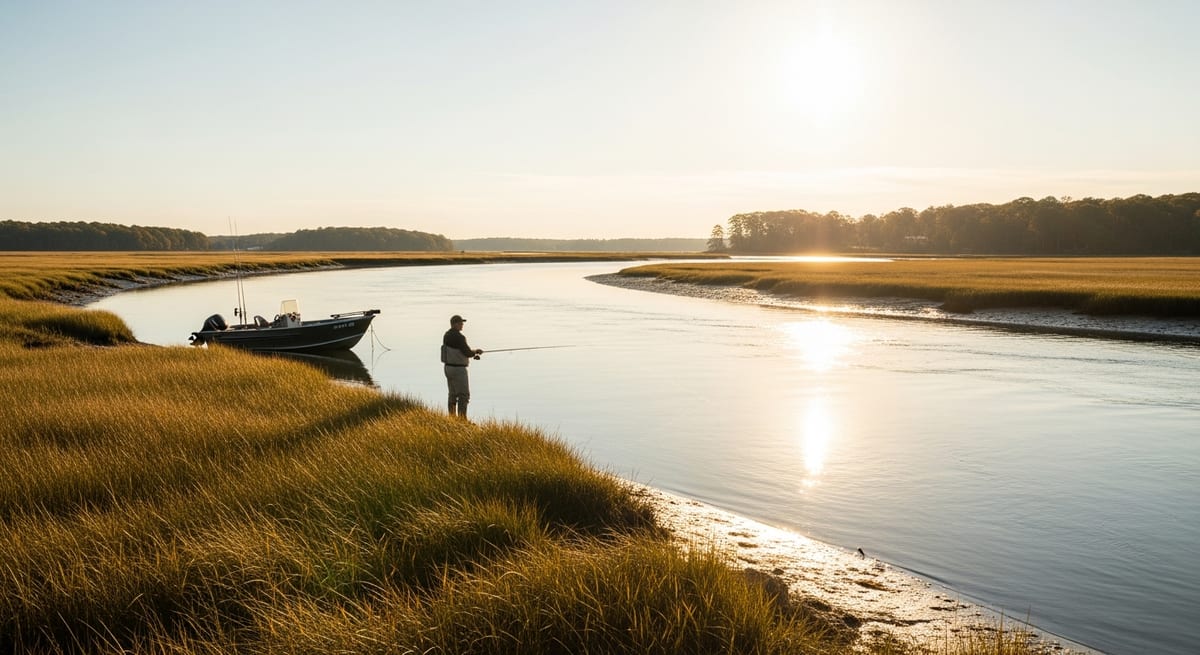
Connecticut's tidal rivers are genuinely special fishing environments, places where freshwater and saltwater species overlap, where tidal current creates constantly changing conditions, and where the concentration of fish life per accessible mile rivals anything in New England. The Thames, lower Connecticut, lower Housatonic, Niantic, and dozens of smaller tidal creeks all hold fish worth targeting. Here's how to approach them.
What Makes Tidal Rivers Different
A tidal river reverses direction twice a day. Current that was running downstream at 6 AM is running upstream by noon, then downstream again by evening. This cycle drives every aspect of fish behavior in tidal water:
The tide determines where fish hold: Fish face into current to conserve energy and intercept food. On the incoming tide, fish face upstream (toward you if you're near the mouth). On the outgoing, they face downstream. The same rock or pool that holds fish on an incoming tide may be empty on the outgoing, because the fish have moved to face the reversed current.
The tide concentrates bait: Outgoing tides flush baitfish and crustaceans out of marsh grass, backwater coves, and shallow flats. Predators stack at the mouths of creeks and the edges of flats waiting for this bait flush. This is why the two hours before and after low tide at a tidal creek mouth is consistently the most productive fishing window.
Salinity gradation: From the Sound toward the river's headwaters, salinity drops from full marine to fresh. The mixing zone is a rich, productive environment. Both marine and freshwater species use it. In CT, this mixing zone extends miles upstream on the major rivers.
Species by River Section
Lower tidal (river mouth, full marine influence):
- Striped bass (May-November). The primary target in lower tidal rivers
- Bluefish (June-September), follow bunker into river mouths
- Fluke (June-September), bottom fish on sandy areas near the mouth
- Weakfish/sea trout, occasional; best in August at night
- Tautog, rocky structure near river mouth year-round
Mid-tidal (brackish mixing zone):
- Striped bass, move well upriver following bait
- White perch, abundant, often overlooked; excellent eating. Spring spawning run is exceptional
- American shad, massive spring spawning run (April-June) on the Connecticut River; also present on the Housatonic and Thames
- Hickory shad, smaller than American shad; hits small shad darts readily
Upper tidal (near freshwater transition):
- Largemouth bass, use tidal marsh edges extensively
- Chain pickerel, grass marsh edges
- Catfish (channel and brown bullhead), bottom of tidal pools at night
Reading a Tidal River for Fish Position
Tidal creek mouths: Where a smaller tidal creek enters the main river is one of the highest-percentage spots in any tidal river system. The junction creates current variation, bait concentration, and depth change. Fish these on outgoing tide as bait flushes out.
Points and bends: Inside bends create current slacks (slack water) where fish hold. Outside bends accelerate current and create deeper scour holes, also productive fish-holding water.
Riprap and bridge abutments: Hard structure in a tidal river creates current breaks and bait-holding habitat. Any riprap bank (railroad causeway, dam face) holds stripers, tautog, and bass depending on salinity and season.
Grass bed edges: Spartina salt marsh grass beds are the nursery of the estuary, everything lives in them. The outside grass edge at mid-to-high tide is prime striper and snapper water. Bass push into the grass at high water and retreat to the edge as it falls.
Channel edges in the lower river: The navigation channel in lower rivers maintains depth where natural shoaling would reduce it. Fish hold on the channel edges and transition between channel and flat, particularly during incoming and outgoing current flow.
Gear and Tactics
For stripers in tidal rivers: The same gear as Long Island Sound inshore, medium-heavy 7-foot spinning rod, 4000-5000 reel, 20-30 lb braid, 20-30 lb fluorocarbon leader. Bucktail jigs, swimbaits, surface plugs, and live eels at night.
For white perch: An underrated tidal river target. A 4-6 lb spinning setup with small tube jigs, small spinnerbaits, and white/chartreuse jig heads catches white perch throughout the brackish zone. Spring (April-May) spawning runs concentrate them in numbers in river shallows.
For American shad: Shad darts (small teardrop-shaped weighted jigs in bright colors, pink, red, chartreuse, yellow) on 8-10 lb line drifted through shad pools on the incoming tide. The Connecticut River shad run (April-June) is one of New England's great spring fishing events.
For bass in tidal marshes: A weedless frog or surface walking plug in the grass edges at high tide, and a weightless Senko or chatterbait along the grass line as the tide falls, classic tidal marsh bass tactics.
EVERY SATURDAY MORNING
Weekly fishing intelligence
Nationwide conditions, what's biting, and honest gear deals. One email, no noise.
No spam. Unsubscribe anytime.