
CT Wading on the Farmington, Salmon River, and Housatonic Is Different from What Most Safety Guides Describe. What Trout Communities Report About Reading Spring Flows, the 2012 Felt Sole Rule, and Recovering When a Crossing Goes Wrong.
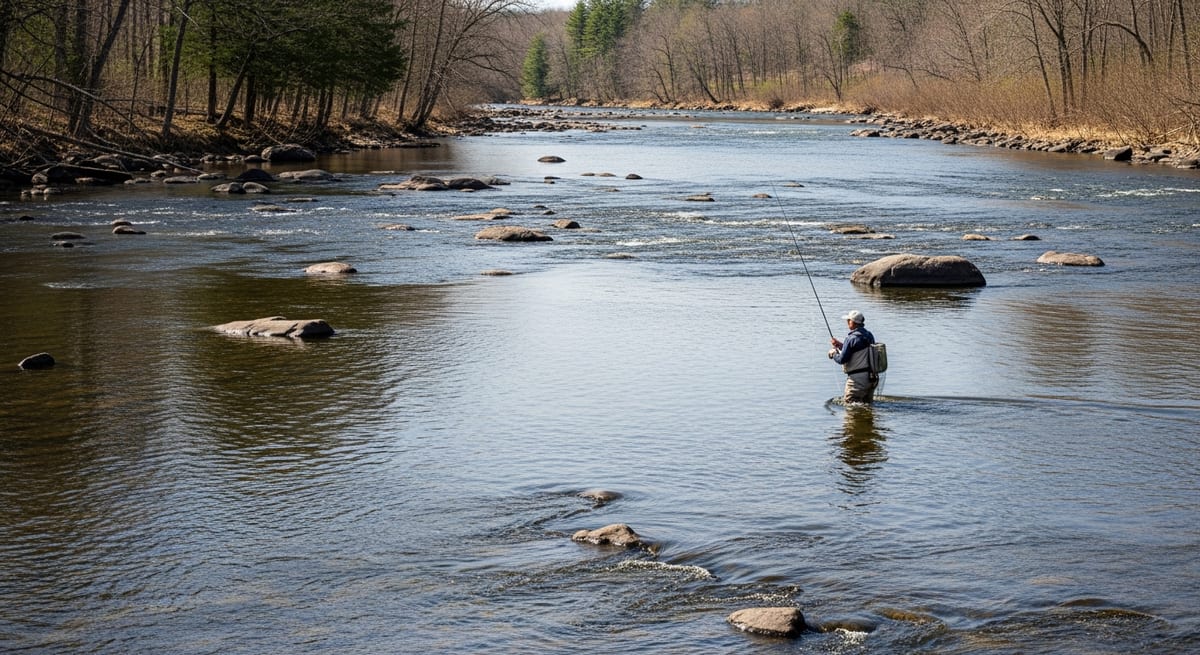
Connecticut DEEP banned felt-soled wading footwear statewide in 2012 under CGS Section 26-55i, a didymo-prevention measure targeting the invasive alga that colonizes felt fibers and spreads between watersheds. More than a decade later, it remains the regulation that draws the most questions on CT trout forums, particularly from visiting anglers arriving from states where felt is still permitted. The ban also pushed CT waders to refine their footing approach on algae-slicked rock, which is the substrate behind most of the falls that do happen on local rivers. Current is deceptive, CT rivers vary widely by season and recent rainfall, and cold water drains strength faster than most anglers expect on the Farmington and Housatonic in spring.
Reading CT River Flows Before You Step In
Before entering any moving water, read it from the bank. On CT rivers this step takes longer than most general guides suggest because local conditions vary sharply by season, recent rainfall, and which section of the river you're entering.
Check the USGS gauge first: The Farmington River at Unionville (USGS station 01186000) and the Salmon River near East Hampton (station 01119500) both have real-time flow data updating every 15 minutes. Anglers who wade these rivers consistently report that flows above roughly 400 cfs on the lower Farmington push conditions from manageable to marginal for most waders, though that number shifts with channel width and the specific section being crossed. Checking the gauge before driving out is standard practice among Farmington regulars, particularly in April and May when snowmelt can spike flows overnight.
Surface velocity vs. actual velocity: Current appears slower from above than it is. Water moving at even moderate speeds generates surprising lateral force on a standing body; USGS whitewater safety literature notes the physics are counterintuitive until you've felt them. Waist-deep water in meaningful current is genuinely dangerous for most adults. The consistent advice from waders on the Housatonic and Willimantic is to assume the current is faster than it looks from the bank.
Where current concentrates: Current accelerates around outside bends, narrows, and obstructions. It slows on inside bends, in pools, and behind structure. On the Farmington and Willimantic, spring runoff can effectively double current speed in a given section compared to summer low flows. Planning a wade path to stay in slower water when crossing is not overcaution; it is efficiency.
Visible depth cues: Darker water is typically deeper. White, frothy water over rocks is shallow but turbulent. The smooth, V-shaped downstream seam between rocks indicates a channel, often deeper than surrounding water. On the Farmington's limestone sections in particular, these depth transitions can be abrupt and are not visible without polarized lenses.
Bottom type: Algae-slicked limestone ledge is the most technically demanding CT wading surface. The Farmington's regulated catch-and-release sections and parts of the Housatonic carry significant algae load in warmer months. Gravel and cobble are more forgiving. Large boulders create uneven footing but are more stable than small cobble that shifts underfoot.
How Regulars Move Through Moving Water
Shuffle, don't step: On rocky bottoms, shuffle feet forward and to the side rather than lifting them. Lifting a foot removes contact with the bottom briefly, and during that moment current can push the standing leg off balance. The consensus among guides and regulars who fish the Farmington's catch-and-release sections is that the shuffle is the single most effective habit change for anglers new to technical wading.
Face upstream or diagonal: Face into the current when crossing. The strongest flow hits a narrow profile when you face it; turning downstream creates instability and lets current get behind the knees.
Wading staff: On significant current or uneven rocky bottom, a staff provides the third point of contact that makes an uncertain crossing manageable. Commercial collapsible staffs with magnetic chest-pack clips are standard among Farmington regulars who fish through runoff season. Anglers who wade the Housatonic's rocky mid-river sections consistently describe a staff as non-negotiable above certain flow levels.
One step at a time, feel for purchase: Place each foot deliberately, confirm it holds, then move the other. Never have both feet moving simultaneously.
Angle with difficult current, not against it: When wading upstream is impractical in strong current, the standard approach among experienced CT waders is to angle downstream, facing the near bank, moving diagonally with the current toward the far side rather than fighting straight across. The current assists the crossing rather than opposing it.
Read your depth honestly: When the water reaches your thighs in meaningful current, the question of whether to go deeper is worth a real pause. Waist-deep fast water is around the practical limit for most adults without buoyant waders. Anglers who regularly fish Connecticut's higher-gradient streams in spring tend to wade shallower than they would on the same water in August. That pattern reflects accumulated experience, not overcaution.
What CT Waders Carry: The Felt Sole Rule and Gear for Local Rivers
Felt soles are banned in Connecticut. Under CGS Section 26-55i (effective 2012), felt-soled wading footwear is prohibited statewide to prevent the spread of didymo (Didymosphenia geminata, commonly called rock snot) and other invasive aquatic species that colonize felt fibers and survive transport between watersheds. Carbide-stud rubber soles are the practical replacement in use across the CT trout community. On clean gravel and cobble, the dominant substrate on the Farmington and Salmon River, waders who made the transition report that traction difference is minimal on typical conditions. On algae-slicked ledge, technique and deliberate foot placement matter more than sole type regardless.
Waders: Neoprene through cold-water periods; wading literature generally pegs the crossover point at around 50-55°F water temperature, though individual tolerance varies. Breathable waders work when conditions warm. The Farmington and Salmon River run cold through much of the trout season, and anglers fishing April and early May typically run neoprene.
Wading belt: Non-negotiable with chest waders. If you fall, waders fill with water. A properly cinched belt dramatically slows water entry, giving time to find footing or reach shallow water. Without it, waders fill immediately and become extremely heavy. This is non-negotiable regardless of how shallow the planned wade looks from the bank.
Polarized glasses: Essential for reading the bottom. What looks like uniform substrate from above is often a complex mix of depths and footing types. The Farmington's limestone sections can conceal sudden depth changes that polarized lenses make visible before you step into them.
Wading staff lanyard: A collapsible staff attached via magnetic chest-pack clip is with you without requiring you to carry it by hand. This configuration is standard among Farmington and Salmon River regulars who wade through spring runoff windows.
Inflation PFD for tidal wading: Modern wading PFDs in chest-pack style inflate automatically on water contact. Anglers wading tidal stretches, including the Pawcatuck mouth near Westerly, the Niantic River flats, and the Thames near the jetties, deal with depth transitions less predictable than a managed trout river. Solo waders on those coastal stretches increasingly carry one.
When a Crossing Goes Wrong: What Farmington and Housatonic Waders Report
Falls happen to experienced waders. The Farmington and Housatonic both see waders go in during spring runoff, and what separates a recoverable fall from a dangerous one is almost always what happens in the first few seconds.
Don't fight the current: Fighting river current is exhausting and ineffective. Waders who have gone in on both CT trout rivers and tidal flats report the same consistent finding: going with the current is the correct instinct, not the panicked one.
Roll onto your back, feet downstream, toes up: The defensive swimming position. Feet absorb rock impacts instead of your head. CT rivers vary widely, and a fall on the lower Farmington in normal summer flows is a very different event from going in during peak spring runoff or in the Housatonic's main channel. The defensive position applies across all of them.
Float to slower water before trying to stand: Fast water around your legs will knock you down again. Eddies behind boulders, inside bends, and shoreline shallows are all valid targets. The Farmington's pools and the Salmon River's flatter sections give more options than a high-gradient rocky run. Trying to stand in mid-current before reaching calmer water is where recoverable falls become prolonged problems.
Swim diagonally toward the bank or an eddy: Diagonal is far more efficient than fighting straight across. Aim for the nearest calm water: eddy behind a boulder, inside bend, or the bank itself.
Controlled breathing in cold water: Cold water triggers a gasp reflex and can cause hyperventilation. Controlled breathing is the primary cognitive task in the first seconds after going in. The wading belt slows water entry into chest waders; the wader air pocket provides some buoyancy early in the fall.
After the fall: Get out, warm up, and reassess before continuing. The Farmington in April runs cold enough that continuing to wade with wet layers under breathable waders is a genuine hypothermia consideration, not just discomfort. A break on the bank to warm up is not conceding the session.
EVERY SATURDAY MORNING
Weekly fishing intelligence
Nationwide conditions, what's biting, and honest gear deals. One email, no noise.
No spam. Unsubscribe anytime.