
When Bantam and Candlewood Bass Won't Chase, CT Anglers Reach for a Suspending Jerkbait. What Cold-Water Communities Report About the Pause Window, Farmington Trout Technique, and Reading the Line Tick.
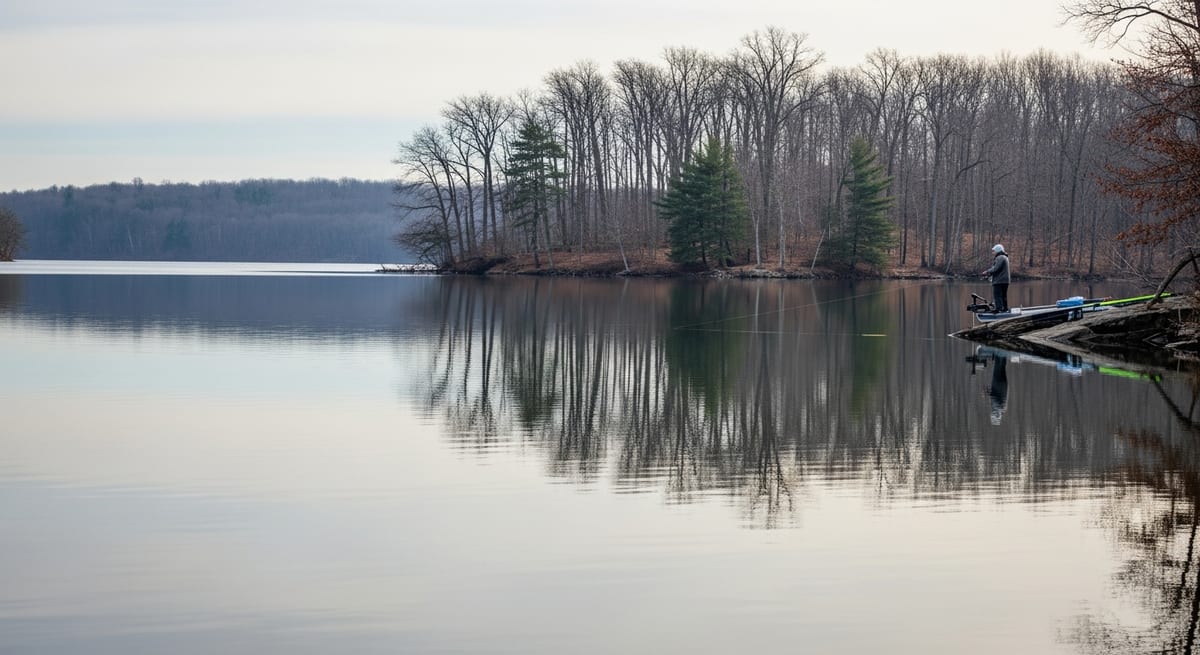
Anglers fishing Candlewood's mid-lake humps and Bantam's rocky points in late October and November have consistently reported jerkbaits drawing bass that refused every other hard bait in the box, often on pauses held well past the point most anglers would have reeled in and moved on. The lure's long, slender profile and suspending action trigger reaction strikes from fish running on a slow cold-water metabolism, and the CT bass community has built a consistent body of knowledge around working them on our lakes and rivers from late fall through early spring.
How a Jerkbait Differs From Other Hard Baits
A jerkbait is a long, slender hard lure, either suspending, slowly sinking, or slowly floating, designed to dart, flash, and hang nearly stationary between rod snaps. Unlike a crankbait that wobbles on a straight retrieve, a jerkbait does almost nothing on the reel. All the action comes from rod input.
Suspension is what defines the cold-water jerkbait. A quality suspending model hovers near-stationary in the water column after each snap. A bass or trout following the lure watches it appear to stall: suspended, quivering slightly, not escaping. CT bass communities on Bantam and Candlewood consistently attribute most cold-water jerkbait strikes to this pause phase, not to the dart itself.
The main jerkbait types:
- Suspending (most common for CT lake conditions): Neutral or near-neutral buoyancy. Holds in place on the pause. Models like the Rapala Shadow Rap, Lucky Craft Pointer 100, and Megabass Vision 110 are frequently cited in CT bass communities fishing Bantam and Candlewood.
- Floating: Rises slowly on the pause. Anglers fishing shallower Farmington River pools sometimes favor this style on mild late-winter days when fish show slightly more willingness to move.
- Sinking/gliding: Descends slowly on the pause. Better for fish holding at depth in cold conditions, such as Candlewood's mid-water structure in November and December.
How CT Anglers Work the Jerk-Pause Retrieve
Basic retrieve: Rod tip held low, pointing toward the water at roughly 30 to 45 degrees. A sharp sideways snap of the rod (6 to 12 inches of travel) sends the lure darting to one side. Reel in the slack. Pause. Snap again. The lure darts back the other direction. Pause again.
The pause is where cold-water jerkbait fishing diverges from every other technique in the box. In the temperature range where Bantam and Candlewood bass begin pulling off main-lake points toward mid-depth structure, which many CT anglers track in the mid- to upper-50°F zone, pauses of several seconds are common. Anglers on CT bass forums have reported productive pauses in the 8 to 10-second range during cold post-front conditions, though the right length varies considerably with fish activity on a given day. The lure hangs suspended, a slight rod-transmitted quiver the only sign of life.
Anglers who fish jerkbaits on Lillinonah in late October describe bass tracking the lure for an extended distance before committing only when it fully stopped. What separates experienced jerkbait anglers from casual users, according to the CT community, is watching the line intently on every pause rather than relying on rod feel. Most fish are lost because anglers wait for a thump that never arrives instead of watching for the line to tick or move sideways.
Cadence patterns CT communities have reported:
- 2 jerks, extended pause (cold-water standard on Bantam and Candlewood)
- 3 quick jerks, shorter pause (early spring, when fish begin showing more willingness to chase)
- Single slow jerk, deliberate pause, repeat (for fish that appear to be following but not committing)
Where and When CT Bass Communities Reach for Jerkbaits
Cold, clear water in late fall and early spring: The reliable jerkbait window on Bantam, Candlewood, and Lillinonah. Anglers who fish these lakes report the lure outperforming crankbaits and spinnerbaits once fish have moved off main weedlines and are staging on deeper structure. The clearer the water, the more consistently CT communities recommend jerkbaits: visibility allows bass to track the lure from a distance and react to the pause.
Cold-front recovery on CT's clear lakes: After a front moves through Connecticut and fish go negative, CT bass communities lean toward extended pauses and a slower overall cadence. Bantam regulars describe this as one of the few reliable patterns in a tough late-October or early-November window, a consistency that has held across multiple recent fall seasons. CT DEEP's public angler reports from fall creel surveys reflect reduced overall catch rates following frontal passages, which aligns with community reports of front-funk fish refusing faster presentations.
Smallmouth on rocky structure: Candlewood and Bantam both carry smallmouth populations, and anglers fishing rocky points and submerged gravel flats in the 5 to 15-foot range report strong jerkbait results in spring. CT DEEP maintains a 12-inch minimum size limit for bass statewide; smallmouth and largemouth share the same regulation. Anglers targeting smallmouth on Candlewood in April and early May report jerkbaits drawing fish that had been ignoring drop shots and tube jigs.
Trout on the Farmington and Housatonic: A slim suspending or floating minnow bait (a Rapala Original or similar narrow-profile lure), jerked and paused in pools and eddy margins, produces both stocked and wild trout in CT rivers. Farmington River regulars report consistent jerkbait takes in pools through the Collinsville and Avon stretches during late-winter and early-spring trout stocking windows. The Farmington's Trophy Trout Management Area carries gear restrictions anglers should verify directly on CT DEEP's site before fishing. The Housatonic's broader, slower pools also produce on this presentation when water clarity improves after runoff settles.
Conditions that limit jerkbait effectiveness: CT bass communities consistently note dropping jerkbaits from the rotation in heavy surface vegetation, where treble hooks collect milfoil and lily pad stems on almost every cast. In turbulent, high-water conditions common after spring rain events on the CT River and Housatonic, the darting action loses its definition and other presentations outperform. Stained or off-color water also undercuts the visual trigger that makes jerkbaits effective in the first place.
EVERY SATURDAY MORNING
Weekly fishing intelligence
Nationwide conditions, what's biting, and honest gear deals. One email, no noise.
No spam. Unsubscribe anytime.