
Farmington TMA and Salmon River Browns Push Into Shallow Runs Every October While Most CT Anglers Have Called the Season. What CT DEEP Stocking Data, TMA Regulars, and the Fall Hatch Calendar Reveal About Connecticut's Most Overlooked Trout Window
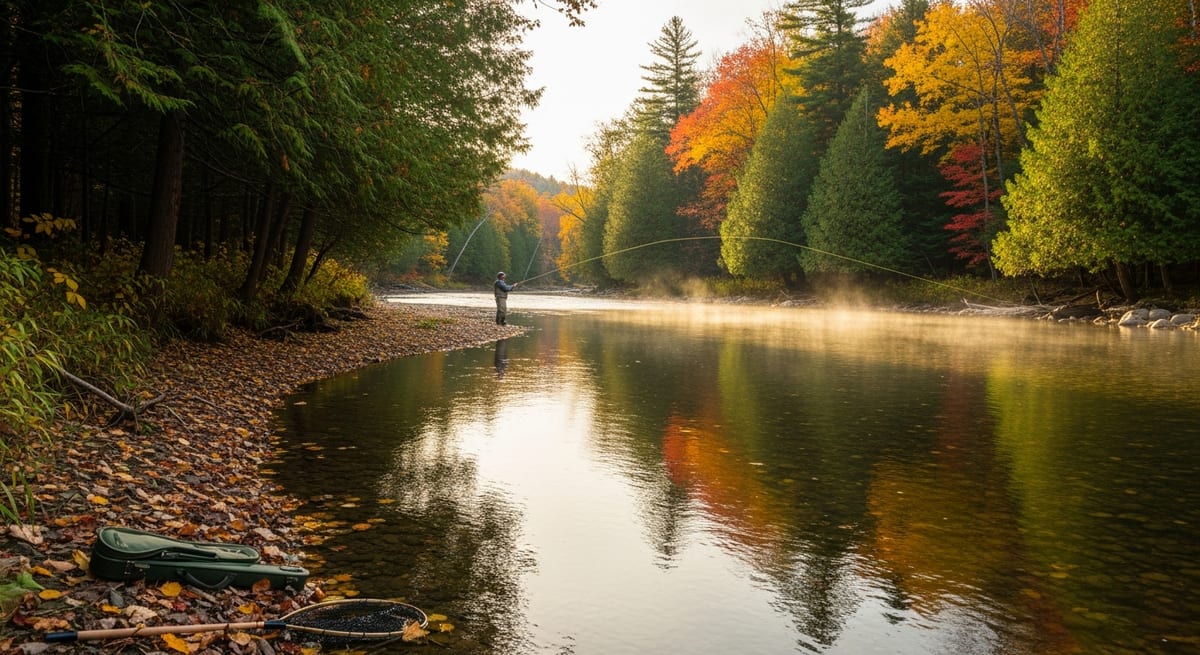
The Salmon River sees a documented run of large brown trout from the Connecticut River each October and November, with fish in the 16-22 inch range moving into accessible water at the Route 16 bridge and Comstock Bridge sections in East Hampton. Anglers who stay on CT rivers through this period report conditions that contrast sharply with the spring season: river temperatures back in the 52-62°F range, Blue-Winged Olive hatches on overcast afternoons, and fish that have spent months with minimal pressure. CT DEEP freshwater reports and TMA community observations consistently describe the October-November window as among the most underutilized in the state's trout season.
What River Temperature Data and the Pre-Spawn Calendar Reveal About CT's Fall Trout Activation Window
The fall trout window on CT rivers opens when surface temperatures drop back through the 60°F mark, typically in late September on the Farmington and Housatonic, and running into early November in warmer years. Holdover brown trout that feed minimally during summer heat respond quickly once temperatures settle in the 52-62°F range, a shift that shows up in DEEP-gauged river data for the Farmington near Riverton.
Brown trout pre-spawn staging typically begins in October on CT rivers, with spawning itself occurring from late October through mid-November depending on conditions that season. Male browns become territorial during this period and often shift into shallower, faster water. TMA regulars and CT Trout Unlimited chapter reports describe a noticeable increase in streamer takes from mid-October onward, with fish responding to larger, more aggressive presentations than they would accept in calmer feeding periods.
Reduced angling pressure compounds the opportunity. CT rivers in October carry a fraction of their spring crowds, and fish that have seen constant presentation pressure since April reset toward less-educated feeding behavior. The consensus among Farmington TMA regulars is that October fish are more willing to eat larger patterns than the same fish would consider in May.
Fall also brings some of the year's most reliable hatches. Blue-Winged Olives hatch on overcast afternoons from late September through November, and October Caddis, the largest caddis of the CT season, produce aggressive surface activity in early October. Community reports from the Farmington valley consistently describe fall dry fly fishing as outperforming many spring days when crowds compete for the same water.
Farmington TMA, Salmon River, and Housatonic: Where CT Fall Trout Reports Concentrate
Three CT rivers draw the most consistent fall trout reports from community anglers:
Farmington River (TMA section, Riverton to New Hartford): The Farmington's wild brown and rainbow population holds year-round in catch-and-release water. Fall BWO hatches, typically active on overcast afternoons from late September through early November, produce surface-feeding fish in slower runs and tail-outs. TMA regulars report fish concentrating near the Hogback Road pull-off and the Route 44 section in October. CT DEEP stocking records show the TMA receives holdover-quality fish that are fully wild in behavior by the time fall arrives.
Salmon River (below Salmon River Reservoir, East Hampton): CT DEEP creel data and multi-season angler reports document a fall brown trout run from the Connecticut River each October and November. Fish in the 16-22 inch range push upstream to the Route 16 bridge and the DEEP's Comstock Bridge fishing area, both of which provide foot access to the most productive fall sections. Anglers who target this run report that egg patterns and larger streamers outperform other presentations once fish are actively pushing upstream.
Housatonic River (TMA, West Cornwall): The Housatonic TMA holds wild brown trout that respond to October Caddis hatches in the first two weeks of October. Pull-outs along Route 7 near Falls Village and the West Cornwall covered bridge area provide foot access to riffled water where staging browns hold. The Housatonic Fly Fishers Association regularly publishes fall condition reports from the Cornwall section.
Below-TMA Farmington (Burlington section): Stocked water below the catch-and-release boundary holds late-season holdovers that see far fewer anglers in fall than spring. Regulars report productive nymph fishing in deeper pools through October.
October Caddis, BWO, and Egg Patterns: What Farmington and Housatonic Regulars Report About Fall Fly Selection
Fall fly selection on CT trout streams follows the hatch calendar more closely than in any other season:
October Caddis (size 8-10, orange/rust): The largest caddis hatch of the CT season typically runs from early to mid-October on the Farmington and Housatonic. These are large flies and takes during the hatch are often aggressive. Elk-hair caddis in burnt orange and palmered caddis patterns in rust appear most frequently in CTTU fly swap threads and local shop reports from the Farmington valley. Fish the hatch in late afternoon when adults are most active on the water surface.
Blue-Winged Olive (size 18-22): BWO hatches intensify on CT streams in fall, particularly on overcast days with falling barometric pressure. Community reports consistently note that matching size precisely matters more in fall than spring, with refusals common when a fly is two sizes off from what fish are keying on.
Streamers (size 4-6, articulated): Territorial pre-spawn browns are among the most responsive streamer targets of the year. Articulated streamers in olive/white or black/olive, swung and stripped through pools, account for many of the season's largest fish. Regulars on the Farmington TMA describe dark November days as producing the most consistent streamer takes of any period in the season.
Egg patterns (size 10-12, chartreuse or orange): Non-spawning trout and brook trout position downstream of active redds to intercept drifting eggs. Anglers report that reading the downstream drift line from spawning gravel matters more than exact pattern color.
Woolly Bugger (size 6-8, black/olive/brown): The fallback when conditions reduce visibility. Swung on a downstream arc through pools and deeper runs, it finds fish that won't chase an aggressive strip presentation.
CT Fly Fishing Communities Have Largely Settled the Redd Ethics Debate. What TMA Regulars and CTTU Members Report About the Lines Most Anglers Observe
Fall spawning creates ethical territory that CT trout anglers discuss more actively than almost any other topic on the water. Based on public forum discussions, CTTU chapter meeting records, and TMA community observations, a working consensus has emerged across three distinct situations:
Walking on or through active redds is near-universally regarded as unacceptable. Brown trout build redds on gravel bars, visible as lighter-colored, cleaned patches in shallow water where the fish have disturbed sediment. Wading through these areas destroys deposited eggs. CT DEEP regulations on TMA water actively discourage redd disturbance, and the TMA community treats it as a baseline expectation rather than a judgment call.
Targeting fish actively on their redds is more debated but leans negative in CT fly fishing community discussions. The argument regulars make is that a fish defending its redd is responding to territorial instinct rather than prey drive, and catching it this way is viewed as taking unfair advantage rather than genuine angling. Casting to pre-spawn fish staging near, but not yet on, their eventual redd sites is regarded differently by most TMA regulars.
Post-spawn fish are the most broadly accepted fall target. Browns that have completed spawning and dropped back into holding lies are actively feeding to rebuild condition, often positioned in deeper runs and pools on the Farmington and Salmon River. These fish tend to run 15-20 inches and are in accessible water through late November.
Cold fall water, typically below 55°F on CT rivers by late October, supports strong catch-and-release survival. CT DEEP guidance on trout handling recommends minimizing air exposure and reviving fish fully in moving water before release.
EVERY SATURDAY MORNING
Weekly fishing intelligence
Nationwide conditions, what's biting, and honest gear deals. One email, no noise.
No spam. Unsubscribe anytime.