
The Housatonic Brown Trout Section Gets the Traffic. What's Below Stevenson Dam, and Below Derby, doesn't See Nearly as Many Rods.
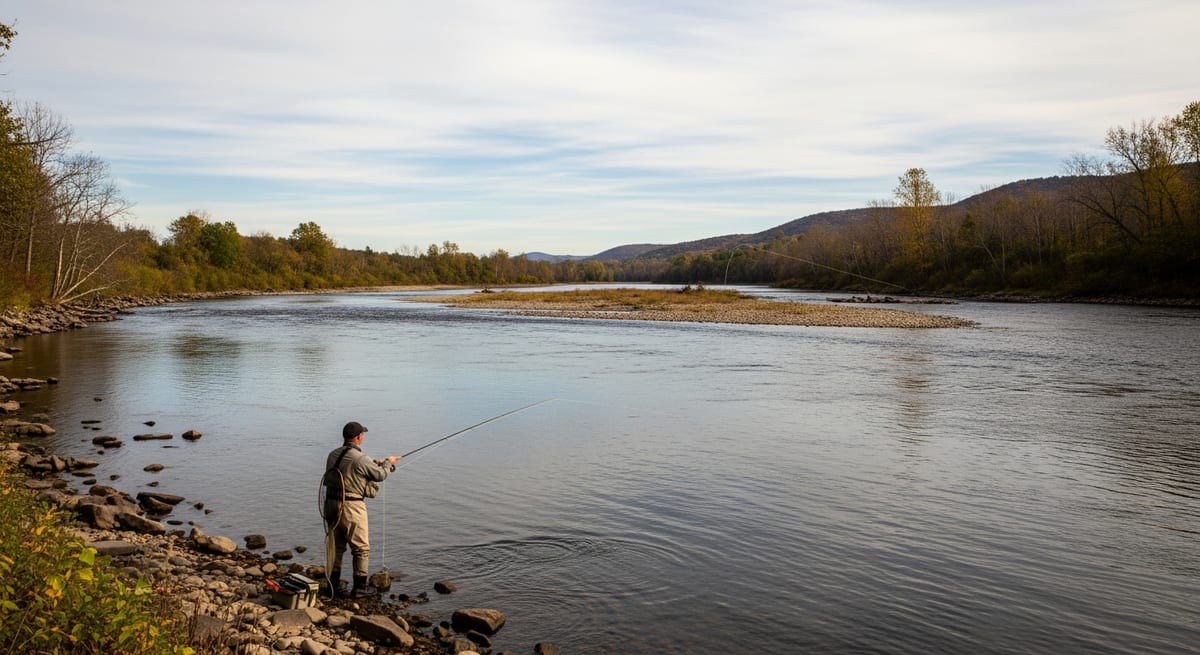
Anglers fishing the Derby Pool at Birmingham Park during the April shad run describe some of the most overlooked river action in Connecticut. Fish stacking in the current while much of the state's angling attention stays fixed on the fly water 40 miles upstream. The Housatonic flows 149 miles from Pittsfield, Massachusetts through western Connecticut to Long Island Sound at Stratford. The Cornwall-through-Kent corridor gets the fly-fishing attention, and not without reason, cT DEEP manages it as Trout Management Area water with naturally reproducing wild browns. But the middle river below Stevenson Dam holds quality smallmouth that see a fraction of that pressure, and the tidal reach below Derby runs a spring shad migration that most inland anglers never get around to. Anglers who fish all three sections tend to treat each one as its own destination, different gear, different timing, different techniques entirely.
The Cornwall-to-Kent TMA: What Wild Brown Trout Water Actually Demands
The 10-mile stretch from Cornwall Bridge through Kent holds one of Connecticut's more significant wild brown trout populations, cT DEEP electrofishing surveys have documented naturally reproducing fish across multiple sections of this corridor, which is the basis for the Trout Management Area designation it carries. This water is demanding, but anglers who fish it consistently don't treat it as unapproachable.
West Cornwall Covered Bridge Area: The most famous access point, and the most heavily fished. The bridge pool and the runs above and below it draw significant weekend pressure, especially during the Hendrickson hatch. Anglers who fish this stretch regularly tend to report weekday mornings as the more productive window. The flat glides 100 yards upstream rarely get worked by weekend crowds, and they hold fish through the season.
What to expect: Wild browns in this section run a meaningful size range; CT DEEP TMA survey data has historically documented fish averaging in the low-to-mid teens, with larger individuals present in deeper holding water and channel edges. Because this is a naturally reproducing population, not a stocked one. These fish are significantly warier than average CT trout.
The river runs gin-clear, which means leader length and presentation matter more here than almost anywhere else in the state. Leaders of 12-15 feet with 4X-6X tippet are standard among Housatonic regulars; anglers fishing low summer flows often extend to 16-18 feet. The consistent pattern reported across CT fly-fishing communities: switching to dries before the water has warmed enough for consistent surface activity. Staying subsurface until you're watching actual risers is the approach that produces on this water.
Trout Management Area rules: CT DEEP designates specific Housatonic reaches as Trout Management Areas (TMA) with special regulations, artificial lures only, catch and release in some stretches. Always check current CT DEEP regulations for the specific section you plan to fish before you show up. These zones shift, and the fines are substantial.
Best season: The Housatonic fishes year-round. The Hendrickson hatch in late April draws anglers from across New England, deservedly so. Sulphurs and Cahills carry through May-June. Terrestrials (beetles, ants, hoppers) are a genuine option from July through September: lower pressure, willing fish in the afternoon hours when the main crowds are off the water. BWOs start in October and carry into early November.
Nymphing: Highly productive when hatches aren't firing. Pat's Rubber Legs, Pheasant Tails, Hare's Ear, standard Western patterns translate well to the Housatonic despite its New England setting.
Brook trout show up in the smaller tributaries, particularly around Salmon Creek and the Falls Village area, worth exploring when the pressured main stem isn't producing.
Below Stevenson Dam: The Smallmouth Section That Trout-Focused Anglers Tend to Skip
Below the Stevenson Dam impoundment, the Housatonic shifts into strong smallmouth water, rocky structure, significant current, and fish that bass anglers who target this section regularly rate alongside the better river bass fishing in Connecticut. Most trout-focused anglers pass through the Shelton-to-Derby stretch on their way upstream. The fish on the other side of that windshield are worth stopping for.
Target structure: Rocky points, mid-river boulders, bridge abutment eddies, and tailwater below the dam. Smallmouth in this section typically run 10-16 inches; channel edges and deeper current seams tend to hold the larger fish. The current makes them fight well above their nominal size. Anglers who fish this section often rank it above equivalent lake bass fishing purely for the quality of the fight.
Best techniques:
- Tube jigs and Ned rigs worked slowly along rocky bottom, crayfish are the primary forage through this section
- Brown and orange crayfish soft plastics tend to outperform in slower or post-frontal conditions
- In-line spinners (Mepps, Blue Fox) worked across current in the faster runs
- Clouser minnows and woolhead sculpins on a fly rod, less common on the middle Housatonic than the results warrant, based on reports from anglers who've put consistent time into this stretch
Spring shad overlap: CT DEEP's ongoing fish passage work at Stevenson Dam has extended the effective range of the shad run in recent seasons. Reports from anglers fishing the Derby-to-Shelton corridor indicate shad moving through this middle section during April and into early May, coinciding with the peak of the lower-river run. Rigging a second rod during that window has produced unexpectedly strong dual-species days for anglers who know to look for it.
The Tidal Reach at Derby: Shad, Stripers, and the Spring Season That Inland Anglers Miss
The tidal Housatonic from Derby to the mouth at Stratford is a completely different fishery from what's upstream, and it draws its own community of anglers who don't spend much time thinking about what's happening at Cornwall Bridge.
American shad run (April-May): This is the most spectacular spring fishing event on the Housatonic. Shad enter the river in late March, with peak numbers typically arriving through April and holding into May. The Derby Pool at Birmingham Park is the most accessible entry point, and during a strong afternoon in late April the pool sees fish activity that anglers who fish this run consistently describe as some of the more reliable spring river action in the state.
Standard approach: dart jigs in the 1/4 to 3/8 oz range in red/white, pink, or chartreuse, cast quartering downstream and retrieved with a slow, steady swing. Water temperature and flow both affect the bite. Anglers who fish the Derby Pool regularly note that retrieve speed matters and can shift inside an hour, varying the pace until the fish respond on a given day is standard practice. The run is consistent but not mechanical: the stacks are there, but the bite window requires reading conditions.
Striped bass: The lower Housatonic is a reliable early-season striper spot. Fish push in well ahead of the main coastal migration, may and early June are the consistent window, particularly at dawn and dusk along the channel edges. Eels, bunker, and large soft plastics all produce. Surface plugs at first light are worth trying when fish are visibly pushing bait.
Bluefish: A fall reliable, bluefish push bait into the river mouth area September through October. Metal lures and large poppers, fast retrieve.
Access: Birmingham Park in Derby provides solid public access to the tidal section with parking. During peak shad season, the main lot fills early; the side streets near the boat launch offer additional entry points.
Access Points, Regulations, and the PCB Consumption Question
Access points:
- West Cornwall Covered Bridge (Sharon/Cornwall), parking, primary fly fishing access
- Falls Village (Canaan), parking, wade access above and below Falls Village Dam
- Kent Falls State Park, picnic area, river access below the falls
- Stevenson Dam area, multiple access points in the Monroe/Stevenson area
- Birmingham Park, Derby, tidal section access, shad and striper fishing
Regulations: The Housatonic has multiple designated zones, tMA, no-kill, catch-and-release, artificial-only. That vary by reach and can change year to year. CT DEEP publishes a zone map annually. Review it before each trip, not once at the start of the season and not carried over from prior years. Boundaries have shifted, and the fines are real. Long-time TMA regulars pull the current zone map before heading out every season. That's not excessive caution, that's standard practice on this river.
CT fishing license: Required for all anglers 16 and over. The TMA stretch may require a specific trout/salmon stamp, verify current requirements before you fish.
The PCB question: The Housatonic has documented PCB contamination from historic General Electric manufacturing operations in Pittsfield, MA. CT DEEP and MA DEP both issue reach-specific consumption advisories, and some fish from some stretches should not be eaten. Check the current CT DEEP consumption advisory before keeping any fish. The advisory is reach-specific, updated periodically, and the distinction between sections matters. It's not a blanket river-wide ruling.
The consensus among anglers who fish the Housatonic across all three sections, reflected consistently in CT fishing club discussions and community threads, has settled on catch and release regardless of section and species. The PCB advisory creates genuine uncertainty in some stretches, and the wild brown trout population in the TMA benefits from the practice. Both considerations point the same direction.
EVERY SATURDAY MORNING
Weekly fishing intelligence
Nationwide conditions, what's biting, and honest gear deals. One email, no noise.
No spam. Unsubscribe anytime.