
Line Twist Is a Spooling Problem, Not a Retrieve Problem. What CT Shore Anglers Do Differently When Loading Mono, Braid, and Fluoro.
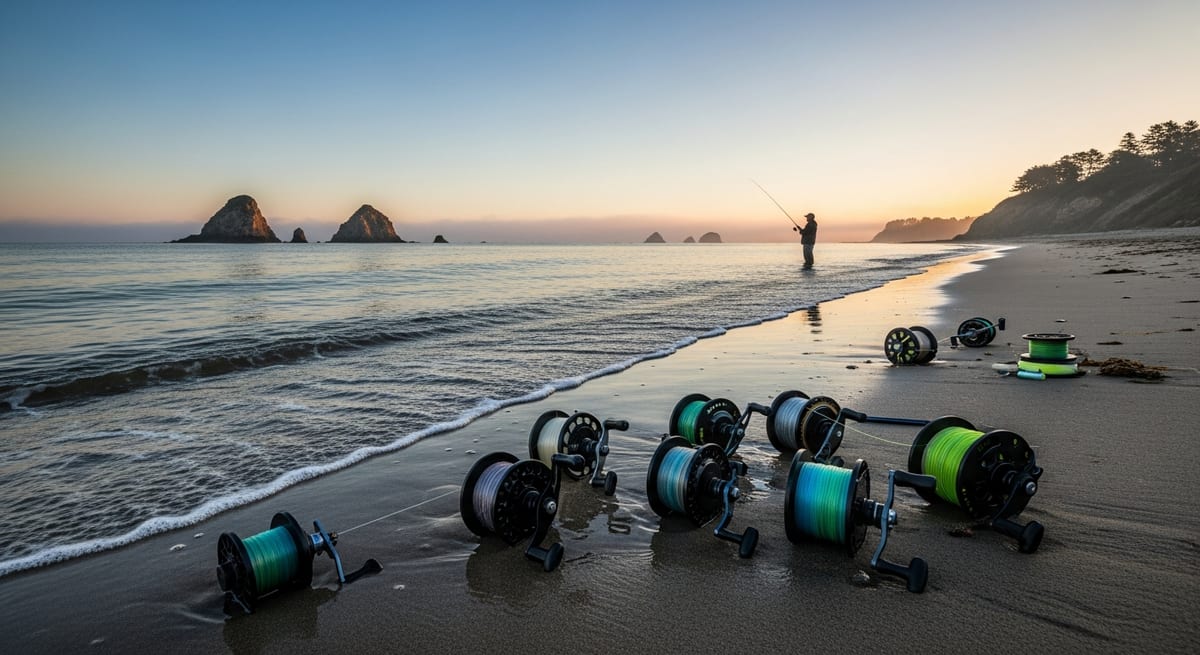
Anglers who fish Connecticut's tidal rips. The Niantic River mouth, the Thames estuary, the eastern Sound near the Race, report that line twist failures tend to cluster at the start of the season, not mid-summer: the reel was spooled incorrectly months earlier and the bird's nests didn't appear until the line had enough outings to reveal the problem. Line loaded with twist tangles within the first several casts. Line loaded correctly casts smoothly, stores without memory, and lasts the season. The method differs across monofilament, fluorocarbon, and braid, and the braid step most anglers skip is the one responsible for catastrophic failures under a running fish.
Why Line Twist Happens, and Where It Usually Starts
Line twist is the rotational torque that builds up in fishing line and expresses itself as loops and tangles during casting or retrieve. Severe line twist turns an afternoon on the water into an afternoon picking at bird's nests.
The spooling step most anglers get wrong:
When filling a spinning reel, line comes off the supply spool while the reel spool rotates. If the line comes off in a direction that adds rotational torque rather than canceling it, twist gets loaded in before a single cast is made. CT anglers fishing tight-space shorelines, rocky points on Long Island Sound, tidal creek mouths on the Housatonic, report this as the root cause of most early-season tangle problems.
Lures that spin on retrieve:
Certain lures, spoons, some spinners, metal jigs that roll, rotate with every revolution of the retrieve and add twist continuously. A spoon working a long retrieve through a bunker school can complete hundreds of rotations before it reaches the rod tip.
Bail closure under tension:
If the bail snaps closed against a running fish or during the retrieve, it introduces twist at the point of closure. The consensus among Long Island Sound surf casters is to close the bail manually with the off hand rather than letting a rod sweep snap it shut.
The spooling step is a one-time fix before the season starts, and anglers who address it there eliminate the most common source entirely.
Spooling Mono and Fluorocarbon: The Direction Test That Changes Everything
Monofilament and fluorocarbon follow the same spooling process. The critical variable is whether line comes off the supply spool in the same rotational direction as it goes onto the reel spool. Getting this wrong once is how twist gets baked in before the first cast.
Setting up the supply spool: CT anglers who spool without twist consistently orient the supply spool flat on the floor with the label facing up, so line peels off the face of the spool rather than from the side.
Threading and tying on: The line runs from the supply spool through the first rod guide (the one closest to the reel), through the bail, and ties to the reel spool arbor with an arbor knot. Arbor knot method: wrap the line around the spool arbor, tie an overhand knot in the tag end, then tie a second overhand knot in the main line just above the first, with both knots sliding toward the arbor and seating firmly when the tag end is pulled.
The direction test: After closing the bail, five or six turns of the handle reveal whether the orientation is correct. If loops form and twist is visible in the line between the first guide and the reel, flipping the supply spool over (label side down) reverses the twist direction. The orientation that produces minimal twist is the one to hold for the full fill. CT kayak anglers fishing the Housatonic and the lower Connecticut River describe this single test as the step that eliminated most of their early-season tangle issues.
Spooling under tension: Light finger pressure applied to the line between the supply spool and the first guide as the reel fills keeps line lying flat and tight on the spool. Line filled under no tension creates an uneven base that causes casting problems regardless of twist direction.
Fill level: Most reel manufacturers cite approximately 1/8 inch from the spool rim as the target fill level, close enough that underfilling doesn't cost casting distance, but not so full that line falls off in loose loops during the cast. The exact threshold varies by reel model and is typically noted in the reel's documentation.
Spooling Braid: The Backing Step That Prevents Catastrophic Failure
Braid requires one step that monofilament doesn't. Braid's smooth surface can slip on a bare reel spool under load. A failure mode called "braid slip," where the entire line spool spins freely inside the reel and a fish takes everything.
CT striper anglers fishing the Thames estuary and the eastern Race in autumn, where large fish make sustained runs, identify braid slip on improperly spooled reels as a real, season-ending failure. A short monofilament backing takes under a minute to add and eliminates it.
Monofilament backing: Fifteen to twenty yards of monofilament (any weight) spooled onto the bare reel first using an arbor knot provides the grip surface braid needs. The backing only needs to cover the arbor and a few initial layers. It doesn't take up meaningful capacity on the spool.
Connecting braid to mono: A double uni knot or an Albright knot connects the braid tag end to the monofilament backing. Both pass through guides without catching and hold reliably under load.
Spooling the braid: Same process as monofilament, supply spool flat on the floor, finger tension on the line, steady cranking pace. The direction test applies to braid as well.
Fill level: Same target as monofilament, approximately 1/8 inch from the spool rim.
Knot technique with braid: Braid has essentially zero stretch and generates friction heat faster than mono when a knot cinches. CT striper anglers who use braid as their primary spinning line consistently wet braid knots thoroughly before pulling them tight. Wrap counts in uni knots with braid tend to run higher than with monofilament, but the count that holds well varies meaningfully by line diameter and manufacturer. Anglers fishing heavier braid typically test their preferred count on a new line brand before trusting it on a full season of running fish.
When Twist Is Already In the Line
Twist already present in the line, visible as spiral loops even under no tension, doesn't always require immediate re-spooling. CT shore anglers fishing tidal locations describe using moving water to work twist out before deciding whether fresh line is needed.
The drag strip method: With the lure removed and the reel engaged, letting out approximately 100 yards of line, by holding the rod parallel to the water and walking, or by letting current draw the line, allows the line moving through water to straighten and unwind accumulated twist along the run length. Reeling back in under light tension consolidates the improvement. One or two repetitions clears moderate twist; twist that reappears immediately after the first attempt signals that fresh line is the right call.
When fresh line is the call: Line that can't be salvaged by the drag strip method should be stripped and disposed of without leaving coils in shoreline vegetation, monofilament takes years to break down and entangles shorebirds and wading birds. Some CT bait and tackle shops accept spent monofilament for recycling; DEEP-managed public access areas sometimes have dedicated fishing line recycling tubes mounted near launch points. Fresh line, spooled correctly, is the only fix for severe twist.
Ongoing prevention: Anglers who run rotating lures, spoons, spinners, metal jigs that roll on retrieve, typically add a barrel swivel between main line and lure to interrupt rotational transfer. Manually closing the bail rather than relying on a rod sweep reduces cumulative twist on every retrieve.
When to Replace Line: What Lasts a Season and What Doesn't
Monofilament: Monofilament degrades from UV exposure, heat, and abrasion. CT anglers who store reels in vehicles or direct sun through summer report accelerated degradation. The line becomes stiff, cloudy, and develops persistent coils that won't straighten even off the reel. Fresh mono that looks clear and supple is typically still sound; mono that coils persistently under no tension has lost its usefulness.
Replacing monofilament at the start of each season is the standard practice for regular CT anglers, with mid-season replacement warranted if visible damage or significant memory appears before fall.
Fluorocarbon: Fluoro resists UV degradation better than monofilament and typically lasts a season or two longer as mainline. Leaders take the most abuse. The rocky shorelines of Long Island Sound and the stone structure of the lower Connecticut River are harder on fluoro leaders than open-water fishing. Leaders showing nicks or abrasion marks warrant replacement; mainline fluorocarbon typically runs 2-3 seasons with regular use before knot strength starts to feel reduced.
Braided line: Braid doesn't degrade from UV the way monofilament does, and a well-maintained braid can run three or more seasons. The failure mode to watch for is abrasion: it appears as a white, fuzzy section where the weave has been disrupted, typically from repeated contact with rocks, pilings, or dock structure. Sections with visible abrasion damage should be cut off and the leader re-tied before the next session.
CT striper anglers who fish multiple full tides through rocky LIS structure on braid-spooled spinning gear describe pulling off the top 20-30 yards at the start of each season and re-tying the leader connection. The lower braid on the reel shows no meaningful wear in most cases. The top section accumulates the contact damage from a full year of fishing, and removing it resets the effective running line without the cost of a full re-spool.
EVERY SATURDAY MORNING
Weekly fishing intelligence
Nationwide conditions, what's biting, and honest gear deals. One email, no noise.
No spam. Unsubscribe anytime.