
Most CT Anglers Are Fishing the Wrong Line for the Water They're On
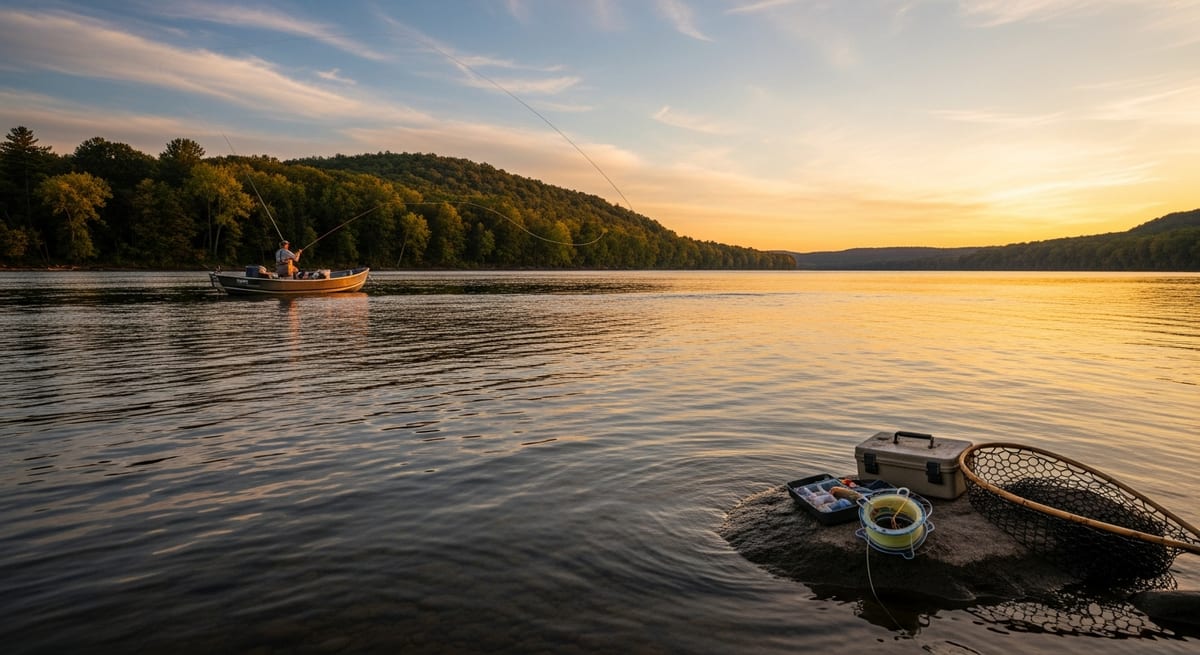
On the Housatonic's lower estuary, where tidal current runs hard through the fall striper migration, anglers running heavy monofilament can lose 20-30 percent of their hookset energy to line stretch before pressure ever reaches the fish. Anglers who fish that estuary in fall describe the pattern clearly: solid sets, short runs, hooks gone, and an easy misdiagnosis of dull hardware. The line was the problem, and it's the kind of problem that masquerades as bad luck all day long. Braid, mono, and fluorocarbon behave like three completely different materials on the water. Anglers who fish CT rivers, tidal water, and inland reservoirs across multiple seasons often end up with a line system that looks nothing like what they started with, and the pattern of what gets changed and why is consistent enough to be useful. What follows draws on accumulated community knowledge from CT tidal and freshwater anglers, organized by water type and application.
Monofilament: Still the Right Call in More Situations Than You'd Think
Most anglers start on mono and treat it like a starter kit to graduate from. Experienced freshwater regulars push back on that framing consistently, mono remains the correct choice for a real range of CT situations, and on light spinning setups it handles better than anything else available.
When mono earns its place:
- Topwater fishing. The stretch actually helps here. It gives bass or pickerel a split second to fully commit before the line loads, which translates to fewer fish that short-strike and spin off the hooks on the pause
- Spinning reels with 4-10 lb line, in lighter weights, mono behaves far better than braid on a spinning spool; lighter braid winds-knot badly and digs into itself
- Float fishing and bobber rigs. It casts well, doesn't create friction problems, and the stretch absorbs strike shock naturally
- Anglers newer to the sport, mono is forgiving on the spool and far less likely to create the braid tangles that end a day faster than a cold front
On CT's light-tackle freshwater scenes, yellow perch on the Quinnipiac, early-season trout on the Farmington's public-access sections, smaller bass on the inland reservoirs. Anglers consistently find that mono in the 6-10 lb range handles cleanly without adding complexity to the setup. CT DEEP's freshwater regulations require a separate trout/salmon stamp for designated trout management areas including portions of the Farmington; confirm that stamp requirement before targeting those sections.
Mono drawbacks: It absorbs water and breaks down under UV exposure. Mono left on a spool in direct sun all summer is not the same line put on in the spring. It'll coil, kink, and snap at the knot exactly when it matters most. Change it every season. Budget monofilament in 8 lb test runs just a few dollars per spool at most CT tackle shops. There is no reason to fish degraded line.
On diameter: Mono runs noticeably thicker than braid at equivalent breaking strength. A 20 lb mono takes up significantly more spool space than 20 lb braid, which matters when loading reels for heavier applications or targeting spool capacity for long casts.
Braided Line: What Changes When You Take Out the Stretch
Braid is woven from synthetic fibers, spectra or Dyneema, typically, and it fishes nothing like mono. The stretch is gone. What replaces it is direct, immediate feedback from the bottom all the way up through the rod blank. Anglers who make the switch to braid for striper jigging in the Sound describe a learning curve: the feedback from structure, current seams, and soft strikes before the hit is significantly more direct than anything mono transmits, and it takes time to recalibrate what a bite actually feels like.
When braid is the clear choice:
- Deep water jigging and bottom fishing, zero-stretch transmits feel directly from the structure to the hand; soft takes that mono would absorb entirely become detectable
- Heavy-cover bass and chain pickerel fishing where horsing fish clear of grass or submerged timber without hesitation is the priority
- Striper fishing in the Sound and along the Connecticut River: 30 lb braid is the dominant setup choice among CT tidal-water regulars for this application, holding up consistently across multiple seasons
- Longer casts on heavier spinning setups where braid's thin diameter gets real distance that thick mono can't match
Braid drawbacks: It's visible in clear water, and that matters on calm, low-pressure days on places like Candlewood Lake or the upper Farmington's clear-water runs. It has no shock absorption, so headshaking fish can tear hooks on hard-running strikes. And if it digs into itself on a loosely-filled spool, you're cutting it off with a knife, not picking it apart with your fingers.
Running braid to a fluoro leader is the standard approach among experienced CT striper and heavy bass anglers: 20-30 lb braid as main line with a fluorocarbon leader. Leader length depends on what you're solving for, clear-water invisibility or terminal abrasion protection, and that distinction is covered in the fluorocarbon section below. The combination gives you braid's casting distance and bottom sensitivity with near-invisible line right where the fish are looking.
Fluorocarbon: The Case for Leaders Over Full Spools
Manufacturers report that fluorocarbon's refractive index is closer to water than other line materials, and many CT anglers fishing pressured clear-water spots, bantam Lake largemouth, the Farmington's catch-and-release sections, spooked trout on the upper reaches, find this matters in practice. How much depends on water clarity, light angle, and depth. Fluoro also sinks (useful for keeping rigs in the zone), resists abrasion better than mono, and carries less stretch than mono while staying more forgiving than braid.
Where fluoro actually earns its price:
- Leader material. This is the application fluoro was built for. A terminal section on a braid rig provides near-invisibility right where fish are inspecting the bait
- Clear-water finesse situations, pressured largemouth on Bantam Lake, spooked trout on the Farmington's catch-and-release sections, panfish that approach but won't commit
- Drop-shot and ned rig applications where the presentation needs to look completely natural drifting in current
- Rocky or structure-heavy water where abrasion resistance matters more than stretch management
What leader length actually determines: Two different lengths come up in CT angler discussions and they serve genuinely different purposes. A 6-10 foot fluoro leader is what most striper casters and jiggers run, long enough that fish working near the surface encounter near-invisible line well before reaching the braid connection, which is critical in clear Sound water or low-tide river conditions.
A 12-18 inch bite leader is a different tool: it's there primarily for abrasion resistance and basic terminal invisibility near the hook, not to hide the entire working section of line. Use the long leader in clear water or when targeting pressured fish that short-strike; use the shorter bite leader in stained or moving water when the priority is protecting the knot connection near structure. Running a 12-inch leader in clear water and wondering why fish are refusing is one of the more commonly reported setup mismatches on CT tidal water.
Fluoro drawbacks: Full-spool fluoro is significantly more expensive than mono. It has memory. It coils stubbornly on the spool and resists laying flat without stretching. Pure fluoro on a spinning reel in heavier weights is genuinely frustrating to manage for long sessions. Knot construction matters more with fluoro than with mono; many CT anglers favor an improved clinch or double uni for fluoro connections, noting that the Palomar, reliable for braid, requires careful seating to perform consistently when tied to stiffer fluoro.
Run mono or braid as main line and keep a dedicated spool of 8-15 lb fluorocarbon for leaders only. That single spool covers most of the fishing in CT, adjust leader length based on whether you're solving for invisibility over distance or just terminal protection.
Line Weight: Match the Line to the Lure, Not Just the Fish
Line weight affects how lures fish, not just whether the fish eventually pulls free. A 1/8 oz jig fishes completely differently on 6 lb mono versus 20 lb braid, heavier line creates more water resistance in the column, kills action on light lures, and makes subtle bottom contact nearly impossible to detect. Experienced CT anglers match line to the presentation as much as to the target species, and the difference in results is consistent across reports from freshwater and tidal-water regulars alike.
Light spinning (4-8 lb mono or 10-15 lb braid): Panfish, trout, yellow perch, early-season crappie. Matches light lures and finesse rigs. In the clear CT reservoirs that see consistent angling pressure, this range draws significantly more bites than stepping up unnecessarily heavy.
Medium spinning (10-14 lb mono or 15-20 lb braid): All-around freshwater CT setup, largemouth, Connecticut River smallmouth, walleye, northern pike with an appropriate fluoro leader. The most versatile range for a single rod covering mixed freshwater species.
Heavy spinning and baitcaster (17-25 lb mono or 30-50 lb braid): Striper fishing in the Sound and on the CT River, heavy-cover bass, saltwater bottom fishing over structure. CT DEEP Marine Fisheries posts current striped bass size and bag limits each season; slot-limit rules have shifted in recent years and confirming current regulations before targeting Sound fish takes thirty seconds and prevents real problems. The 30 lb braid with a 20 lb fluoro leader is among the most consistently reported setups for Sound striper work.
Leader weights: 12-17 lb fluoro handles most inshore saltwater and CT freshwater situations without issue. Drop to 8-10 lb for clear-water trout and panfish. Go heavier: 20-25 lb, when working rocky structure, mussel beds, or the submerged timber that will shred anything lighter.
The most commonly reported setup issue among CT anglers: medium-weight presentations on line that's too heavy for the bait to move naturally. If a jig isn't swimming correctly, check the line before blaming the lure.
EVERY SATURDAY MORNING
Weekly fishing intelligence
Nationwide conditions, what's biting, and honest gear deals. One email, no noise.
No spam. Unsubscribe anytime.