
The Days CT Anglers Fall Through Ice Rarely Feel Like the Dangerous Ones. What Bantam, Candlewood, and Moodus Regulars Have Learned About Reading Thickness and Getting Out
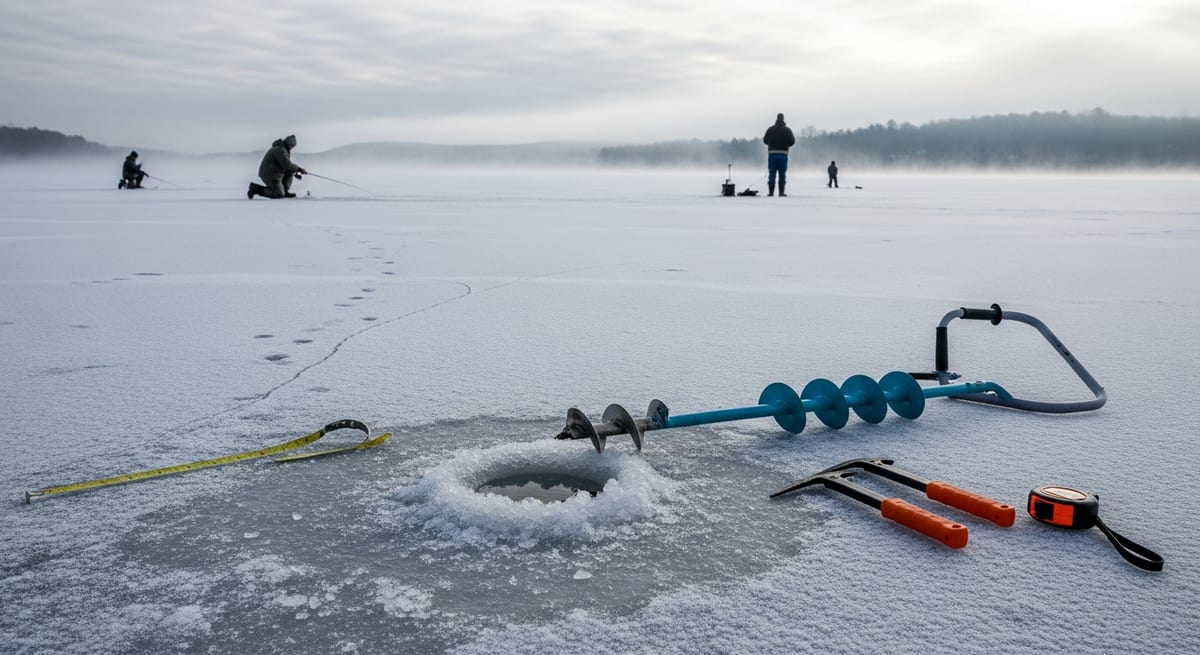
Anglers who've fished Bantam Lake, Candlewood, and Moodus Reservoir through multiple Connecticut winters share a consistent observation: the most dangerous days on CT ice aren't the coldest ones. They're the marginal days. A week into a January freeze, after a brief warm spell, when the surface looks continuous from the boat launch but thickness varies by several inches from one spot to the next. CT DEEP recommends a minimum of 4 inches of clear blue ice for foot traffic, and anglers on the state's larger reservoirs note that hitting that minimum uniformly across a full water body often takes longer than the calendar suggests. What follows covers the safety fundamentals CT ice anglers rely on before drilling their first hole, and what to do if the ice gives way.
Thickness Isn't Uniform, especially on CT's Larger Reservoirs
Ice thickness is the primary safety variable, but on Connecticut waters like Candlewood Lake and Barkhamsted Reservoir, anglers consistently report significant variation across a single water body. Inlets from the Farmington River on Barkhamsted and cove mouths on Candlewood routinely show thinner ice than the main basin, sometimes several inches thinner over just 30 feet of lateral distance. Subsurface current, springs, and outflow points create weak zones that aren't visible from the surface.
CT DEEP's ice safety guidelines align with the following widely-cited minimums for clear, blue ice:
- 2 inches: Stay off.
- 4 inches: Safe for foot traffic and ice fishing on foot. The CT DEEP minimum for a single angler.
- 5-6 inches: Safe for groups on foot or small snowmobiles.
- 8-12 inches: Safe for ATVs and snowmobiles.
- 12-15 inches: Safe for light vehicles.
White or layered ice: Standard ice safety resources, including guidance from the Minnesota DNR and the U.S. Army Corps Cold Regions Research Laboratory, note that milky or opaque ice, which contains air pockets and water inclusions, carries significantly less load than clear ice of the same measured thickness. Many CT anglers treat the effective capacity of white ice as roughly half that of clear ice, though actual degradation varies with ice age, temperature history, and layering. The conservative approach is to treat any section of white or cloudy ice as structurally unproven until you've augured through it.
Old spring ice is a separate problem. Ice in late February and March on CT lakes has typically gone through multiple freeze-thaw cycles. Moodus Reservoir, which warms quickly in the shallows, and the southern arms of Candlewood both see rapid deterioration once late-winter temperatures turn variable. Visual thickness means little once internal honeycombing sets in. The surface can appear solid while structural integrity is already compromised.
How CT Anglers Check Thickness Before Moving Out
Ice chisel: Chipping through ice manually near the launch gives an immediate first read before committing to the open water. Slow, but useful when conditions are borderline and the question is whether to step out at all.
Hand auger: A 4-6 inch hand auger drills test holes in under a minute. Anglers fishing Bantam Lake, where ice depth varies noticeably between the shallow west end and the deeper main basin, typically drill test holes every 50 to 75 feet when moving to a new area, particularly near inlet channels and any visible color transition.
Test at every transition. Any shift from clear blue to white or gray ice warrants its own hole. On Moodus Reservoir, anglers report that the northern coves hold thinner ice than the open basin well into January even after a sustained cold stretch. The color difference is there if you're looking for it.
Drilling a test hole takes about 15 seconds. CT anglers who fish hard water regularly note that the habit becomes automatic after a season or two, and that the variation it reveals, four inches in one spot, two and a half inches thirty feet away, is often exactly the thing that would have gone undetected.
What CT Ice Anglers Don't Dismiss
Cracking sounds, and knowing which kind. Ice makes noise as it expands and contracts with temperature swings. The ticking and popping that spreads across a lake on a cold morning is thermal expansion, normal, and a sign the ice is responding to temperature change. What's different is a crack that radiates outward from where you're standing, especially if accompanied by visible movement or flex underfoot. CT anglers who fish Candlewood regularly describe the distinction as directional: thermal cracks move across the lake on their own; structural cracks move from you outward. The second kind means redistribute weight immediately, lie flat, spread arms and legs, and move toward shore.
Slush on top of ice. Standing water or wet slush on an otherwise solid surface is a stress indicator. Ice that's being loaded beyond capacity, or is waterlogged from below, pushes water upward. Near the dam face on Barkhamsted during high-outflow periods, anglers have reported this pattern even when the ice appeared thick. The slush signals pressure from underneath, not surface melt.
Flex underfoot. Any visible bounce or spring in the ice surface is grounds to retreat. Do not run, lie flat and distribute weight across a larger area while moving toward shore.
Color transitions. Dark patches may indicate thin ice over current channels or deep water. On Candlewood, the channels between islands and the main basin frequently run darker than the surrounding ice. Anglers who know the lake fish around those transitions, not across them.
Late-season ice. Connecticut's ice window is narrow. On most years, the usable season on Bantam, Moodus, and the shallower arms of Candlewood runs six to eight weeks, shorter than inland northern states, and highly sensitive to CT's variable winter temperatures. By late February, after any warming stretch, experienced anglers on these waters treat anything south of a lake's main basin as marginal regardless of how it looks from shore.
What CT Ice Anglers Carry
Ice picks (ice claws). The item CT ice anglers most consistently cite is a pair of ice picks, two sharpened metal spikes on a connected cord, worn around the neck or clipped to the outside of a jacket where either hand can reach them. If you go through, the picks give you grip on the ice edge to haul yourself back onto the surface. Simple in design, under $20, and small enough to fit in a jacket pocket. CT anglers who move between kayak fishing in warmer months and hard-water fishing in winter. A common crossover on Bantam and Moodus, have widely adopted picks as standard kit, particularly after fall-through accounts circulated in Northeast fishing forums over the past several seasons.
Throw rope. A 50-foot throw bag lets a partner assist from a safe distance without approaching the break zone. The point CT ice anglers emphasize consistently: moving onto thin ice to help someone who went through is how two people end up in the water. The bag stays attached to the outside of a pack, not buried inside it.
Ice fishing suit or floating bib. Modern bibs designed for flotation are standard on CT's larger frozen reservoirs, candlewood, Bantam, and Barkhamsted included. These suits trap air on entry and provide buoyancy during self-rescue, buying time for ice pick work. Flotation performance varies by manufacturer and fit; anglers who rely on a suit for buoyancy typically verify the product's specific rating before the season rather than assuming a general standard applies across brands.
Pack waist buckle, unfastened on ice. A loaded pack with a fastened waist buckle adds drag if you go through and complicates removal underwater. Anglers who lead ice fishing trips on Bantam make this a pre-launch check before anyone steps onto the water.
Trip plan on shore. Before heading to Moodus Reservoir or Barkhamsted, leave specifics with someone who will act on them: the lake, the section of water you plan to fish, and your expected return time. This applies especially in December and late February, when CT ice conditions shift fastest.
If the Ice Gives Way
Cold shock is the first obstacle. Immersion in near-freezing water triggers an involuntary gasp reflex. Knowing it's coming, and that clothing will provide some flotation for the first several minutes, makes it easier to stay deliberate rather than thrash.
Turn toward the direction you came from. The ice you walked in on already supported your weight. That's where you return.
Use your picks. Jam both spikes into the ice edge ahead of you and kick with your feet in a horizontal swimming motion. The goal is to slide your body back onto the ice surface, not to pull yourself straight up against gravity. Once your hips reach the edge, the rest follows.
Once back on the surface, roll. Rolling distributes weight across a larger ice area than standing. Roll away from the hole toward shore before attempting to stand.
Wet clothing in sub-freezing air loses its insulating value quickly. Get to your vehicle or a shelter as soon as possible, remove wet layers, and replace with dry ones. Body heat alone will not stabilize the situation.
CT anglers who guide ice fishing sessions on Candlewood and Bantam make one consistent recommendation: handle your picks in a dry-run before the season, at the water's edge in fall, or in shallow water with a partner present, so the motion is already familiar. The technique is simple, but "horizontal, not vertical" is easier to execute under stress when it has already been done once in a controlled setting. That one practice session is where the reflex gets built.
EVERY SATURDAY MORNING
Weekly fishing intelligence
Nationwide conditions, what's biting, and honest gear deals. One email, no noise.
No spam. Unsubscribe anytime.