
CT Impoundment Bass Don't All Spawn at Once. What Candlewood, Bantam, and Moodus Anglers Report About the Phased Spring Window, Pre-Spawn Staging, and the DEEP Regulations That Apply to Bedding Fish
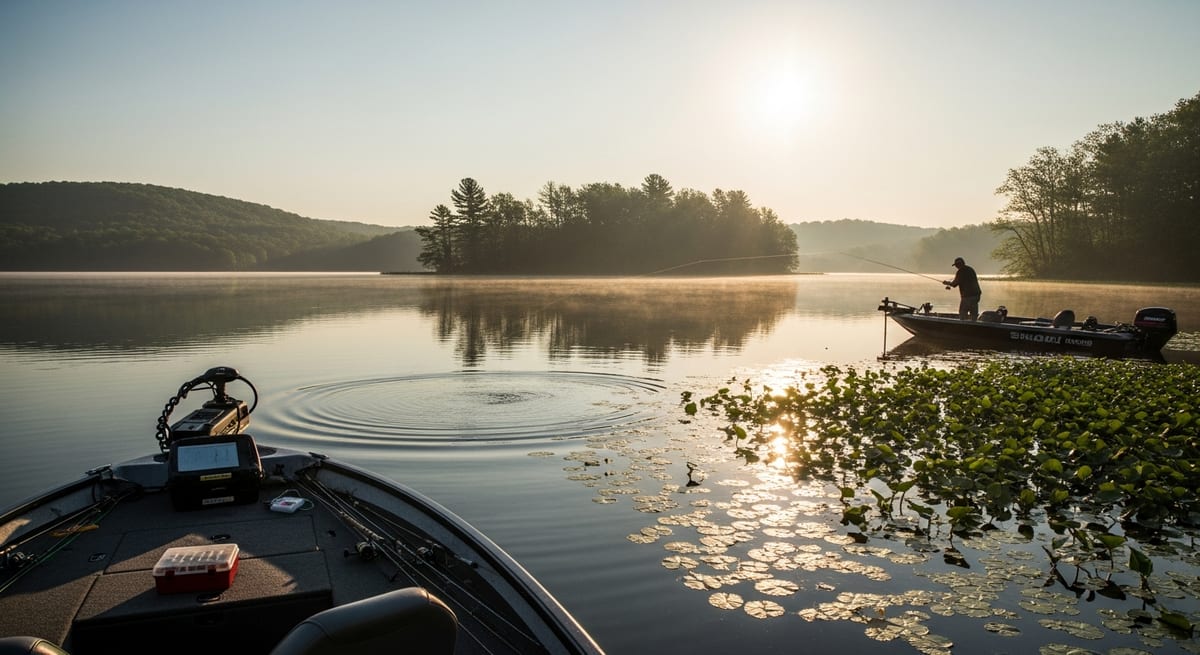
Anglers fishing the northwest arm of Candlewood Lake in the first week of May often find pre-spawn largemouth stacked in 8 to 10 feet along rocky transitions. Bantam Lake, smaller and shallower, can have bass already visible on beds in protected coves that same weekend. CT impoundments don't run the spawn on the same calendar. Communities fishing multiple CT lakes in the same spring week describe moving from Candlewood to Bantam to Moodus Reservoir and encountering three different spawn phases back to back. Generic spawn-timing charts don't capture that, and planning around CT impoundment specifics requires a different framework than national guides provide.
How CT Impoundments Phase the Spawn Differently
The bass spawn runs in three phases, but on CT water those phases don't stack neatly by date. They run in parallel across different lakes, depending on depth, water clarity, and how quickly a given basin absorbs heat. Pre-spawn begins as water temperatures reach 55-65°F. Bass move from winter depths toward shallow spawning areas, feeding actively along the way. On deeper impoundments like Candlewood Lake and Lake Lillinonah, pre-spawn staging can extend well into May before it fully resolves. The spawn itself begins around 65-72°F. Female bass hold on beds in oval, fan-swept depressions of gravel, sand, or hard bottom, typically in 1-5 feet of water, while males guard nearby. Shallow, dark-bottomed ponds and Bantam Lake's protected coves can reach spawn temperatures two to three weeks before Candlewood's main basin. Both waters fishing in different phases the same weekend. Post-spawn follows when water climbs above 72°F. Females retreat to deeper structure to recover; males guard fry briefly before scattering. Anglers who fish Moodus Reservoir report a compressed post-spawn transition compared to larger impoundments, with bass returning to more active feeding patterns relatively quickly in smaller, warmer water.
Pre-Spawn Staging: Where CT Bass Concentrate First
Pre-spawn is consistently described among CT impoundment bass communities as one of the most productive windows of the spring calendar. The fish are in feeding mode and accessible in transitional depths, before territorial instinct replaces hunger. On Candlewood Lake, anglers report the earliest pre-spawn activity along south- and west-facing rocky points and submerged gravel bars in 6-12 feet, particularly in coves off Route 37 on the north end. On Lake Lillinonah, creek channel mouths, where bass migrate from winter depth toward spawning flats, concentrate fish in the same temperature window. On Bantam Lake, the eastern gravel bars draw the first pre-spawn movement, warming faster than the deeper western shorelines.
For lures, CT bass communities fishing the pre-spawn window report consistent results with medium-diving crankbaits worked over gravel and rocky transitions, and with jerkbaits in 55-62°F water retrieved with extended pauses as temperatures approach the low 60s. A 3/8 oz football jig dragged slowly along hard-bottom transitions in 8-10 feet has been a recurring recommendation on CT bass forums targeting pre-spawn fish on Candlewood and Lillinonah. A swimbait paralleled to a bank edge in 8 feet is a frequently cited approach for targeting the larger female fish still holding in transitional depth before fully committing to the shallows.
Reading CT Coves for Visible Beds
On a calm, sunny day with polarized sunglasses, bass beds on CT impoundments are visible from a boat or kayak. They appear as oval, fan-swept depressions in light-colored bottom, roughly 18 inches to 3 feet across, typically in 1-5 feet of water. The male, smaller and darker, usually hovers directly over or near the bed. The female, often the larger fish, may hold slightly deeper nearby. Protected coves with hard sand or gravel bottom are the primary search target: the northeast arms of Candlewood, the shallow flats on the south end of Bantam, and the sheltered pockets on Moodus Reservoir are consistently mentioned in angler reports as high-density bed areas during the spawn window.
Sight fishing a bedding bass is a patience exercise more than a technique one. The fish aren't actively feeding; they're in territorial mode. The most commonly reported approach among CT communities is a small (3") creature bait or tube dropped directly onto the bed and left motionless for 30-45 seconds. The bass will often pick it up to remove it from the nest, not to eat. Multiple presentations to the same fish before a hookup are typical. Anglers fishing less-pressured back-cove access points on Candlewood and Lillinonah generally report undisturbed beds and more consistent fish behavior compared to beds near high-traffic launch sites.
The Post-Spawn Lull: What CT Impoundment Anglers Report
The week immediately following the spawn is consistently reported as the most difficult stretch of the CT bass calendar. Female bass, depleted from spawning, drop to deeper, cooler structure, often holding in 12-20 feet near submerged points and rock piles. Males remain in the shallows briefly to guard fry but are not aggressive feeders. Communities fishing Candlewood and Lillinonah during this window describe inconsistent action, with the most productive fish being males caught on reaction baits worked quickly past fry schools near shallow cover.
The post-spawn lull typically runs one to two weeks before females resume active feeding and scatter toward main-lake structure. Anglers familiar with their home water use this window to scout offshore humps, main-lake points, and creek arm staging areas they will return to as summer fishing patterns develop, rather than forcing low-percentage presentations at fish that aren't in a feeding posture.
CT DEEP Regulations and the Community View on Bedding Bass
Under current CT DEEP freshwater regulations, largemouth bass carry a 12-inch minimum size limit and a 5-fish daily bag limit, with no closed season on most CT impoundments. Anglers should verify current rules directly at the DEEP Fisheries Division website before fishing, as limits and special provisions are updated periodically and specific waterbodies may carry modified regulations in a given season.
The bed ethics question generates consistent discussion in CT bass communities, particularly on pressured waters. The practical concern on Candlewood and Bantam is that repeated targeting of specific beds at high-traffic launch areas can result in nest abandonment at those sites. The informal community norm observed on most CT impoundments runs beyond the 12-inch legal minimum: anglers who fish these waters regularly report that keeping bedding females from smaller CT ponds and reservoirs draws visible community criticism, and that catch-and-release with a quick return to the bed is the baseline expectation among regulars regardless of legal size. On small, isolated ponds where bass populations are more sensitive to individual-bed disruption, some CT anglers choose to leave visible beds unfished entirely during peak incubation.
EVERY SATURDAY MORNING
Weekly fishing intelligence
Nationwide conditions, what's biting, and honest gear deals. One email, no noise.
No spam. Unsubscribe anytime.