
The Beds on Bantam and Candlewood Are Visible in May. CT's Spawning-Season Ethics for Bass, Trout, and Stripers Are Three Separate Questions, and Fishing Forums Usually Conflate Them.
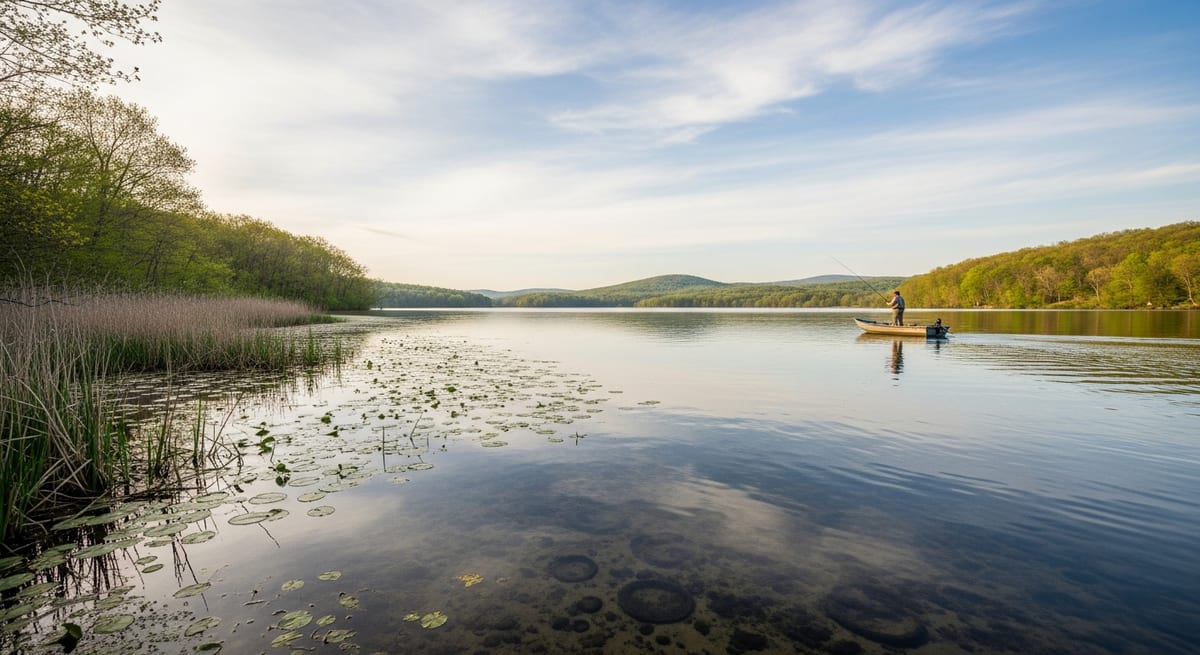
Male largemouth bass on Bantam Lake start guarding visible shallow-water nests in mid-May, and a single bed in a protected cove can be fished by four or five different anglers across the same long weekend before the eggs hatch. The forums argue about it every spring. What the science actually shows varies considerably by species, and Connecticut's three main spawning conversations. Bass beds, trout redds, striper slot fish, don't resolve to the same answer.
Bass: Bed Fishing on Bantam, Candlewood, Lillinonah, and Wononscopomuc
Largemouth bass on Connecticut's larger lakes, bantam, Candlewood, Lake Lillinonah, Wononscopomuc, typically begin building and guarding shallow-water nests when water temperatures climb into the mid-60s to low 70s°F, which on most of these lakes means the second or third week of May running through early June. Smallmouth bass spawn at slightly cooler temperatures, often moving onto beds earlier in the month when water reaches the upper 50s to mid-60s. On waters that hold both species, smallmouth may already be completing their spawn while largemouth are just starting.
The beds are shallow, typically two to five feet in protected coves, and visible from a kayak or a high bank. Males will strike aggressively and repeatedly from the same nest. That's the root of the annual debate.
What the research shows: Studies on catch-and-release bed fishing consistently find that brief encounters, where the male is landed quickly, released in the water, and returns to the nest before opportunistic nest predators (bluegill, perch, minnows) can move in, have limited impact on hatch success. The damage threshold shifts with extended encounters: a fish caught repeatedly off the same nest over several hours, or held for multiple photos before release, leaves the eggs exposed long enough for bluegill to do real work. No single study establishes a precise safe-handling cutoff; the consistent guidance across the literature is simply as quickly as possible, in the water, near the nest.
Anglers who regularly fish Candlewood and Bantam by kayak, based on CT fishing community threads active in spring 2026, tend to release directly into the water near the nest rather than swinging fish to the boat. A habit that minimizes exposure time without requiring any regulatory compliance, because none is needed. Bed fishing for largemouth and smallmouth is legal under Connecticut law as long as the fish meets the 12-inch minimum that applies to most CT waters. Voluntary release speed is a personal ethic, not a mandate.
Female bass: Female largemouth and smallmouth typically leave the immediate nest area after spawning. Catching females moving through shallow structure near nesting coves has less direct nest impact than targeting males off active beds.
Trout: The Farmington's Redd Ethic Developed From the Community Up, and It's the Practical Standard
Brown trout in Connecticut spawn in fall, typically October through December on both the Farmington and Housatonic. Rainbow trout spawn in spring, with Farmington River fish often active on redds from mid-March through late April. In a cold spring, active rainbow redds can persist into early May in the upper catch-and-release section, meaning that by the time most CT anglers are focused on spring trout fishing, brown trout spawning is months past but rainbow redds may still be live.
Redds are visible as lighter-colored, cleaned patches of gravel where the fish fan away silt. Wading directly through an active redd compacts or displaces that gravel and kills eggs on contact. This is the primary damage vector on heavily fished catch-and-release water, more consequential than the act of fishing itself.
The Farmington River Anglers Association, which has conducted stream stewardship and public education on the river for decades, has long emphasized redd avoidance as the highest-impact single behavior during spawning periods. Their guidance is consistent and specific: walk around active redds even if it means wading deeper or crossing to the opposite bank. Among Farmington regulars as of the 2025-2026 season, redd avoidance is effectively the default, deviation gets noticed and is informally corrected by other anglers on the water. The FRAA's reach into the regular angler community on this stretch means the ethic is socially enforced in a way that actually functions at the fishery level.
Fishing near but not through active redds is a grayer area. The self-imposed standard among regulars is to leave fish holding directly over or immediately beside active gravel alone and move to holding water that isn't active spawning habitat. Not legally required, but widely practiced and worth knowing before wading the C&R section in April.
For stocked trout on CT DEEP program waters, the conservation logic differs. Most stocked fish in Connecticut's non-wild-trout waters don't naturally reproduce at population-meaningful levels. Fish the regulations CT DEEP sets for those waters, which are calibrated to the stocking program and not to natural spawn protection.
Striped Bass: The Large Breeding Females Are in CT Waters in May, and That's Exactly What the Slot Limit Addresses
Connecticut striped bass are migratory, wintering off the mid-Atlantic coast and typically appearing at Long Island Sound entry points and Connecticut river mouths in late April and early May as water temperatures and bunker movement pull them north. Their primary spawning grounds are the Chesapeake Bay and Hudson River, and spawning timing in both systems varies year to year with spring water temperatures. Fish can still be in transitional post-spawn condition when they arrive in Connecticut.
The fish showing up at the Connecticut River mouth near Old Saybrook, the Housatonic River mouth, Niantic Bay, and Thames River structure in May include the large, older females. Fish in the 30-inch-and-up range that carry significantly more eggs than smaller fish and account for a disproportionate share of annual egg production. These are the fish ASMFC and Connecticut regulations are explicitly designed to protect.
CT DEEP regulations, check each spring: CT DEEP's recreational striped bass regulations change from year to year in alignment with ASMFC stock assessments. Regulations in effect for 2025, adopted under management actions associated with ASMFC Amendment 7, use a slot limit structure that restricts harvest of large breeding-class females above the maximum slot size. The ASMFC's 2023 benchmark stock assessment found striped bass below the biomass target, which drove the tightened restrictions that remain in effect going into 2025-2026. For current season slot range and daily limits, which adjust year to year based on stock condition, check CT DEEP's Marine Fisheries Division page before fishing.
Most of the striper population's recruitment success or failure is determined by Chesapeake Bay spawning conditions, which CT anglers don't influence. But protecting large breeding females during their time on Connecticut waters, specifically by following the slot limit rather than targeting or keeping fish above the maximum, is a contribution to the long-term population picture that aggregates meaningfully across all CT anglers on these waters.
Panfish and Perch: Spring Spawning Pressure Is Not a Conservation Concern
Bluegill, crappie, yellow perch, and other panfish all spawn in spring. On Connecticut's warmwater lakes, bantam, Candlewood, Lake Beseck, Rogers, bluegill and crappie build nests in colonies: large cleared areas in two to five feet of water with multiple beds visible simultaneously from a boat or kayak.
No credible research suggests recreational catch-and-release fishing of panfish during spring spawning has meaningful negative impacts on CT panfish populations. These species reproduce prolifically and sustain high natural mortality rates; recreational fishing represents a small share of total mortality. Connecticut creel limits where they exist are designed to prevent overharvest of adults, not to restrict spring fishing pressure.
Spring is the most productive season to fish panfish, shallow, concentrated, actively feeding. If harvesting for the table, stay within legal creel limits. Population dynamics for panfish are more constrained by size-selective harvest over time than by any spawn-period fishing pressure. The practical conservation concern is keeping adults in the system; the spawn itself is not the vulnerability.
How CT's Fishing Communities Have Actually Built Spawn Ethics, on Specific Waters
The informal ethical frameworks that exist on Connecticut waters didn't originate from regulators. They developed from communities of long-time anglers who watch specific fisheries year over year and accumulate observable feedback. The difference between a generic online debate and a functional community ethic is that the latter is attached to a named place and enforced by people who fish that place regularly.
The Farmington River Anglers Association's redd-avoidance guidance is the clearest example in Connecticut: a named, organized community that developed a specific behavioral standard based on what demonstrably damages a fishery, communicated it across angler generations, and created informal social enforcement that functions on a pressure-fished public water. Anglers fishing the Farmington for the first time in spring benefit from looking up FRAA guidance directly rather than relying on generic spawn-ethics discourse that may not reflect the Farmington's specific conditions.
On the bass lakes, candlewood, Bantam, Lillinonah, no single organization holds the same standard-setting role, but the consensus among anglers active on CT bass forums and in tournament circuits as of spring 2026 is consistent: release in the water, release near the nest, don't make the same visible bed your all-day spot.
What long-time CT bass anglers do differently: Forum discussions and tournament angler reports from Candlewood and Bantam suggest that anglers who have fished these lakes across multiple seasons tend to move on after one catch from a bed rather than returning to the same nest repeatedly, not because it's required, but because beds that take concentrated weekend pressure sometimes don't produce fry in that cove the following year. That's community-aggregated observation rather than peer-reviewed data, but it's the kind of local signal that builds durable ethics on specific waters.
The long-term quality of CT's best bass ponds, the wild brown trout fishery on the Farmington, the spring striper run off Old Saybrook, all of it reflects accumulated decisions made by anglers who went beyond the legal floor. The regulations set the minimum. What happens above that minimum is built one decision at a time.
EVERY SATURDAY MORNING
Weekly fishing intelligence
Nationwide conditions, what's biting, and honest gear deals. One email, no noise.
No spam. Unsubscribe anytime.