
The Race Draws Stripers and False Albacore Weeks Before New Haven Sees Them. CT Anglers Who Know Which End They're On Fish a Different Season Entirely.
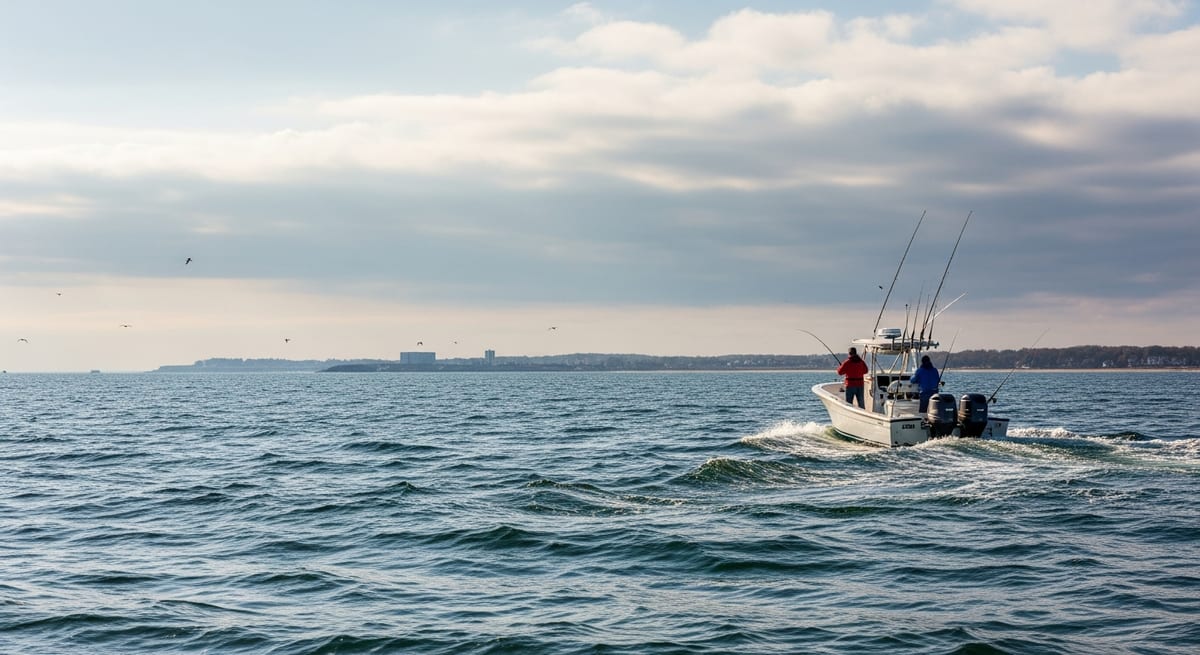
According to NOAA tidal current tables, the Race. The deep channel between Fishers Island and Orient Point on Long Island's North Fork, runs at 3 to 4 knots on a spring tide, faster than most displacement hulls cruise under power. That current is why stripers and false albacore concentrate at the eastern end of Connecticut's Sound weeks before the same fish ever reach New Haven or Bridgeport. Anglers who've fished both ends consistently describe the experience as running two different seasons simultaneously. Long Island Sound covers approximately 1,300 square miles of semi-enclosed water between Connecticut and New York, fed by the Connecticut River, the Thames, the Housatonic, and a dozen smaller river systems. Stripers, bluefish, fluke, sea bass, tautog, and false albacore move through at different windows throughout the year. Fish are in the Sound. The question experienced CT anglers ask is which section they're in, what's running there right now, and whether the trip warrants a launch at Niantic or at Milford.
What Moves Through the Sound and When
Striped Bass
The marquee species of the CT coast. Migratory fish arrive in May following the Atlantic coast migration, staging on the eastern end first, fishers Island Sound, the Race, Watch Hill, before spreading west as surface temps climb through the mid-50s into the low 60s. CT shore anglers and kayak fishers who report to the CT Fishing Forum consistently describe the eastern Race area as productive 10 to 14 days ahead of the Norwalk Islands or Stratford Shoal.
Peak action runs May-June and September-November. The fall run is what most serious CT saltwater anglers build their entire season around, typically kicking off in mid-September and holding through October in a good year. Summer fish are resident along the full Sound from Stonington to Greenwich.
Bluefish
Blues arrive with the spring striper push. Most of the summer run is smaller fish; larger "gorilla blues" push through in fall alongside the striper migration. They're aggressive, willing to eat almost anything, and routinely the highest-action-per-trip species when they're running.
CT charter captains are consistent on one handling point: bleed bluefish immediately at the rail and keep them on ice. The fish degrades fast, and most of the species' table reputation traces directly to fish that weren't handled right. NOAA FishWatch handling guidance recommends the same practice for oily-fleshed pelagics.
Fluke (Summer Flounder)
The primary target for most CT boat anglers in summer. Fluke run June through September, with peak action July-August when Sound water temps are warmest. They hold on sandy or mixed bottom near structure, channel edges, drop-offs, wreck areas.
The Housatonic River mouth, New Haven Harbor channel edges, and the Fishers Island area are among the most consistently reported CT fluke grounds. Anglers drifting those spots report reliable results with a 5-inch Z-Man Jerk ShadZ in white or chartreuse on a 1-oz jighead worked along the bottom. A setup that comes up repeatedly in trip reports across both the eastern and western Sound charter fleet.
Black Sea Bass
Spring (May-June) and fall (September-October) are the productive windows, typically when water temps sit in the mid-50s to low 60s. Sea bass aggregate on hard structure: rocky reefs, wrecks, lobster pot areas.
The eastern Sound between Old Lyme and Stonington holds some of the best natural structure in CT waters. Bottom jigging with 2-3 oz diamond jigs tipped with squid strip, or squid on a hi-lo rig, both produce reliably. Anglers targeting structure off Stonington and Mystic in fall 2024 reported solid action through mid-October before the temperature window closed.
Tautog (Blackfish)
Tautog are a different kind of challenge, locating productive rock piles and learning to read structure takes more blank trips than most other Sound species demand. The best windows are spring (April-May) and fall (October-November) when water temps are coolest.
The gear requirements reflect that. Pulling a 6-lb blackfish out of a ledge crack in 40 feet of water requires leverage that light spinning tackle doesn't reliably provide. The Shimano Torium 16 and similar high-capacity conventionals loaded with 40-50 lb braid come up repeatedly in CT tautog discussions on fishing forums. The combination handles both the current and the fish. Green crab remains the most reliable bait; Asian shore crab and sand fleas also work.
Launch from Mystic or Stonington for access to the rocky structure between Watch Hill and the Fishers Island Sound edges. This stretch is widely considered the best fall tautog ground in CT waters by anglers who fish it season over season.
False Albacore
A September-October window that's brief and often intense. Albies arrive in the eastern Sound first. The Race, Fishers Island Sound, Watch Hill, then push west chasing peanut bunker and sand eels.
Albie anglers who fished the Race during fall 2024 reported schools completely ignoring 2-inch Got-Cha plugs and eating nothing but small diamond jigs stripped fast near the surface. The consensus on CT fishing forums heading into each fall season runs toward matching the bait size precisely and retrieving faster than feels intuitive. Fish on sand eels want a different presentation than fish on bunker, and the gap between correct and wrong isn't subtle.
CT Marine Licensing and Current-Season Regulations
Connecticut requires a separate Marine Waters Fishing License (formerly the Saltwater Certificate) for any angler 16 or older fishing marine waters. This is independent of an inland freshwater license. You need both if you're fishing both.
Key regulations as of the 2026 season, rules shift year to year based on stock assessments and federal action, so always verify at portal.ct.gov/DEEP/Fishing before you go:
- Striped bass: CT has followed emergency federal action with tightened limits in recent seasons. A one-fish-per-day limit with specific size slot restrictions. Rules can change mid-season. Check DEEP's Marine Fisheries site or call the office before your first trip, and again at the start of the fall run.
- Fluke: CT tracks federal assessments, typically a 19" minimum and a 3-fish bag limit in recent seasons. Confirm current-year rules before you launch; these move with stock surveys.
- Black sea bass: Federal groundfish rules apply. The minimum size has historically been set in the 12" to 13" range depending on the current season's federal action; verify the current DEEP regulation summary before targeting them.
- Tautog: Slot limits apply with a 16" minimum. CT maintains some of the most restrictive tautog regulations in the region due to ongoing population concerns, expect lower bag limits in fall and plan accordingly.
The DEEP Marine Fisheries Division publishes updated regulation summaries at the start of each season. Last year's regulation sheet is not a reliable source for current-year trips.
Eastern Sound, Western Sound. The Access and the Fishing
Eastern Connecticut (Stonington to Old Saybrook)
The Race and Fishers Island Sound concentrate baitfish and predators unlike anything in the western reaches. The fast tidal exchange, documented in NOAA current charts at 3 to 4 knots on spring tides, draws species earlier in every migration window and keeps structure-oriented fish like tautog and sea bass active year-round. Fishing the tide changes is essential, not optional.
Anglers and charter captains running out of Niantic, Mystic, and Stonington consistently describe the eastern Sound as more technically demanding than the western harbors. Southwest winds over a strong ebb build steep, fast chop, and boats under 18 feet have a hard time in conditions that develop around the Race on a full moon. An 18-22 ft center console is considered the practical minimum by most of the eastern Sound charter fleet.
Launch ramps at Mystic, Stonington, Niantic, and Old Saybrook all provide solid access. The Niantic Bay launch is the most commonly mentioned eastern staging point among CT striper and albie anglers heading for the Race.
Western Connecticut (Branford to Greenwich)
Less dramatic structure, more developed shoreline, but the western Sound is genuinely productive for anglers who know where to look. New Haven Harbor holds early-season stripers along the breakwaters in May, with fish coming in shallower than anglers used to open-Sound conditions expect. The Housatonic River mouth runs solid fluke from late June through August.
The Norwalk Islands are underrated for fall tautog. Anglers who've worked the rocky structure around those islands in October and November report consistent blackfish that most of the CT fleet misses, attention has typically shifted east for stripers and albies by that point, leaving those rock piles relatively unfished.
Launch ramps at Branford, New Haven, Milford, Stratford, Bridgeport, and Norwalk all give access to western Sound fishing.
Charter Fleet Access
CT's charter fleet is well-developed across both ends of the Sound. Boats run out of New Haven, Milford, Bridgeport, Norwalk, Old Saybrook, Niantic, Mystic, and Stonington. Most offer half-day and full-day trips for fluke, sea bass, and bluefish in summer, with striper charters running through the fall migration.
Charter captains out of Old Saybrook and Stonington frequently note that first-timers book trips without checking what's in season. A half-day fluke charter in mid-October puts anglers on the water during the striper run on the same water. Trip reports on CT fishing forums and charter review sites point to this as the most common first-charter mistake. Call ahead, ask what's running, and book accordingly.
EVERY SATURDAY MORNING
Weekly fishing intelligence
Nationwide conditions, what's biting, and honest gear deals. One email, no noise.
No spam. Unsubscribe anytime.