
CT Shore Stripers Move Into Shin-Deep Rocky Points in Complete Darkness. Night Tide Regulars Know the Two-Hour Window That Makes It Happen.
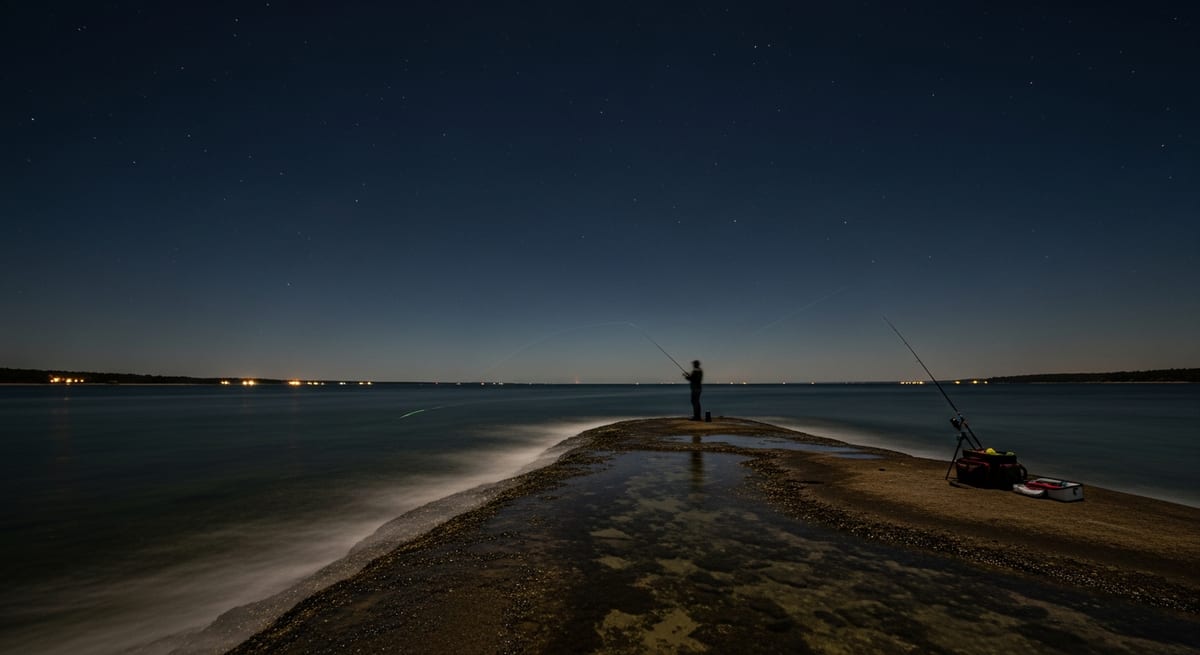
Striped bass that ignore plugs for six straight hours of daylight in June will slide into shin-deep water over the same rocky flat at 11 PM. A behavioral shift CT shore anglers who fish the night incoming have documented consistently across shoreline from Old Saybrook to Groton. The fish aren't absent during the day; they're holding deeper and off exposed structure, too wary to cross open shallows in daylight. After dark, that calculus changes. Shore fishing for CT stripers isn't just a summer heat workaround, among anglers who have made night sessions a regular practice, incoming tides between 10 PM and 2 AM tend to outproduce daytime hours from June through August, and the fish that show up are often the larger class that held off-structure all day.
Why the Tide Window Matters More Than Sunset
Striped bass hunt largely by lateral line, vibration detection, and their eyes are adapted for low light. Darkness removes the wariness that keeps bass off exposed structure during the day. CT surf anglers who fish regularly after sunset describe a consistent pattern: rocky points and beach flats that hold almost nothing at 2 PM can go active within minutes of full dark, particularly when moving water arrives at the same time.
The window that consistently produces: The first two hours of an incoming tide, especially when that tide change falls between 10 PM and 2 AM. Water flooding over structure and flats in darkness is what CT night striper regulars identify as the high-probability window for shore fishing in June and July.
Moving water matters more than darkness alone. Shore anglers who've pushed through slack tide report the fishing typically stalls even when conditions otherwise look right. The approach that produces most reliably: time sessions around the tide table first, then confirm sunset aligns with a useful tide phase.
Darkness and an incoming tide don't converge every night. Anglers who fish this pattern seriously run a tide app alongside a moon-phase calendar, targeting nights where the first two hours of incoming fall squarely in the late-night window rather than at dawn.
CT Shore Access Points That Night Tide Regulars Return To
Connecticut River Mouth (Old Saybrook): Among the most consistently productive night striper locations on the CT shore, according to anglers who fish the area regularly. The outgoing and incoming tides create current seams off the jetties that stripers hold in predictably. Access from Saybrook Point Park or the North Jetty. Night navigation here rewards anglers who've walked the layout in daylight. The jetty structure reads differently after dark and footing demands attention.
Housatonic River Mouth (Stratford): Strong tidal flow, and on the outgoing tide, disoriented baitfish flush from the river and bass stage to intercept them. Stratford Point and the Housatonic boat launch provide access to the tidal zone. The outgoing is the tide to target in this stretch.
Bluff Point State Park (Groton): A roughly mile-long walk in, but notably lower pressure than the Saybrook jetties. The Poquonnock River inlet near the tip of the point draws favorable reports from anglers who make the walk on incoming tides from June through August. Confirm current seasonal access details with CT DEEP before planning a trip, park access rules can affect overnight presence at the point.
Niantic River and Bay: The tidal stretch along River Road has several pull-offs and fishable banks. In a productive June, the river mouth sees consistent night striper activity and lighter pressure than the well-known jetty fisheries to the east and west.
Hammonasset Beach State Park (Madison): The western jetties produce when baitfish stack against the rocks, and the long open beach gives room to work a surf rod without crowding. Verify current state park access rules before planning a night session, overnight access policies vary by season and are subject to change.
Reading the Forage, and What to Tie On After Dark
CT shore anglers who consistently produce on night tides tend to spend a few minutes reading surface activity before committing to a presentation. Forage-matching after dark often matters more than pattern-matching in low light.
Sand eels and silversides move into protected coves and along beaches after dark, primary forage in June and July along most of CT's shoreline. Long, slender presentations work: a Bomber Long A, a soft plastic sand eel on a light jighead, or a pencil popper worked in the wash.
Juvenile bunker (menhaden) show up in river mouths and embayments by mid-summer. When bass blow up on something chunky near the surface at night, it's often bunker. The standard adjustment is sizing up. A 7-8 inch swimmer or a large pencil popper covers it.
Squid, especially in May-June, draw stripers into shallow water after dark in predictable ways. Look for squid drawn to dock lights and work the edges of those light-dark transitions.
When forage isn't obvious, many CT night anglers default to a 6-inch dark paddle tail on a 1.5 oz jighead. It covers the water column without committing to a single forage profile.
On lure selection: CT surf anglers who focus on night stripers tend to simplify their approach. Plugs that push water and create vibration outperform fine-tuned color matches in low light, silhouette matters more than shade. Dark colors, black, purple, dark olive, read better against the sky from below. White works in very dark, calm conditions; the choice typically comes down to how much ambient light is on the water.
Surface plugs produce the most dramatic strikes night striper fishing offers. A pencil popper or Danny-style swimmer worked along beaches and over shallow rocky structure draws blowups in water that looks impossibly thin. A Gibbs Pencil in the 2-2.5 oz range is the standard reference among CT surf anglers fishing open beach after dark.
Swimming plugs: a Bomber Long A or Gibbs Bottle Plug swum slowly parallel to shore at 1-3 feet, retrieved at a walking pace, are consistently cited by CT shore regulars as workhorses for the larger striper class, particularly fish in the keeper-and-above range.
Bucktails with pork rind: White or yellow, 1-3 oz depending on current strength, slow-rolled along the bottom in river mouths on the outgoing tide. Effective in the Housatonic and CT River mouths and still common among anglers who grew up fishing those systems.
Night Fishing Safety on CT's Shoreline
Night fishing on rocky CT shoreline introduces real hazards that daytime trips don't. Anglers who fish the jetties and points after dark consistently flag the same risks for anyone new to the practice.
Headlamp with red-light mode: Red light preserves night vision without spooking bass. Carry a backup, dead batteries on a rocky jetty at midnight are a genuine problem, not a minor inconvenience.
Know the spot in daylight first: Walk intended water before fishing it after dark. Drop-offs and slippery rocks that are obvious at noon are invisible at night. Non-slip wading boots are standard among night anglers on the jetties and rocky CT shoreline.
Wade more conservatively than seems necessary: Bass in darkness often move into water where aggressive wading isn't required anyway. Night striper regulars routinely describe fishing from firm footing on structure rather than pushing into the wash.
Leave a float plan: Where you're going, what water, and when you expect to be back. Text someone before leaving the car.
Dress for actual conditions: Long Island Sound nights in summer can run 55-65°F with a sea breeze on the water. An extra layer takes no space and matters if conditions shift.
Phone in a waterproof case, on your person: not in a bag. If you go in, you want it reachable.
CT Striper Regulations: Verify Before You Go
Connecticut's striped bass regulations change from year to year and reflect coastwide management pressure on the Atlantic stock. Size limits, slot windows, and possession limits have shifted multiple times in recent seasons based on ASMFC stock assessments, what was legal last June may not be legal this June.
Before the first night out of the season, check current CT DEEP Marine Fisheries regulations directly. Do not assume rules carry over from the prior year.
Night fishing doesn't change what's legal, but low-light conditions make careful measurement more important. A bump board worn on the belt and a reliable headlamp are standard among anglers who practice consistent catch-and-release after dark, measuring a fish cleanly in moving water at 1 AM is harder than it sounds, and a confident, legal release matters.
Current regulations: CT DEEP Marine Fisheries at ct.gov/deep.
EVERY SATURDAY MORNING
Weekly fishing intelligence
Nationwide conditions, what's biting, and honest gear deals. One email, no noise.
No spam. Unsubscribe anytime.