
Pre-Spawn Bass Fishing in Connecticut: The Best Window of the Year
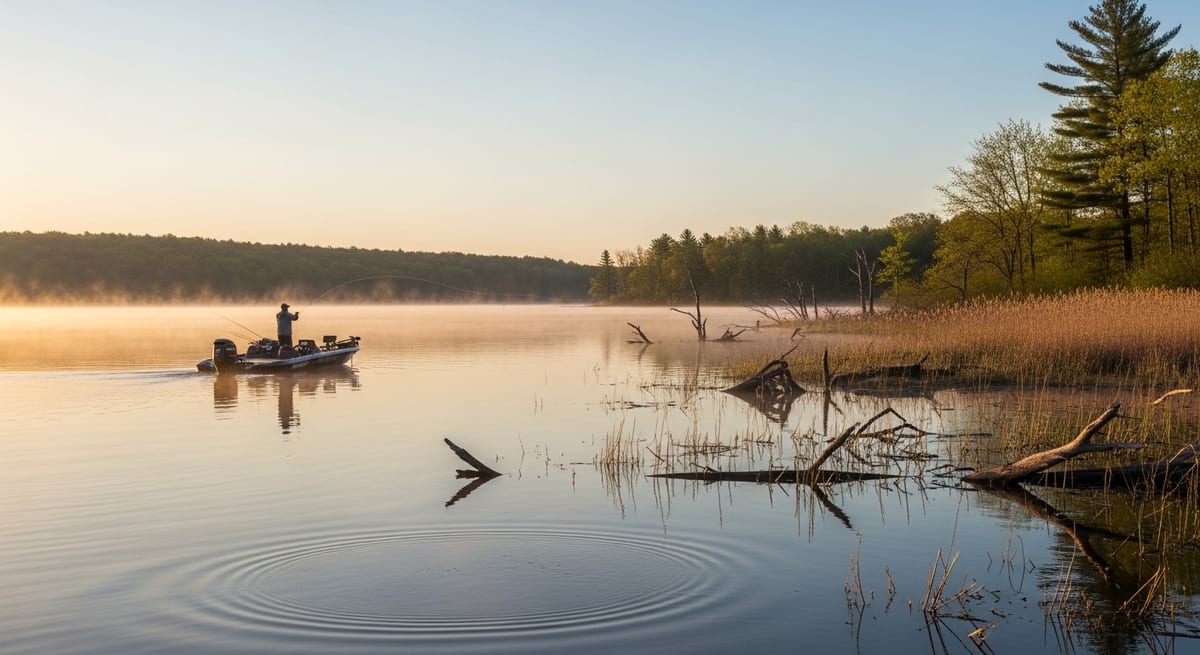
There are two windows each year when Connecticut's largemouth bass are reliably catchable for anglers of every skill level: the post-spawn feeding frenzy in early summer and the pre-spawn period in April and early May. Pre-spawn is arguably better. The fish are big (females are gravid with eggs), they're feeding hard, and they're positioned in water shallow enough to find from shore or by kayak. If you fish only one window each year, make it this one.
Understanding the Pre-Spawn Period
Pre-spawn in Connecticut happens when water temperatures rise from the winter cold into the 55-65°F range, typically mid-April through mid-May depending on the body of water and the season. What defines this period biologically: female bass have developed their eggs and are moving from winter deep-water holding areas toward shallow spawning flats. They're not yet on beds (that happens when temps hit 65-70°F), but they're staging near spawning areas and actively eating to fuel the energy demands of the spawn.
Why pre-spawn bass are so catchable:
- They're feeding actively, building energy reserves
- They're in predictable, accessible locations (transition zones near spawning flats)
- They're aggressive and will hit reaction baits that they'd ignore in fall or winter
- The biggest fish (gravid females) are in the shallows: 4-8 lb fish are routinely caught pre-spawn when summer months rarely produce them
Temperature triggers: A sustained warming trend is the key signal. Two to three days of air temps above 60°F will pull pre-spawn bass from deep structure into staging areas. A cold front will push them back temporarily, but the response is often a feeding frenzy 24-48 hours after the front passes.
Where to Find Pre-Spawn Bass in CT
Staging areas (the most important concept): Pre-spawn bass don't jump directly from deep water to spawning flats. They stage on the transition structure between. These are the highest-percentage locations in early April before spawning begins:
- Points: Underwater points that connect deeper water to shallow spawning flats are the #1 pre-spawn holding spot in every lake. Bass use the point as an elevator, moving from 8-15 feet on the deep side up to 2-4 feet on the tip when conditions are right.
- Creek channel edges: Where a creek channel runs through a shallow flat, bass follow the channel edge from deep water to the spawn. Fish the creek mouth where it meets the main lake or pond.
- First drop-offs: The first significant depth change adjacent to spawning flats (usually a 2-5 foot drop). Bass school on these ledges before moving onto the flat.
- Laydown trees at the right depth: Fallen trees that start in shallow water and extend into 4-8 feet of water are pre-spawn magnets. The tree provides cover and the depth gradient is exactly what staging fish want.
Best CT waters for pre-spawn:
- Candlewood Lake: Rocky points, submerged structure, large shallow coves with adjacent deep water. Excellent pre-spawn positioning. Boat or kayak access via state launch.
- Lake Zoar (Stevenson Dam area): Long, reservoir-style lake with many points and coves. Good bank access in some areas.
- Bantam Lake (Litchfield): CT's largest natural lake, with good pre-spawn bass populations on the shallow western end points.
- Mashapaug Lake (Union): Clear, clean water in northeastern CT. Wild fish population with excellent spring fishing.
- Local ponds: Don't overlook smaller town and state ponds. Squantz Pond, Gardner Lake, Moodus Reservoir. Each has good largemouth populations and the first warming days of spring produce excellent fishing on these smaller, quicker-warming bodies.
Best Pre-Spawn Lures
Jerkbait (2.5-4 inch suspending): The premier pre-spawn lure in cold water. A suspending jerkbait worked with a jerk-jerk-pause cadence in 45-58°F water triggers strikes from bass that won't commit to faster presentations. The key is the pause, suspend the bait motionless for 5-10 seconds in cold water. Rapala X-Rap, Lucky Craft Pointer, and Megabass Vision 110 in natural perch, shad, or ghost patterns. Fish it on 10 lb fluorocarbon on a medium casting rod.
Swimbait (paddle tail, 3-4 inch, 1/4 oz jighead): As water warms above 55°F, swimbaits become more effective. A slow, steady retrieve with occasional twitches through staging areas and along points. Shad, perch, and white colors match CT spring forage. Swimbaits cover more water than jerkbaits and allow you to locate active fish quickly.
Ned rig / finesse jig: In clear water or after cold fronts, a Ned rig worked slowly along transition structure is the finesse option. Fish it on 6-8 lb fluorocarbon with a spinning rod. Let it sit on the bottom, drag slowly, let it sit again. Pre-spawn females will hold it longer than summer bass, don't rush the hookset.
Squarebill crankbait (1.5-2.5 inch): When water breaks above 58°F and bass are more active, a squarebill bounced through laydowns and along rocky transitions triggers reaction strikes. The deflection action when it hits structure often triggers fish that are following but not committing.
Fluke / soft jerkbait (4 inch, weightless or very light weight): A weightless soft jerkbait cast over shallow flats and worked with erratic twitches mimics dying shad or perch and draws explosive strikes in 2-4 feet of water as bass push into the shallows. Zoom Super Fluke or Gulp Alive Minnow in white, pearl, or chartreuse/white.
Presentation and Timing Details
Water temperature is everything: Carry a thermometer and check water temperature at your first stop. Below 50°F, work slow, cold presentations (jerkbait with long pauses, finesse jig). 50-58°F, add swimbaits and crankbaits. Above 58°F, topwater becomes viable at dawn, swimbaits and reaction baits in open water, flipping jigs to laydowns and heavy cover.
Time of day: Pre-spawn bass follow temperature logic. Cold spring mornings push fish deeper; the afternoon warming can produce a defined "feeding window" as shallow water heats up. April bass in CT are often most active from 11 AM-4 PM. The opposite of summer when they feed at dawn and dusk. Later in May as water stabilizes, the standard early-morning pattern returns.
After a cold front: A hard cold front will temporarily shut down pre-spawn activity. Bass retreat to deeper staging areas. The typical pattern: day 1 after the front is tough, day 2 is picking up, day 3+ is often excellent as the rebound feeding frenzy begins. Don't skip post-front fishing based on bad weather predictions. Some of the best pre-spawn sessions follow cold fronts by 48-72 hours.
Polarized sunglasses: Essential in spring. Clear water plus low sun angles makes it possible to sight-fish for pre-spawn bass in 2-5 feet. You can see fish holding over gravel points or edges before you cast. Once you can see them, slow down, extend casts to avoid spooking, and use finesse presentations.
Ethical Considerations
Pre-spawn and spawning bass are in a vulnerable life stage. A few practices protect the population:
Minimize air exposure: Pre-spawn females especially, large, gravid fish, are stressed by extended time out of the water. Keep fish in the water while removing the hook when possible, and limit photos to 30 seconds or less. A quick dip and release produces better survival rates than extended lip-held photo sessions.
Avoid releasing bass far from where you caught them: If you catch a fish at a specific point or staging area, release it there. Pre-spawn fish are oriented to specific locations and releasing them elsewhere can disrupt their reproductive timing.
Don't harvest large pre-spawn females: This is personal ethics beyond regulation. The largest females carry the most eggs and contribute disproportionately to year-class strength. A 5-pound pre-spawn female released to spawn will produce thousands of bass that will swim CT waters for years.
Best Connecticut Waters for Pre-Spawn Bass
Moodus Reservoir (East Haddam): One of CT's premier bass fisheries. Excellent pre-spawn staging with deep channel structure, rocky points, and clear water. Tournament history supports it as a top producer.
Lake Hayward (East Haddam/Colchester): Outstanding bass lake with excellent access and an active angling community. Pre-spawn bass stack on the points and submerged structure.
Lake Pocotopaug (East Hampton): Larger reservoir with good boat launch access and strong bass population.
Mashapaug Lake (Union): Northwestern CT gem in Bigelow Hollow State Park. Excellent largemouth bass population, less pressure than western CT lakes.
Gardner Lake (Bozrah/Salem): Eastern CT bass lake with quality fish and state boat launch access.
Candlewood Lake (Danbury area): Connecticut's largest lake. Bass are present but pressure is high. Pre-spawn staging on the main lake points is productive for anglers willing to work for it among crowds.
Any local town pond with 10+ feet of depth: Don't overlook local small water. Connecticut's hundreds of town-owned ponds hold largemouth bass that get almost no pressure compared to the named lakes. A 3-acre town pond with a deep hole and some structure can produce incredible pre-spawn fishing if you're the only one who fishes it.
EVERY SATURDAY MORNING
Weekly fishing intelligence
Nationwide conditions, what's biting, and honest gear deals. One email, no noise.
No spam. Unsubscribe anytime.