
Largemouth Bass Fishing in Connecticut: Where to Go, When to Go, and What to Use
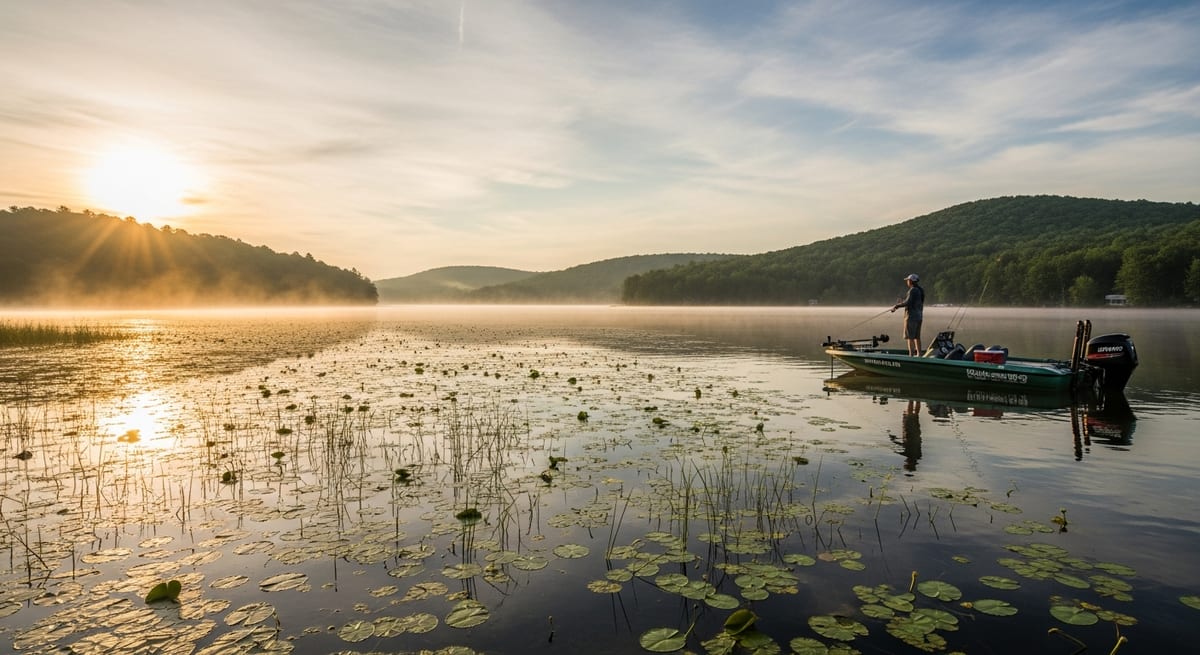
The back coves of Lake Lillinonah can hold stacked pre-spawn largemouth by mid-April, before most Connecticut anglers have even dusted off their gear. Connecticut's mix of clear highland lakes, weedy impoundments, and brackish coastal coves gives largemouth bass a lot of habitat to work with. Most of the state's lakes and ponds hold fish, but size, pressure, and access vary enough that where you go matters. A quiet highland lake in Winsted fishes nothing like a tidal cove near Mystic, and knowing which water fits which season is most of the game. The spring topwater bite at dawn is one of those sessions that reminds you why you started fishing in the first place. October, when water temperatures crash back through the 60s and bass go on a pre-winter feed, isn't far behind.
Best CT Waters for Largemouth Bass
Connecticut holds over 2,000 lakes and ponds, and largemouth bass inhabit the majority of them. These are the waters consistently worth the drive:
Highland Lake (Winsted): One of the stronger bass lakes in northwestern CT. Clear water, extensive weed structure, and a healthy population that holds up even with decent summer pressure. Public access is available via the DEEP-managed boat launch on the north shore, parking fills early on summer weekends, so plan accordingly. Kayak-friendly with no motor restrictions that limit other options in the region.
Mashapaug Lake (Union): A northeastern CT lake straddling the Massachusetts border, set within the Nipmuck State Forest. The drive keeps it off most anglers' radar, which generally means less competition on the water and fish that respond more readily to standard presentations. The lake has good weed structure in the shallower northern basin and drops to fishable depths on the southern end. Public access via DEEP launch off Bigelow Road.
Bashan Lake (East Haddam): Central CT lake with solid weed structure and consistent largemouth populations. Also holds pike and crappie, throwing a bigger swimbait through the deeper weed edges is worth a few casts if you want a shot at something unusual.
Moodus Reservoir (East Haddam): Part of the Salmon River drainage. Productive for larger fish, with good depth variation and public access via DEEP boat launch off Leesville Road.
Lake Lillinonah (Southbury/Newtown): A large impoundment on the Housatonic River and one of the most consistently productive bass fisheries in the state. Rocky points, deep coves, bridge pilings, and extensive weed edges hold both largemouth and smallmouth. Big fish come out of here every spring. It's worth the longer run from the launch.
Candlewood Lake (New Milford/Danbury): Connecticut's largest lake, with good bass fishing in the shallower coves and along the eastern shoreline. Boat traffic is heavy from Memorial Day through Labor Day, early morning is when you want to be on the water.
Tidal coves and coastal ponds: Southeastern CT tidal rivers and ponds near Mystic, the Niantic Bay area, and Patchaug Pond hold largemouth in brackish and freshwater transition zones. These fish are often aggressive and see a fraction of the pressure found on the inland lakes. The same tidal stretches near Mystic and the lower Connecticut River also produce CT blue crabs from July through September. The Connecticut blue crab fishing guide covers the trap, trotline, and tidal-stage notes for anglers already on that water.
Seasonal Patterns
Pre-spawn (April-early May): As water temperatures climb from the 50s into the low 60s°F, largemouth begin moving from winter holding areas toward spawning flats. For many CT anglers, this is typically the most productive feeding window of the year. Fish are active, shallow, and staging near areas they'll soon spawn.
Target the transition zones: shallow points, the edges of first drop-offs adjacent to spawning flats, and the mouths of creek arms. Slower presentations work best in water below 58°F, texas-rigged soft plastics and jigs with long pauses between moves. As temps push into the 58-65°F range, swimbaits and crankbaits come into play.
Spawn (mid-May-mid-June): Timing varies with elevation and weather, highland lakes like Mashapaug typically run a week or two behind warmer lowland ponds. Bass move to beds in 1-5 feet of water on sandy, gravel, or firm-bottom flats. Males guard nests visibly; post-spawn females recover quickly and feed aggressively by late May.
Sight fishing with a finesse approach, drop shot, Ned rig, small tube, can produce well on the beds. Most serious CT bass anglers release bed fish immediately to protect the spawn.
Summer (late June-August): Largemouth move to thermal-comfort zones as surface temps climb above 75°F. The best summer bite is early, poppers, frogs, and hollow-body swimbaits over weed mats from 6-9am before the heat locks in. Midday, fish move deeper (8-15 feet) along weed edges and beneath lily pad canopy.
Soft plastics fished slowly, wacky-rigged stickbaits, finesse jigs, are consistent once the topwater bite shuts off. Evening picks back up as temperatures drop.
Fall (September-November): Often the most overlooked season on Connecticut water, and often the most productive. Dropping temps through the 60s°F triggers a pre-winter feeding binge. Bass push back shallow onto points, flats, and creek mouths, chasing shad, perch, and bluegill.
Reaction baits take over in fall, spinnerbaits, chatterbaits, lipless crankbaits, jerkbaits. October is frequently the best month of the year for big largemouth in CT, especially on the Housatonic impoundments.
Winter (December-March): Bass become lethargic in water below 50°F, holding deep at the base of steep drop-offs near their spawning flats. Finesse presentations fished extremely slowly can still produce, tube jigs and small shaky heads on 6-8 lb fluorocarbon, dragged along bottom. Not prime season, but fish are catchable on the right day.
Best Lures for CT Bass
Senko-style soft stickbait (4-5 inch, wacky rigged): A wacky-rigged stickbait, yamamoto Senko or any solid knockoff, on a size 1/0 wacky hook is one of the most reliable all-season CT bass producers you'll find. Cast near structure, let it fall on a slack line, and the side-to-side flutter on the drop triggers strikes from fish that ignore everything else. Green pumpkin and watermelon/red flake are the go-to colors in CT's tannin-stained waters.
Texas-rigged soft plastic (creature bait, craw, or ribbon tail worm, 5-7 inch): Built to penetrate weed mats, flip into docks, and pitch to laydown logs. Run 3/16-3/8 oz bullet weight with a 3/0-4/0 wide-gap hook. Green pumpkin, black/blue flake, and watermelon red cover most conditions. The standard presentation for heavy cover.
Spinnerbait (3/8-1/2 oz, white/chartreuse or white/white): Excellent for covering water quickly in spring and fall. A willow-leaf/Colorado blade combination is a reliable choice for CT bass in murky water, works over weed tops, alongside weed edges, and around dock pilings.
Hollow-body frog: The most explosive surface presentation in summer bass fishing. A frog walked over lily pad mats from late June through September produces topwater strikes that are hard to match with anything else. Use a heavy-action rod and 50-65 lb braid to pull fish out of the slop before they wrap you.
Ned rig (2.5-3 inch mushroom jig head, 1/8 oz, with ElaZtech finesse stick): An underused finesse approach that works exceptionally well on pressured CT bass. The buoyant tail stands off bottom even at rest. Fish it slowly along rock points and gravel flats in clear water, candlewood and Highland Lake after a cold front are prime situations.
Lipless crankbait (1/2 oz, red craw or shad colors): Fall baitfish schools pull bass into aggressive chasing mode. Rip a lipless crankbait through submerged weed edges with a hard pause, october strikes on this bait can be violent.
Connecticut Bass Regulations
Connecticut largemouth bass regulations (verify current year at CT DEEP website before fishing):
Minimum size: 12 inches total length Daily bag limit: 5 largemouth bass per day (combined largemouth and smallmouth in most waters) Season: Year-round on most waters, with a slot-protection period in some DEEP designated "trophy bass" waters
Trophy bass waters: CT DEEP maintains a list of designated waters with enhanced regulations (typically 15" or 18" minimum, reduced bag limits) to protect large-fish populations. These waters are listed in the annual CT Angler's Guide. Check before fishing any large lake or reservoir.
License: Connecticut fishing license required for all anglers 16 years and older. Available online at the CT DEEP website or at many sporting goods stores and license agents.
Gear for CT Bass Fishing
Spinning setup (finesse): 6'8-7'2 medium or medium-light action spinning rod, 2500-3000 size spinning reel, 10-15 lb fluorocarbon mainline. Use for wacky rigs, Ned rig, drop shot, and light presentations.
Casting setup (workhorse): 7'-7'3 medium-heavy casting rod, 7:1 baitcasting reel, 15-20 lb fluorocarbon or 30-50 lb braid (for frog/heavy cover). Use for Texas rigs, spinnerbaits, crankbaits, and jigs.
Frog/cover setup: 7'3-7'6 heavy casting rod, high-speed (7:3 or higher) baitcasting reel, 50-65 lb braid. For frog fishing and flipping heavy mats.
Boat or kayak: Most CT bass lakes have DEEP public launches that accept cartop boats and kayaks. A kayak opens up the smaller, shallower ponds that don't allow motors. For the larger lakes, candlewood, Lillinonah. A small motorized boat covers more water effectively.
EVERY SATURDAY MORNING
Weekly fishing intelligence
Nationwide conditions, what's biting, and honest gear deals. One email, no noise.
No spam. Unsubscribe anytime.