
CT Sea Bass Anglers on the Norwalk Islands Ledges and Branford Reefs Report the Depth Shift Arrives Earlier Than Most Expect. What LIS Bottom Fishing Communities, CTDEEP Reef Surveys, and Charter Logs Reveal About Structure, the 45-to-65-Foot Band, and Fall Keeper Ratios
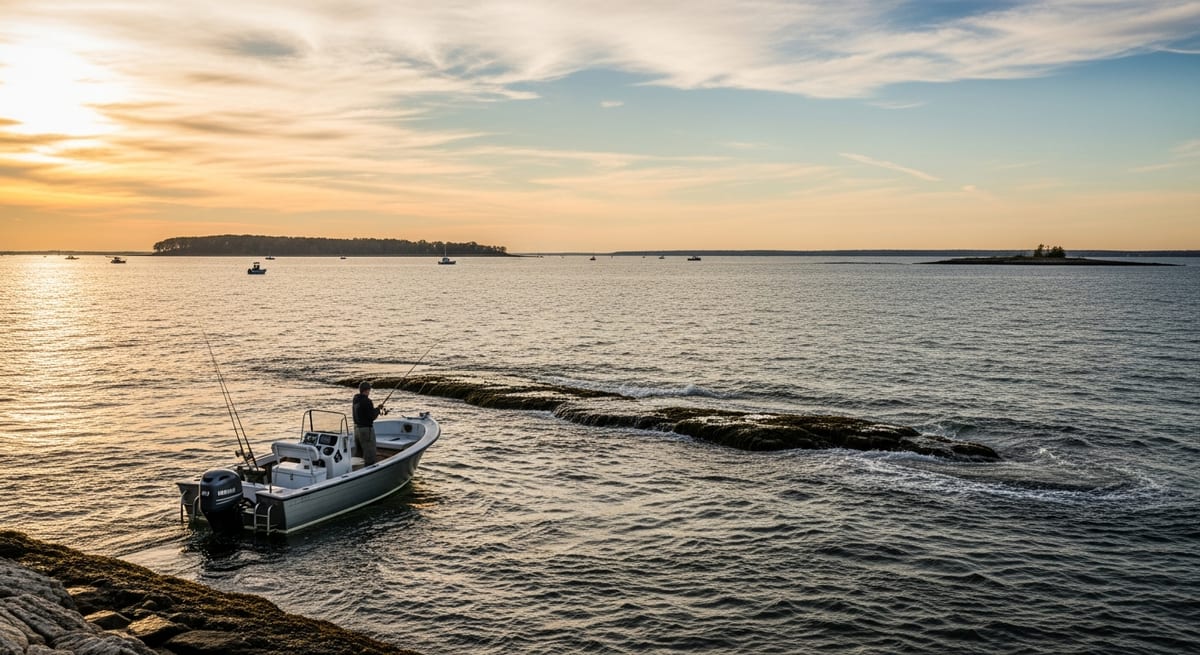
Anglers who cross-reference CTDEEP creel data with charter trip logs report that Connecticut's black sea bass harvest peaks not in midsummer but in the two-week window around Labor Day, when surface temperatures drop below 68°F and fish that spent August in 60-plus-foot depths push back onto mid-range reefs. The species draws heavily from the CT bottom fishing community, lIS charter captains frequently cite sea bass as the most-requested bottom target among day-trip clients, and the artificial reef program CTDEEP has expanded since 2015 has given boat anglers dozens of documented hard-bottom coordinates that hold fish from late May through early December. Shore-accessible rocky structure near Hammonasset Beach State Park and the New Haven Harbor breakwater adds a no-boat option that CT inshore communities have documented producing keeper fish on incoming tides.
CT Sea Bass Regulations: The State-Federal Split Anglers Routinely Misread
Black sea bass in Connecticut fall under a state-federal management split that makes annual verification mandatory, aSMFC and NOAA set the quota framework, and CT DEEP Marine Fisheries implements season dates, bag limits, and size minimums within that federal envelope. The result: regulations can shift year to year even when the stock is healthy.
As of the 2024-2025 season, the recreational minimum was 13 inches total length with a 3-fish daily bag limit during the primary season window. Season dates have historically run approximately mid-May through late December, with a brief closure window around the summer peak, verify exact open dates with CTDEEP Marine Fisheries before every trip, because these are not stable year to year. Enforcement at launch ramps runs highest during Memorial Day weekend and the Labor Day stretch, which are also the peak-density windows. Anglers fishing the Hammonasset Beach State Park rock jetty and the New Haven Harbor breakwater report officers checking frequently during those periods. The CT bottom fishing community broadly treats the 13-inch minimum as a floor, not a target. Many documented trips release undersized fish continuously before finding keeper-class fish on the same structure.
The 45-to-65-Foot Band: How LIS Regulars Track the Summer Depth Shift
The CT bottom fishing community broadly reports the same seasonal pattern: sea bass start the season in 25-to-40-foot water on nearshore structure, then push deeper as Long Island Sound surface temperatures climb through July and August, before returning to mid-depth reefs in September and October. Charter captains who keep detailed trip logs note that fish concentrating in 45-to-65 feet through late August tend to run larger on average than the shallower spring fish, though they require longer runs from coastal launches.
The late-summer depth shift is the piece many casual anglers miss. Boats running straight to 30-foot reefs in August often come back light, while boats dropping to 55-foot hard bottom find fish stacked. The CTDEEP-published artificial reef coordinates (posted at ctdeep.com) include several sites in the 40-to-60-foot range off Branford, Madison, and New Haven. Anglers who regularly cross these coordinates against the seasonal depth pattern report significantly better keeper ratios than those targeting random unmarked bottom.
September and October are the months cited most often in CT sea bass communities as the most reliable window. Cooler water brings fish back to shallower structure, action can be fast during a tide change, and keeper size in fall often exceeds the summer average across documented trip reports.
Named Structure: Norwalk Islands Ledges, Faulkner's Island, and Stratford Shoal
CT sea bass don't concentrate on open sand. The community's most consistently mentioned structures are specific rocky reefs, boulder fields, and artificial sites.
Norwalk Islands (western CT): The ledges and rocky bottom extending east and south of the Norwalk Islands hold fish throughout the season. Accessible from Veterans Memorial Park boat launch in Norwalk and the Westport town ramp. Western CT boat regulars note the Norwalk ledges fish well on an incoming tide when current pushes bait over hard structure.
Faulkner's Island area (Guilford): The rocky bottom surrounding Faulkner's Island is a well-documented sea bass zone for central CT anglers. Guilford's town ramp provides access. The island sits in roughly 20-to-30-foot water with deeper pockets nearby, trip reports from anglers dropping directly onto the hard bottom adjacent to the island document reliable action from late May through October.
Stratford Shoal (mid-Sound): Stratford Shoal, also known as Middle Ground, sits roughly equidistant between the CT and NY shores and is a more exposed open-water target. Anglers running from Milford Point or the Housatonic River mouth report it as a reliable mid-Sound sea bass destination when conditions allow. The community consensus is it fishes best in 2-foot seas or less. Submerged ledge structure holds fish in the 25-to-40-foot range.
CTDEEP Artificial Reefs: The state's reef program has placed structure at multiple sites across the Sound, coordinates are listed at ctdeep.com. Several sites off Branford and New Haven fall in the 40-to-60-foot range and are among the most frequently cited sea bass habitat in CT charter logs and creel survey data.
How LIS Bottom Fishers Rig for Sea Bass
The CT bottom fishing community has largely converged on a consistent setup for Long Island Sound sea bass, with small variations by depth and personal preference.
Rod and reel: A 6-to-7-foot medium-heavy spinning or conventional rod in the 15-to-30-lb class is the standard. Many LIS regulars fish conventional levelwinds for deeper water because the direct-drive feel helps detect the nibble-before-commit bite pattern sea bass are known for.
Line and leader: 20-to-30-lb braid mainline is nearly universal among regular CT sea bass anglers. The no-stretch characteristic in 45-to-65 feet of water makes a meaningful bite-detection difference compared to monofilament. Leader material is typically 15-to-20-lb monofilament or fluorocarbon in 6-to-8-inch dropper sections.
Rig: The standard LIS setup is a two-hook high-low (dropper loop) rig or a spreader rig fished with a 1-to-3-oz sinker matched to current speed. Size 1/0-to-2/0 Chestertown or baitholder hooks are the CT community standard, sea bass have smaller mouths than their body size suggests, and oversized hooks reduce hookups on the initial bite.
Squid, Crabs, and the Freshness Window CT Regulars Prioritize
Among CT sea bass anglers, the most consistent topic in bait discussions isn't which type to use. It's freshness. Anglers active on Connecticut fishing forums and charter regulars report that replacing bait every 10-to-15 minutes regardless of bite activity is the single adjustment that most noticeably improves hookup rates on slow days.
Squid strips are the CT standard. Fresh-dead or thawed squid cut into 1-to-2-inch strips covers most situations. Dried-out squid draws sharply fewer takes. The community recommendation is to keep it on ice at all times and change frequently.
Sea clam is considered the premium option by many Sound regulars and is available at bait shops along the CT shoreline in Milford, Guilford, and Niantic. Harder to transport than squid, but the community consensus is that it outproduces on days when squid is drawing fewer bites, particularly in late summer.
Crab chunks appear less often in bait discussions but consistently: green crab and Asian shore crab cut shell-on is a legitimate option that CT regulars report produces well when sea bass are keyed on crustaceans. Shell-on presentation holds scent longer than peeled crab and is the form most reported in successful trip logs.
On the Water: What the CT Bottom Fishing Community Does Differently
Most sea bass novices drop to the bottom, feel nothing, and move. CT boat regulars who log consistent keeper trips describe a different approach that the community has largely converged on.
Drop and reel up: After hitting bottom, reel up 2-to-3 cranks. CT bottom fishing communities consistently note that sea bass hold just off the bottom, not on it, and that staying slightly elevated keeps bait in the feeding zone without constant snag loss.
Jig slowly: A 6-to-12-inch rod-tip lift with a slow fall triggers strikes that a stationary bait often doesn't. This is a near-universal observation in CT sea bass trip reports from both boat and kayak anglers.
Wait for the commit: Sea bass often nibble before committing. A common error reported in CT sea bass communities is striking at the first tap. Experienced anglers typically wait for a definite pull-down before sweeping the rod upward firmly.
Current and anchor position: Many productive LIS spots fish best when the boat sits upcurrent from the structure so the bait drifts naturally over hard bottom. Anglers who anchor and find themselves pulling directly away from the reef, bait trailing in open water, report poor action even over documented fish-holding coordinates, regardless of season.
Cleaning and Cooking Sea Bass from Long Island Sound
Black sea bass are consistently ranked among the top-table species in Long Island Sound by CT anglers who target multiple species. The white, fine-grained, mildly sweet meat holds up well to pan-frying, baking, and grilling whole on smaller fish.
For cleaning: scale before gutting to keep flesh clean (sea bass scale easily), then fillet along the backbone from behind the gills toward the tail. A legal 13-inch fish yields two respectably sized fillets. CT anglers generally report the fish holds quality on ice for up to two days before cleaning, though processing as soon as practical produces the best result.
For cooking: pan-seared in butter with garlic and lemon is the most commonly reported preparation in the CT sea bass community. The skin crisps well and is worth keeping on the fillet if scaled thoroughly. Whole fish over charcoal is a frequently cited preparation among Norwalk Islands and Faulkner's Island day-trip regulars who clean fish at the ramp and cook the same evening.
EVERY SATURDAY MORNING
Weekly fishing intelligence
Nationwide conditions, what's biting, and honest gear deals. One email, no noise.
No spam. Unsubscribe anytime.