
CT Trout Anglers on the Farmington, Salmon Creek, and Stocked Town Ponds Report Spinning Tackle Outproduces During the Opening-Week Push. What DEEP Stocking Maps, TMA Regulations, and Spring Community Reports Reveal About Inline Spinners, Float Rigs, and the Gear Choices That Move Stocked and Wild Fish
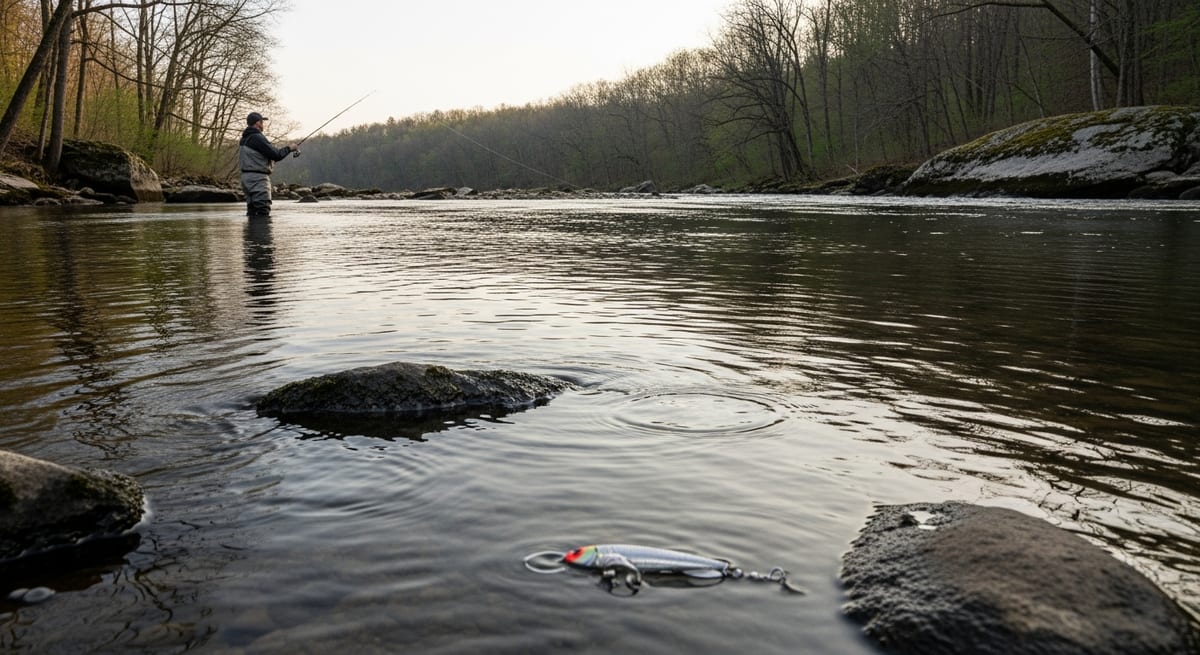
Anglers who fish the Farmington TMA on opening day consistently report that size 2 inline spinners move stocked fish in the first hour, often outpacing fly presentations while water is still cold and fish are freshly stocked. The same report comes from stocked town ponds from Glastonbury to Torrington. The community knowledge built around spinning tackle for CT trout spans Litchfield County wild brook trout streams, Housatonic River brown trout pools, and DEEP-managed stocked impoundments. This article pulls from that collective: what Farmington River regulars, Salmon Creek tributary communities, and stocked-pond anglers report across seasonal conditions, alongside DEEP stocking schedule context, TMA regulation reminders, and the lure and rig choices that surface most consistently in spring community reports.
What Farmington River and Salmon Creek Communities Report About Inline Spinners
Anglers who spin-fish the Farmington below the TMA, particularly the catch-and-release section between Riverton and New Hartford, consistently describe inline spinners as the go-to early-season lure before water warms into the 50s. The blade vibration reaches fish holding in heavy current seams that soft plastics and drifted baits struggle to penetrate at retrieve speed. Size selection: Farmington regulars and Salmon Creek brook trout communities both report size 0 and 1 for low, clear conditions on smaller tributaries; size 2 as the workhorse on main-stem river and pond applications; size 3 when the river is running high and stained after rain. Colors: Silver blade in bright, clear conditions; gold in overcast and lightly tinted water. Fire tiger and trout-pattern blades appear in stained spring runoff reports from both river communities. Brands: Mepps Aglia and Panther Martin are the two names that appear most consistently in CT trout communities and are stocked at virtually every CT tackle shop. Retrieve: Cast upstream and across, retrieve just fast enough to keep the blade rotating. A downstream quarter-cast uses current to assist blade rotation at slower reel speeds, which is useful in cold early-season water when sluggish fish may not chase a fast presentation.
Spoons on CT Trout Water: What Stocked-Pond and River Communities Report
Small casting spoons, 1/8 to 1/4 oz, appear frequently in reports from stocked impoundments and slower river eddies where a wobbling flash profile outperforms spinners. The baitfish-wobble action moves fish that have already seen multiple spinner retrieves on pressured water. KastMaster: Chrome and gold are the two colors with the longest CT stocked-trout track record. Anglers at ponds like Coventry Lake and Wononpakook report the KastMaster in 1/8 oz as effective right after stocking when fish are still active and chasing. Retrieve speed matters: vary it until strikes come. Little Cleo: The heavier wobble at slow speeds makes the Little Cleo a pond-specific tool. CT pond communities report it particularly effective in calm morning conditions when a slower presentation matches the pace of suspended fish. Krocodile: The larger profile produces in early-season river applications when stocked brown trout hold in deeper pools. Anglers on the lower Salmon River report it during the April window when bigger fish from hatchery runs are still concentrated before dispersing.
Float Rigs at CT Stocked Ponds and Slow River Sections: Depth Control and Drift
The float rig is the dominant method reported by anglers fishing stocked ponds across CT, particularly at DEEP-managed public access ponds where fish hold at consistent depths after stocking. The presentation keeps bait off the bottom and suspends it at exactly the depth fish are using, which shifts by water temperature and time since stocking. Basic setup: A pencil or slip float matched to bait weight, set 1.5 to 2.5 feet above the bait for most CT pond applications, with a small split shot 6 inches above a size 8 to 10 hook. Adjust depth in 6-inch increments until strikes come. Baits: PowerBait floating dough, with salmon pink and chartreuse most commonly cited in stocked-pond community reports, fished on a size 10 to 12 treble hook; fresh nightcrawler on a single hook; wax worms during cold April water when fish metabolism slows. Presentation at access points: At DEEP boat-launch ponds like Crystal Lake in Ellington and Mashapaug Lake in Union, anglers report positioning near shaded banks and dock pilings after stocking trucks leave. A float sliding cleanly under indicates a real strike; a sideways lift often does too. Set with a quick rod sweep rather than a hard hook-set on light wire hooks.
Soft Plastics in CT Trout Current: What Spring River Communities Report Works
Soft plastics for trout have a shorter CT community track record than hardware, but specific presentations have earned consistent mentions in spring river reports. Berkley Gulp! Trout Worm: The scent dispersion draws strikes from fish holding in slow current seams that ignore hardware. A 3" Gulp worm on a 1/16 oz jig head, dead-drifted through deep pools, comes up repeatedly in Farmington and Housatonic trout community reports, particularly in mid-April when hatchery fish are still acclimating to river flow. Small grubs on ultralight jig heads: 2" white or chartreuse curly-tail grubs mimic aquatic invertebrates and produce in moving current. Anglers fishing the upper Salmon Creek drainage report them effective for wild brook trout where the presentation reads as a drifting nymph near undercut banks. PowerBait Floating Trout Worm: The natural buoyancy lifts it off bottom when rigged on a small single hook. Community reports from slow Housatonic pools note that this bottom-suspension quality draws inspection strikes from cautious fish that ignore weighted baits entirely. TMA regulation note: The Farmington TMA between Riverton and New Hartford requires single barbless hooks under current DEEP regulations. Verify current rules at ct.gov/deep before any TMA session, as seasonal restrictions apply and can change.
Spinning Tackle for CT Trout Water: What Farmington and Stocked-Pond Communities Run
Rod: A 6 to 7-foot ultralight to light spinning rod is what most CT trout communities describe as the foundation. Ultralight (2 to 6 lb rating) for Salmon Creek and small Litchfield County brook trout tributaries; light (4 to 8 lb) for open Farmington river fishing and stocked-pond applications. The soft tip loads on short, low-angle casts with light lures and absorbs the head shakes of trout on light wire hooks. A fast or medium-fast bass rod loses fish at the net on these hook sizes. Reel: A 1000 or 2000 series spinning reel with a smooth, tested drag. Most CT trout communities report spooling with 4 to 6 lb monofilament or fluorocarbon. Monofilament's inherent stretch functions as shock absorption on light wire hooks and remains the most cited choice in CT stocked-pond reports. Braid adds no meaningful advantage in most CT trout scenarios. Leader tip from the river community: A 24-inch fluorocarbon leader off braid is one exception CT river regulars describe. When fishing a spinner in very clear tailwater below TIN Bridge on the Farmington, the fluoro leader handles visibility concerns while braid handles sensitivity on the main line. Approach and access: CT trout streams are often clear and shallow. Anglers who fish the Farmington regularly note that stealthy approach, staying low, keeping shadows off the water, and arriving before 7 AM on opener, produces measurably more casts before fish move off than careless wading does. DEEP public access to stocked streams statewide is documented in the annual CT Fishing Guide at ct.gov/deep.
EVERY SATURDAY MORNING
Weekly fishing intelligence
Nationwide conditions, what's biting, and honest gear deals. One email, no noise.
No spam. Unsubscribe anytime.