
CT Trout Pools Below Hogback Dam Hold Fish Through January. What Farmington Tailwater Communities Report About Cold-Water Technique, DEEP Seasonal Regulations, and the Windows Most Anglers Miss
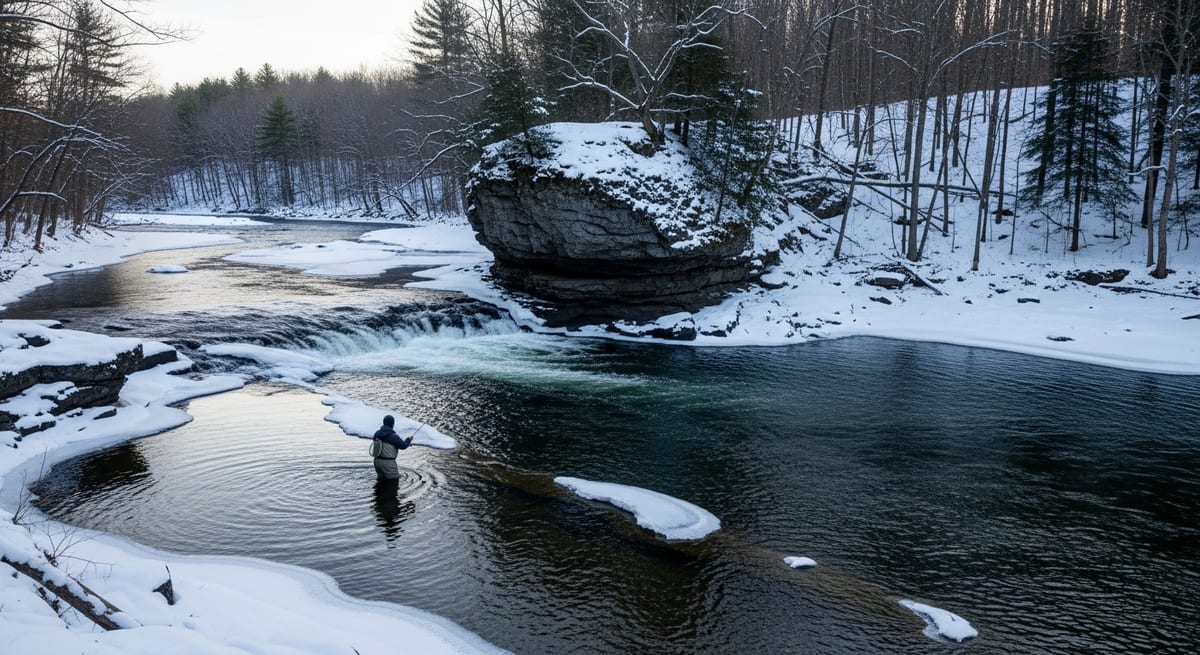
Farmington tailwater regulars report catching brown trout on nymphs and small jigs in late December and into January. Not in numbers, but consistently enough that CT cold-water communities document the winter bite each season. The pools below Hogback Dam don't empty out after CT DEEP's fall stocking window closes; the fish stay, and fishing pressure drops to near zero. Reports from the Farmington's catch-and-release sections, the Salmon River below Dayville, and a handful of known spring-fed streams all describe trout that remain catchable through the cold months: slower, more selective, and requiring a completely different approach than the fall bite, but present and active for anglers who know the conditions.
The Metabolic Window: What Cold Water Actually Does to a Trout Holding in a CT Pool
Trout are cold-blooded, and CT tailwater communities have learned through seasons of winter fishing what that means in practice. A brown trout holding in 38°F water on the lower Farmington is physiologically different from the same fish in October: its metabolism slows with water temperature, it needs less food to maintain itself, and its digestion slows enough that it won't expend significant energy chasing a meal.
This doesn't mean the fish stop feeding. Reports from Farmington and Salmon River communities through multiple winter seasons confirm trout eat throughout the cold months. What changes is how they eat: slowly, selectively, and only for food that passes within a foot or two of their holding position. Presentations requiring the trout to move significantly are largely ignored, which is the consistent finding from CT communities who have worked these pools in January.
CT DEEP creel data from catch-and-release sections documents catch-per-unit-effort dropping in winter but never reaching zero. The anglers who account for the metabolic constraint and fish accordingly access fish that most of the community has stopped looking for.
Where CT Communities Actually Find Winter Trout: Tailwaters, Spring Seeps, and Deep Pool Holds
Farmington River tailwater: Water released from the bottom of Hogback Reservoir maintains temperatures between 40-50°F year-round, warmer than ambient winter air and the reason the river's C&R sections stay open under DEEP year-round regulations. Communities reporting from the upper C&R reach, from the dam down through Riverton, describe it as the most reliable winter trout water in CT by a wide margin. Even mid-week in January, those pools hold fish consistently according to regulars.
Salmon River: The stretch below Dayville holds stocked rainbows and browns that persist well into winter in its cold, clear flows. Communities who fish this water in January note it receives significantly less pressure than the Farmington during the cold months.
Spring-fed tributaries: Streams fed by underground springs maintain near-constant temperatures regardless of air temperature and rarely ice over completely. CT DEEP stream maps identify several in the Thames River watershed and Willimantic drainage. Communities fishing these waters in winter typically keep locations close, but DEEP's public mapping tools locate them.
Deep river pools: In water without a thermal advantage, trout stack in pools deeper than six feet where temperature is most stable and current is minimal. CT river communities report fish holding in a narrow band near bottom in these pools all winter, requiring a presentation that reaches the floor quickly.
Dead Drift and Micro Jigs: What Farmington and Salmon River Communities Report Actually Working
Dead drift nymphing: Reports from CT tailwater communities consistently identify this as the highest-percentage winter approach. A weighted Hare's Ear, Pheasant Tail, or small egg pattern drifted naturally at the depth where fish are holding accounts for the majority of winter trout documented across CT community reports. Weighting to reach the bottom quickly is critical; the fly needs as much time as possible in the narrow strike zone. Strikes in cold water are extremely subtle. Farmington regulars describe watching for any hesitation, twitch, or stoppage of the indicator or line end rather than the aggressive takes common in fall.
Micro jig fishing: Communities fishing the Farmington and Salmon in winter regularly report that a 1/32 or 1/64 oz marabou jig on 4-6 lb fluorocarbon, cast upstream and allowed to fall on a semi-tight line, produces trout that might otherwise ignore a nymph. CT spinning-rod communities describe the winter strike as a light tap or the lure simply stopping its descent rather than a hard pull.
Mealworms and wax worms: Bait communities fishing CT's general trout waters in winter report consistently that live mealworms or wax worms on a small #10-#14 hook with minimal weight, drifted slowly through deep pools, outperforms larger natural baits. The small profile and slow movement match what a winter trout is willing to commit energy to.
What CT Tailwater Communities Report Doing Differently When Water Drops Below 45°F
CT trout communities, particularly those fishing the Farmington and Salmon River through December, report several consistent adjustments that separate productive winter trips from blank days.
Go smaller: Farmington tailwater regulars consistently report that size #16-#18 nymphs outperform the #10 and #12 patterns that dominated the fall bite. The principle, according to community consensus: smaller food items require less digestive energy for a trout with a slowed metabolism. What worked in October often gets refused in January.
Go slower: Regulars on CT trout forums describe extending drifts, lengthening pauses between jig hops, and slowing retrieves considerably once water temperatures drop. Community reports are consistent that a trout in cold water won't move for a fast presentation regardless of how realistic it looks.
Fish the warmest window: On clear winter days, CT communities report the 11 AM to 2 PM window producing the most consistent trout activity. Water temperature monitoring on the Farmington shows a measurable rise during midday sun hours on calm days, enough to shift trout feeding behavior noticeably.
Work the current seams: Winter trout communities emphasize that fish position at current edges (slow water to hold in, with faster water delivering food) rather than tucking into completely still water. That boundary between fast and slow current is where CT communities look first in any winter pool.
Gear That Keeps CT Anglers on the Water in January
CT winter trout communities are consistent on one point: if hands are too cold to tie knots, the rest is irrelevant. Neoprene gloves with fold-back fingertips allow functional dexterity while keeping hands warm enough to fish for hours in January temperatures. The Glacier Glove style is the community standard on CT winter streams.
Waders: CT communities fishing through the cold months report that neoprene waders provide meaningfully better protection in the 35-45°F range than breathables, which allow cold to penetrate quickly if splashed. A soaked leg in 36°F water requires an immediate exit. Standard safety practice among CT winter stream communities is keeping a full change of clothes in the vehicle.
Studded wading boots: Ice forms on CT stream margins, rocks, and wading surfaces after nights below freezing. CT trout communities consider cleated or studded boot soles non-negotiable in January on rivers like the Farmington and Salmon. A fall in near-freezing water is a serious emergency, not a minor inconvenience.
Line and leader care: Fly communities fishing cold CT mornings describe line memory and stiffness as a real limitation in sub-40°F air. Keeping leaders and fly lines inside a coat pocket before rigging up helps significantly. Fluorocarbon holds up better than mono in cold water, according to reports from winter C&R regulars on the Farmington.
Seasonal Closures, Year-Round Waters, and What the Current DEEP Angler's Guide Actually Says
Winter trout fishing in Connecticut is legal in more water than most anglers assume, but seasonal closures are real, vary by water body, and are worth verifying before heading out.
General season close: Most CT trout waters close December 31 under general season regulations and reopen in mid-April. Fishing a general-season water after December 31 is a violation.
Year-round designated waters: The Farmington River's catch-and-release sections are among the CT waters designated open year-round under fly-fishing-only regulations. DEEP's current Angler's Guide lists all year-round open waters by name. Verify against the current guide before fishing any unfamiliar water in January.
Private and Class A streams: Some designated Class A trout streams carry individual open and closed season dates that differ from the general season calendar. These are listed by water body in the DEEP guide.
Regulations change annually: Slot limits, seasonal designations, and special regulations are revised each year. CT fishing communities treat the current DEEP Angler's Guide as the definitive reference, not last season's memory or secondhand reports from the water.
EVERY SATURDAY MORNING
Weekly fishing intelligence
Nationwide conditions, what's biting, and honest gear deals. One email, no noise.
No spam. Unsubscribe anytime.