
CT Shore Communities at the Race, Niantic Bay, and Housatonic Mouth Report the Fall Migration Peaks in a 10-to-14-Day Window Per Spot. What Surf Casters, ASMFC Tagging Data, and DEEP Slot Regulations Reveal About Timing the October Bunker Push on the CT Coast
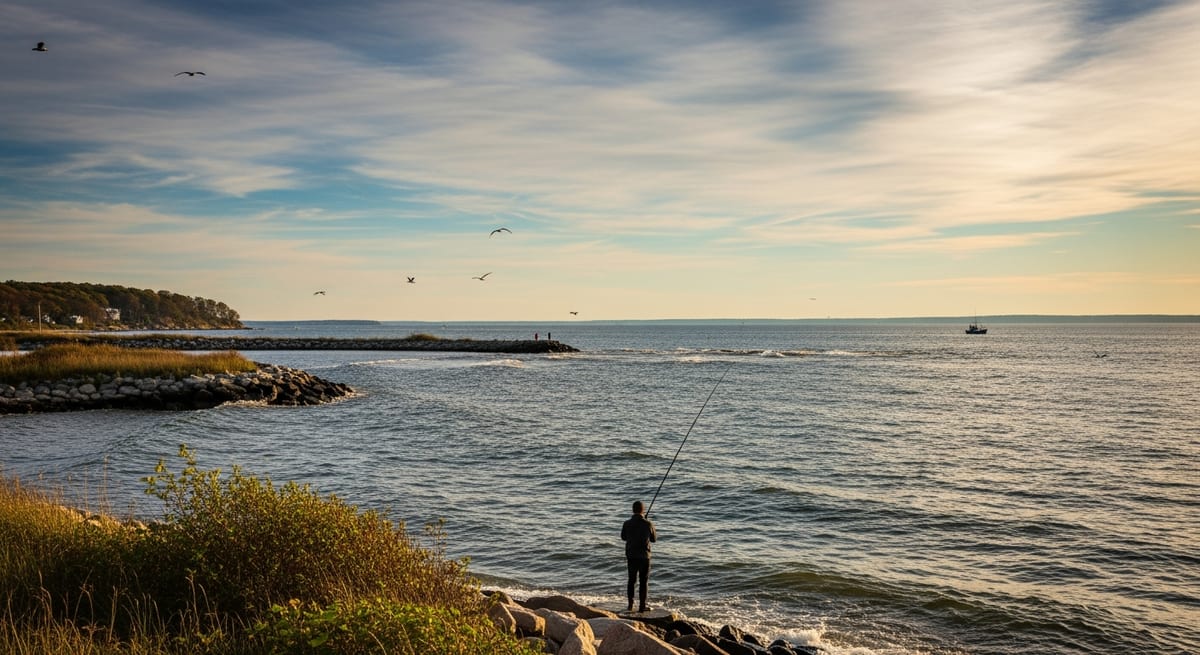
Reports from CT shore communities and DEEP creel data from recent fall seasons describe the same pattern: the highest catch rates for large striped bass appear during a window of roughly 10 to 14 days per access point, not across all of October. Anglers fishing the Race and Fishers Island Sound area historically report the leading edge of the fall migration while spots west of the Connecticut River mouth are still seeing mostly schoolie-class fish. A reflection of the east-to-west movement pattern documented in CT community forums and ASMFC tagging studies. The fish follow bunker schools south through Long Island Sound, and the CT coast sits across that corridor between summer grounds off Rhode Island and Cape Cod and overwintering areas off New Jersey and the Chesapeake. Shore communities at Niantic Bay, Hammonasset Beach State Park, and the Housatonic mouth all report the same sequence: water temps in the 60-65°F range bring the larger fish in, and conditions can shift in days, not weeks.
The East-to-West Pattern CT Shore Communities Consistently Report, and the Temperature Window That Triggers It
The fall migration through Long Island Sound moves generally west and southwest, which means eastern CT access points historically see fish before the western shoreline does. Anglers at the Race, Fishers Island Sound, and along the Stonington and Groton shoreline typically report large bass in late September and early October, well before most western CT spots see comparable activity.
Based on community reports aggregated across CT fishing forums, the peak window at any given access point tends to run 10 to 14 days. Water temperature is a more reliable trigger than the calendar. Shore communities consistently report the most productive large-bass fishing when Sound surface temperatures are between 58 and 65°F, and the consensus among CT surf casters is that when temperatures drop below 55°F, the main body of fish has passed through most coastal access points. The NERACOOS real-time ocean observation network publishes current Long Island Sound surface temperature readings, and anglers who track these data points report the correlation to peak activity holds in most years. The tidal rips and current seams at the Race produce some of the earliest large-bass encounters in the region each fall, with CT boat communities documenting fish there while much of the rest of the CT coast is still in the schoolie phase.
Named CT Access Points Where Shore Communities Report the Most Consistent Fall Activity
Shore access for the fall migration is well documented at multiple public points, with community reporting concentrated at locations that produce year after year. Eastern CT (late September-early October): Bluff Point State Park in Groton offers free public shoreline access and is among the first spots CT anglers report large-bass contact in fall. The Stonington shoreline and Niantic Bay both generate consistent community reports during early to mid-October. The Thames River mouth at New London concentrates migrating bass following bunker into and out of the river system; shore communities describe evening and early-morning tides there as the most productive window. Central CT (mid-October): Cornfield Point in Old Saybrook, at the mouth of the Connecticut River, is one of the most reported central CT fall striper locations, shore communities describe it as a reliable current-swept intercept point for bass moving west. Hammonasset Beach State Park in Madison offers extensive beach and point access and generates substantial community reports during the mid-October peak. Western CT (late October-early November): The Housatonic River mouth (Stratford and Milford side) and Black Rock Harbor in Bridgeport both see the migration's large-fish push as water temperatures drop in late October. CT communities report the Housatonic mouth specifically as a staging area where bunker schools and bass concentrate before the push continues west toward Greenwich and beyond.
What CT Shore and Boat Communities Report About Locating the Bunker Schools
The dominant pattern CT communities report during the fall migration is consistent across years: large stripers follow menhaden. The two migrations are effectively inseparable, and anglers who find concentrated bunker schools consistently report finding bass beneath and around them.
Visual indicators CT communities report using to locate bunker: Diving birds, particularly gannets, terns, and cormorants working a defined area, are the most commonly cited surface signal. Oil slicks on flat water indicate crushed bunker. 'Nervous water,' where the surface is dimpled by thousands of small baitfish, is visible from shore or from a boat at distance. On sonar, bunker appear as dense returns high in the water column. Intercept positioning: The practical consensus among CT boat communities is to position ahead of a moving bunker school rather than running through it. Approach from the side or ahead of the school's direction of travel and present baits as the school moves through. Anglers who drive directly into a bait ball report pushing the bass down temporarily. CT shore anglers at spots like Cornfield Point and the Housatonic mouth report similar logic applies from the bank: cast ahead of a visible bird-working area, not directly into it, for more consistent contact.
What CT Communities Report About the DEEP Slot Limit and Fall Enforcement Patterns
CT's current DEEP striped bass regulations include a slot limit: recreational anglers in Connecticut state waters may retain one fish per day measuring between 28 and 35 inches, or one fish measuring over 35 inches. Bass falling between those thresholds are protected under the slot. For current regulations and any in-season modifications, the CT DEEP Fishing Guide at portal.ct.gov/DEEP is the authoritative source, regulations can change between seasons and should be verified before each trip.
CT shore communities report that EnCon enforcement is a visible presence at high-traffic fall access points during peak October weeks, specifically at the Housatonic mouth, Niantic Bay launch areas, and Connecticut River access points near Old Saybrook. Reports from anglers at these locations describe the same citation patterns repeating each fall: improper measurement technique and retaining fish outside the slot. Boat anglers fishing the Race or western Sound approaches should be aware that Connecticut and New York maintain different striped bass regulations. The state border is relevant when working those boundary waters.
Tactics CT Shore and Boat Communities Report Producing During the October Migration
Live bunker: The most consistently documented large-bass technique during the fall run across CT community reports. A 4-6 inch live menhaden, free-lined or fished under a large foam float at the edge of a bunker school, is cited as producing the largest stripers of the season in most annual accounts from CT surf cast and boat communities at spots like Niantic Bay and the Housatonic mouth. Chunk bunker: Fished on the bottom beneath bunker schools for bass holding in the lower water column. A fish-finder rig with a 3 oz sinker and circle hook, baited with a fresh-cut chunk, is a standard setup CT shore anglers report for keeper-class fish when surface activity stalls. Surface plugs: During active blitzes on bunker, CT anglers report a 3-4 oz pencil popper worked through the edges of the melee produces explosive strikes. The community consensus is to work the fringe of the bait ball rather than casting into the center. Heavy bucktail jig: CT boat communities consistently report a 2-3 oz white bucktail with a paddle-tail trailer, dropped through suspended bunker schools and jigged in the lower water column, as a reliable alternative when surface activity goes quiet. Matching lure size to local bunker, which average 4-6 inches in Sound schools during October, is reported to matter more than color during the peak migration window.
EVERY SATURDAY MORNING
Weekly fishing intelligence
Nationwide conditions, what's biting, and honest gear deals. One email, no noise.
No spam. Unsubscribe anytime.