
Sunfish & Bluegill Fishing in Connecticut: A Beginner's Complete Guide
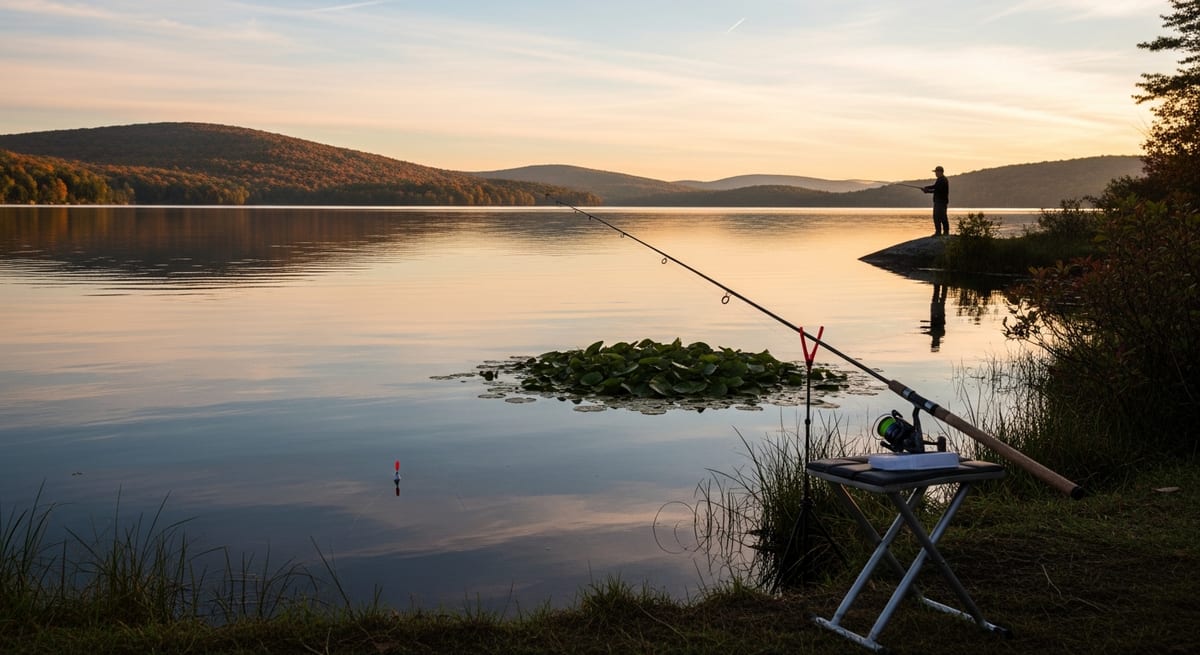
Walk the shoreline at Lake Beseck on a June morning and you can see them before you wet a line, bluegill stacked along the dock pilings, flashing copper and green in two feet of clear water. Connecticut's ponds and lakes are loaded with bluegill and pumpkinseed sunfish, and they're the most agreeable fish you'll ever chase. They hit simple baits, they fight hard on light tackle, and there's a pond within driving distance of almost every address in the state. If you're new to fishing, or you're introducing someone else to it, this is the right fish to start with.
Bluegill vs. Pumpkinseed: What You're Looking At
Pull two sunfish out of the same pond and you might be looking at two different species. Both are common throughout Connecticut and often share the exact same water.
Bluegill (Lepomis macrochirus): Olive-green to dark blue sides with faint vertical bars, a solid blue-black ear flap, and an orange-yellow belly on larger males. The most abundant sunfish in CT ponds. Most fish run 6-9 inches; larger specimens are possible in productive, well-managed lakes.
Pumpkinseed (Lepomis gibbosus): More colorful, orange-red belly, blue-green sides with orange spotting, and a distinctive orange or red edge on the black ear flap. Often pulled up right alongside bluegill. Tends to run slightly smaller.
Both species bite the same baits, require the same gear, and taste the same on the plate. For identification purposes only. You don't need to tell them apart to have a good day on the water.
Where to Find Them in Connecticut
Sunfish hold near structure and vegetation in warm, clear water. In most CT ponds, that means dock pilings, lily pad edges, fallen timber, and rocky shorelines in 2-8 feet of water.
Structure to target:
- Dock and pier pilings (shade and ambush cover)
- Weed edges, lily pads, milfoil, coontail beds
- Submerged brush and fallen trees
- Rocky shorelines in 2-8 feet of water
- Bridge and culvert shadows
Seasonal depth shifts: Through May and early June, sunfish stack in the shallows all day long. Once water temperatures push past 75°F in mid-July, midday fish often slide out to 6-10 feet and return to the edges in the morning and evening. Your best windows are the first two hours after sunrise and the hour before dark.
Three solid CT access points:
Lake Beseck (Middlefield): State boat launch off Route 66 with shore access along the western bank. Dense lily pad growth on the north end holds sunfish all season and is easy to reach on foot.
Crystal Lake (Ellington): A no-motor lake with good clarity. You can see fish in the shallows before you cast. Shore access from the public beach area. One of the more reliable panfish spots in Tolland County.
Mashapaug Lake, bigelow Hollow State Park (Union): Remote and lightly pressured. Walk-in shore access from the park trail system. The coves off the main shoreline hold sunfish from May through October.
Tackle for Sunfish
The goal is gear light enough that even a 6-inch fish puts a real bend in the rod. Ultralight spinning equipment is the standard choice.
Rod and reel: A 5-6 ft ultralight spinning rod with a small spinning reel. A 1000-size reel is commonly used for this kind of fishing, and 4-6 lb monofilament is all you need. No leader required; straight mono works fine for sunfish. Simple and effective.
A cane pole: The traditional sunfish setup, and still one of the most effective tools available. A 10-12 foot cane or fiberglass pole with a fixed length of line, small hook, and a bobber. No casting required, drop straight down alongside docks and lily pads. Tough to beat when fish are holding tight to structure.
Bobber and hook (the classic setup):
- Size 6-10 long-shank or Aberdeen hook
- Small split shot 6 inches above the hook
- Slip or fixed bobber set 1-3 feet deep
- Cast near structure, wait for the dip
Jigs: 1/32 to 1/8 oz jig heads with 1-1.5 inch soft plastic tails or marabou flies catch sunfish consistently, and are especially useful in the cooler water of May when bait fishing slows down.
Best Baits
Sunfish will eat just about anything small enough to fit in their mouths, and they're not shy about it. The trick is matching bait size to the hook rather than overloading it with more than a sunfish can take in.
Nightcrawlers / earthworms: The most consistent sunfish bait in Connecticut. Use a small piece, about 1/4 to 1/3 of a nightcrawler, threaded onto a size 6-8 hook. Sunfish have small mouths and will peck at a large bait without getting hooked. Pinch it to size and you'll start landing fish instead of losing bait.
Wax worms: Excellent for sunfish, especially in early spring when water is still cold and fish are lethargic. Small, soft, and hard to ignore. Available at most CT bait shops in small tubs.
Red worms / mealworms: Smaller than nightcrawlers and well-suited to smaller hook sizes. A good choice when bluegill are being finicky or when you want to avoid constant re-baiting.
Crickets: A summer bait worth keeping in mind. Sunfish actively take crickets near the surface and the strikes are aggressive, particularly good in July and August along lily pad edges when insect activity is high. Hook through the thorax and cast it where the pads meet open water.
Small jigs: 1/32 oz heads with tiny paddle tails work when bait isn't available. Effective year-round, most productive in the cooler shoulder months.
Connecticut Regulations
A Connecticut fishing license is required for all anglers age 15 and older. Licenses are available online through the CT DEEP website or at licensed vendors across the state. A one-day license is available if you're just trying it out.
Sunfish regulations in Connecticut:
- No minimum size limit
- Daily bag limit: 30 fish (combined sunfish species)
Sunfish are resilient and reproduce quickly. They're not a species under pressure. If you're keeping fish, take what you'll eat and release the larger fish, which are the prime spawners.
Eating Quality
Sunfish are genuinely good eating, firm white meat, mild flavor, and none of the strong fishiness people associate with freshwater species. The standard preparation is pan-fried in butter with salt, pepper, and a squeeze of lemon. Simple and hard to improve on.
Cleaning them takes more effort per pound than larger fish. Scale them under running water (they scale quickly), remove the head and gut, then either filet the sides or score the fish and cook whole. Fish from clear, well-oxygenated water, crystal Lake and Bigelow Hollow come to mind, taste noticeably better than fish from warm, murky ponds.
A cooler of 15-20 fish from a productive spot makes a solid meal. Don't overlook them at the table.
EVERY SATURDAY MORNING
Weekly fishing intelligence
Nationwide conditions, what's biting, and honest gear deals. One email, no noise.
No spam. Unsubscribe anytime.