
Candlewood Lake Walleye Feed Hard at First Light and Go Quiet by Mid-Morning. What CT DEEP Freshwater Records, Candlewood Regulars, and Seasonal Depth Data Reveal About Timing, Presentations, and Gear for Connecticut's Only Consistent Walleye Fishery
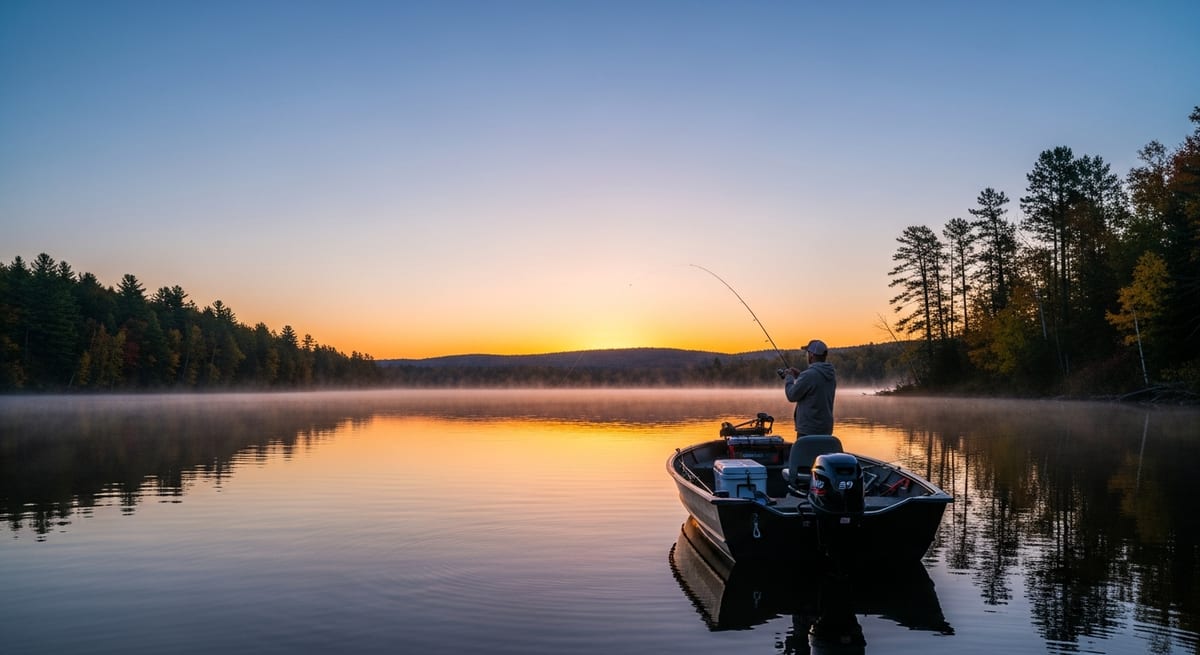
CT DEEP freshwater records identify Candlewood Lake as Connecticut's only established walleye fishery, a stocked population in a reservoir spanning Fairfield and Litchfield counties that gives Northeast anglers a local option for a species most of their peers drive hours to find. Anglers who fish Candlewood across multiple seasons report the same consistent pattern: walleye action concentrates in the 45-minute window around sunrise and again at last light, with midday fishing in summer producing much more slowly than those transition periods. The light-sensitivity that defines walleye behavior is the scheduling rule Candlewood regulars learn quickly, and the one that determines whether a trip ends with fish or not.
The Low-Light Advantage: Why Walleye Biology Sets the Fishing Clock
Walleye have a specialized eye structure called a tapetum lucidum, a reflective layer that amplifies low-light vision and gives the fish a feeding advantage over prey species when conditions are dim. Fisheries literature consistently notes crepuscular and nighttime feeding activity as the walleye baseline, and anglers who fish Candlewood across multiple seasons report this pattern holds reliably on the reservoir.
In bright midday conditions, walleye typically move deeper or seek shaded structure on rocky humps and steep point edges, where their visual advantage over forage fish is preserved. On sunny summer days, Candlewood walleye often retreat to 20-30 feet or more, making midday jigging from a stationary position a low-percentage approach.
Windy or overcast conditions extend walleye feeding windows by reducing light penetration through the water column. Anglers who track conditions on Candlewood report noticeably better mid-morning action on heavily overcast days or in the chop following a cold front passage. Building a Candlewood walleye trip around low-light scheduling, or planning around forecast cloud cover, reflects how consistent anglers approach the fishery.
Spring Rocks, Summer Depth, Fall Daylight: Seasonal Windows on Candlewood
Spring: Walleye typically spawn in early spring, often beginning in March on Candlewood when water temperatures climb into the mid-to-upper 40s. During this period, anglers find fish concentrated on rocky shorelines, gravel points, and riprap in 4-10 feet. The northern sections of the lake, including the Sherman Cove area and rocky points in New Fairfield, hold the structure walleye use during the spawn approach. Pre-spawn and immediate post-spawn periods offer some of the year's most consistent shallow-water access to the species.
Summer: As water temperatures rise, walleye move off shallow structure and locate the thermocline zone. On Candlewood in mid-summer, anglers who troll the mid-lake basin and the deeper sections near the dam report finding fish at 15-30 feet. Trolling along depth contours at the 15-20 foot break at dawn and the 20-25 foot zone through the day is the approach Candlewood regulars describe as most consistent for summer fish.
Fall: Walleye feed more actively through the day as water temperatures drop in autumn. The consensus among anglers who fish Candlewood in October and November is that fall produces the most forgiving walleye action of the year. Fish hold on rocky points and gravel transitions in 8-15 feet, and covering those areas at dawn pays off more reliably than at any point in summer.
How Candlewood Regulars Work the Water: Jigging, Trolling, and Live Bait
Jigging is the foundation. A 1/8 to 3/8 oz jig head with a 3-4 inch paddle tail swimbait or minnow body, worked slowly along the bottom, covers most walleye situations on Candlewood. Anglers who fish the fishery consistently describe the lift-and-drop cadence: lift the rod tip 6-12 inches, then let the jig fall back on semi-slack line. Most strikes happen on the fall, not the upstroke, and a walleye hit on a falling jig is often subtle enough to miss without close attention to line movement.
Trolling is the efficient summer alternative, and it is how most Candlewood walleye anglers cover mid-lake water when fish are scattered across depth. Dragging stick baits or worm harnesses at 1.5-2.5 mph along depth contours at dawn and dusk locates summer fish that jigging from above won't consistently reach. Anglers targeting the 15-20 foot zone typically run 60-80 feet of line at 1.8-2.0 mph with a standard minnow-profile stick bait, adjusting speed and line length to dial in running depth.
Live bait on a slip-sinker rig, a Lindy-style setup with a live minnow, leech, or nightcrawler drifted slowly along the bottom, is the fallback many Candlewood anglers keep rigged on a second rod. When walleye won't commit to artificials, a slow-moving live bait often produces the strikes jigs cannot.
What CT Walleye Anglers Carry: Jigs, Stick Baits, and Live Bait Options
Curly-tail grubs (3-4 inch) on 1/8-1/4 oz jig heads are among the most commonly reported productive combinations on Candlewood, with white, chartreuse, and pink performing in low-light conditions. Anglers fishing the deeper summer structure typically weight up to 3/8 oz to maintain bottom contact in the 20-30 foot zone.
For trolling, Rapala Shad Raps, Countdown series, and similar minnow-profile hard baits in perch, gold/black, and silver/black are the standard Candlewood setup. Lure depth is controlled by lip design and trolling speed. At 1.5-2 mph, most of these lures run 8-15 feet; backing down speed or letting out additional line reaches deeper zones.
Spinner blade harnesses, a spinner blade ahead of a snell with two hooks and a live worm, trolled slowly, are reported as productive in stained water or low-visibility conditions, where blade flash compensates for reduced visibility range.
Live shiners or 3-4 inch suckers under a bobber at 8-15 feet at dawn and dusk remain one of the most consistent approaches Candlewood anglers describe for fish that won't move to artificials.
Light Line and Fluorocarbon Leaders: Gear Notes for Candlewood's Clear Water
Rod: A 6'6" to 7'6" medium spinning rod with moderate to moderate-fast action handles most Candlewood walleye situations. The moderate action matters for light jig presentations: it loads smoothly on the lift and cushions the hookset on walleye's bony mouths, where hard hooksets with a stiff rod lose fish more often than a softer load.
Reel: A size 2500-3000 spinning reel with a smooth, reliable drag covers all Candlewood walleye situations without specialized gear.
Line: Many Candlewood anglers run 8-10 pound fluorocarbon mainline or braid with a 6-8 foot fluorocarbon leader. Candlewood is a clear lake, and leader visibility correlates with refusal rates in those conditions. Low-visibility fluorocarbon leaders reduce refusals and also improve jig action on the fall compared to heavier monofilament.
Hooks: Light wire hooks in size 1 to 1/0 penetrate walleye's bony mouths more reliably than heavy gauge hooks. Use the lightest wire that handles the size fish you expect to encounter.
Reading Candlewood Lake: Where CT DEEP Records and Angler Reports Point
Candlewood Lake is Connecticut's largest lake at roughly 8.4 miles long, spanning Fairfield and Litchfield counties across the New Milford, Sherman, Brookfield, Danbury, and New Fairfield shoreline. CT DEEP has stocked walleye in Candlewood for decades, and current stocking records and population data are available through the DEEP Fisheries Division. Anglers planning a trip should verify current status against the most recent CT DEEP Freshwater Fisheries reports before the season.
Summer fish: The deeper mid-lake sections and the area near the dam hold summer walleye at 15-30 feet. Anglers trolling the north-south mid-lake basin at dawn, before light penetration pushes fish deeper, report the most consistent summer action on the water.
Spring and fall fish: The northern sections, including Sherman Cove and the rocky points in New Fairfield, concentrate walleye during the spawn approach and fall feeding period. Work these areas at dawn with slow jig presentations in 4-15 feet when water temperatures are below 55 degrees.
Regulations: CT DEEP publishes walleye-specific size and bag limits for Candlewood in the annual CT Freshwater Fishing Regulations. Walleye regulations on Candlewood can differ from standard statewide limits. Verify current size and bag limits on the CT DEEP website before each trip.
For Northeast anglers looking beyond Connecticut, Lake Champlain on the Vermont and New York border and Lake Umbagog on the New Hampshire and Maine line are two destinations within driving range that hold consistent walleye populations and see regular trip reports from anglers who fish both waters.
EVERY SATURDAY MORNING
Weekly fishing intelligence
Nationwide conditions, what's biting, and honest gear deals. One email, no noise.
No spam. Unsubscribe anytime.